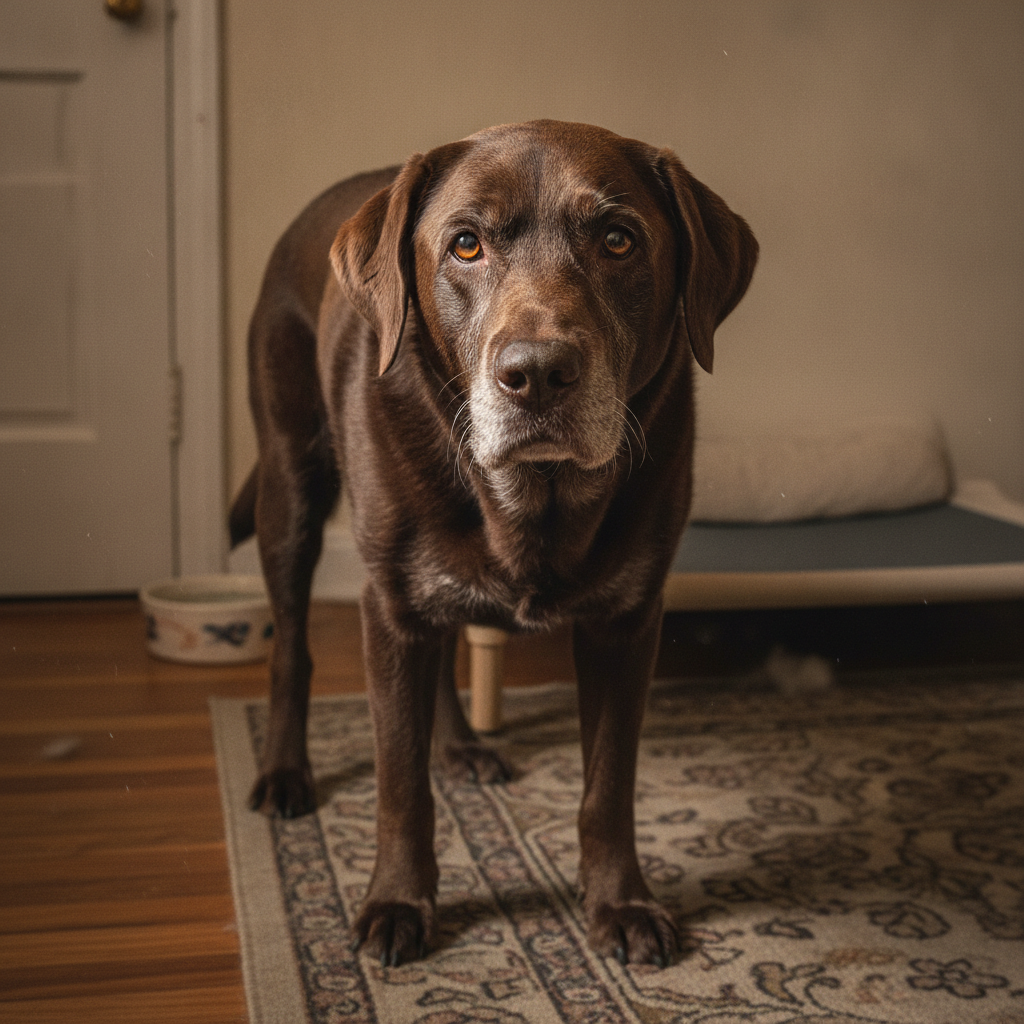
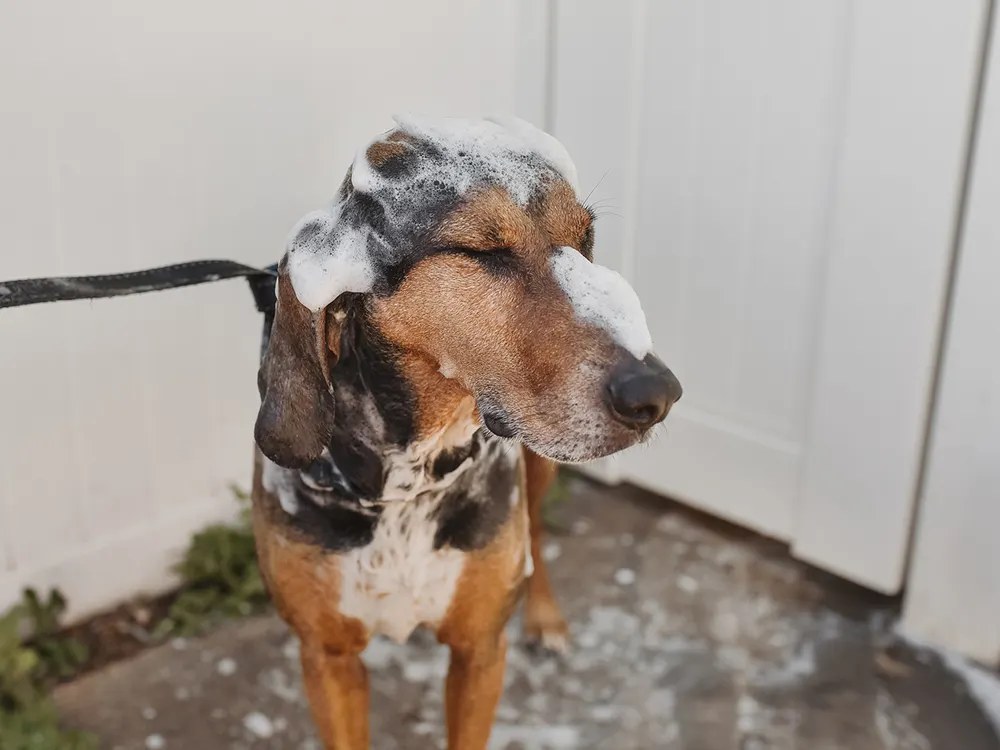
Two things everyone thinks they know about de-skunking a dog are wrong, and both will cost you. The first is tomato juice, which does not neutralize skunk smell; it just gives your nose a second thing to notice. The second, more damaging mistake is hosing your dog down before you treat them, which actually intensifies the odor. What does work is a bit of kitchen chemistry that a chemist worked out decades ago, and once you understand why it works, you will never reach for the tomato juice again.
But before any of that, a reminder that the smell is not the emergency. When your dog comes trotting up reeking of skunk, the smell is the loudest problem, not the most important one. Handle first things first.
Before the smell: check your dog
A skunk that sprayed your dog was frightened, and frightened skunks sometimes bite and scratch too. So your very first move is a quick once-over for wounds, paying special attention to the face and eyes. Skunk spray is genuinely irritating to the eyes and can cause redness, swelling, heavy tearing, and even temporary blindness. If your dog took a hit to the eyes, flush them gently with water and consider calling your vet. And because skunks can carry diseases including rabies, any bite or scratch is a reason to check in with your veterinarian rather than just reaching for the shampoo.
Most dogs come away from a skunk encounter with nothing worse than a horrible smell, and permanent harm is rare. But in heavy exposures the compounds in the spray can, uncommonly, cause a form of anemia, so watch for lethargy, unusually dark stool, or brown urine, and call your vet if you see them.
Why skunk smell is so brutal, and why water makes it worse
The stench comes from a family of sulfur compounds called thiols, the same class of chemicals that makes rotten eggs and burning rubber so unbearable. Skunk musk is loaded with them, and thiols are volatile, meaning they vaporize fast and soak into whatever they touch. That is why the smell seems to travel and cling.
Here is the part that saves you from the classic blunder. Alongside those thiols sit related compounds called thioacetates. On their own they are relatively low-odor, but add water and they convert into more of the smelly thiols. So wetting your dog down before you treat the spray does not rinse the problem away; it activates a fresh wave of stink and makes your remedy less effective. Treat the dry coat first. Rinse later.
“The instinct is always to grab the hose and start washing, and that’s the one thing you shouldn’t do first,” says Dr. Ravi Mehta, a veterinarian who writes for The Pet Times. “Water reactivates part of the odor, and it also spreads the oil around before you’ve neutralized it. Check your dog for injuries, then apply the peroxide mixture to a dry coat and let the chemistry do the work. And please make it fresh every single time. This is not something you keep a jug of under the sink.”
The formula that actually works
The reliable fix is not a commercial secret. It is a mixture a chemist named Paul Krebaum published as a free public service, precisely because the chemistry made it impossible to bottle safely. In an open container, combine one quart of 3 percent hydrogen peroxide, a quarter cup of baking soda, and one to two teaspoons of dishwashing liquid.
Each ingredient has a job. The hydrogen peroxide is an oxidizer: it adds oxygen to the smelly thiol molecules and converts them into sulfonic acids, which have essentially no odor. The baking soda raises the pH, which lets that reaction proceed and pushes the newly formed compounds into a water-soluble, rinseable form. The dish soap cuts through the oily musk so the peroxide can reach the thiols in the first place. Together they do not mask the smell; they chemically dismantle it.
Two safety points are non-negotiable. Mix it in an open container and use it immediately, because the reaction releases oxygen gas, and a sealed bottle of this can build up pressure and burst. And never store leftovers, for the same reason and because it loses its punch fast. Fresh batch, open container, every time. One cosmetic caveat: the peroxide can lighten a dark coat slightly. That mild bleaching is a side effect of the same oxidation that is killing the smell.
Washing it in
Once your dog is checked and you have your batch ready, keep them outside so the odor does not migrate onto your furniture, and wear gloves and clothes you are prepared to sacrifice. Work the mixture into the dry coat, keeping it well away from the eyes, and let it sit for about five minutes. Then rinse thoroughly with lukewarm water. Expect to repeat it; a solid hit of skunk rarely surrenders on the first pass. The sooner you get to it, the better, because the longer the spray sits in the fur, the more it sets and the harder it is to remove.
If you would rather buy a solution, commercial de-skunking sprays, shampoos, and rinses exist, many built around enzymes, and they work best when you follow the directions and finish with a good dog shampoo. Apple cider vinegar, diluted two parts water to one part vinegar, will not break down the thiols but can help knock down lingering odor on household items and, in bowls around a room, absorb some of the smell from the air over a day or so.
Keeping it from happening again
Skunks are not looking for a fight; they would rather be left alone. Your best prevention is distance and recall. If you spot a skunk on a walk, stop, keep your dog close or leashed, and back away slowly, coaxing your dog to come with you. Skunk spray has a range of only about 10 to 15 feet, so getting beyond that and moving off through open ground, away from brush and wooded cover, keeps you out of the line of fire. If your dog is already close, call them to you and walk briskly the other way. This is one of those moments a rock-solid recall pays for itself, for your dog’s safety and your nose alike. Skunks are most active at dawn, dusk, and in warm weather, so time your outings with that in mind.
What newer research adds
The core chemistry has held up: the oxidation approach remains the method veterinary and science communicators point to, and the reason it never became a shelf product is exactly the reason you have to mix it fresh, the oxygen it gives off. What has become clearer over time is how much the myths cost people. Tomato juice appears to “work” only because of a quirk of smell fatigue; your nose stops registering the skunk odor after prolonged exposure, so the juice gets credit the moment your nose gives up. It is not neutralizing anything.
The other durable lesson is the water one. Because the thioacetates in skunk musk keep generating fresh thiols when they get wet, a stinky dog can actually smell worse days later after a plain-water bath. So the up-to-date, evidence-backed routine is the unglamorous one: check your dog, mix the peroxide formula fresh, apply it dry, and only then rinse.
References
- Wood, William F. “The Chemistry of Skunk Spray.” Humboldt State University. https://chemistry.humboldt.edu/skunkspray
- Office for Science and Society, McGill University. “A Solution to Skunk Pollution.” https://www.mcgill.ca/oss/article/environment-history-science-science-everywhere/solution-skunk-pollution
- ASPCA Animal Poison Control Center. “People Foods to Avoid Feeding Your Pets and Household Hazards.” https://www.aspca.org/pet-care/animal-poison-control
- Merck Veterinary Manual. “Rabies in Animals.” https://www.merckvetmanual.com/nervous-system/rabies/rabies-in-animals