


Every Dalmatian Carries a Broken Gene. Fixing It Meant Adding a Pointer.
The spots and the bladder stones came from the same breeding decision. The cure required breaking the breed's purity, and the breed fought it for nearly 40 years.

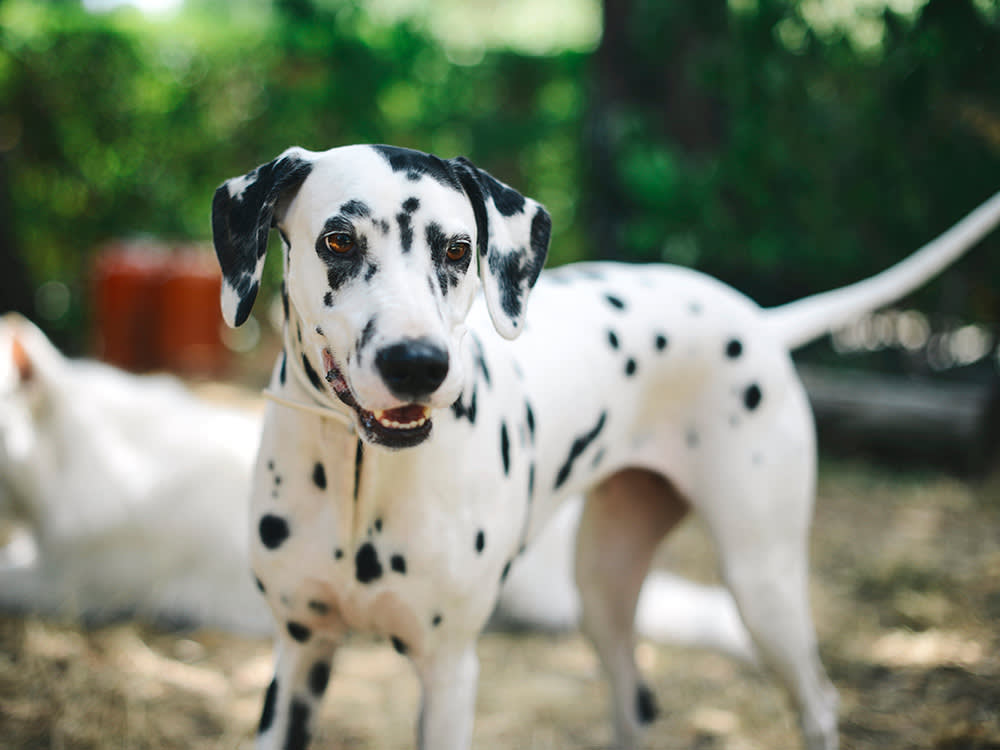
You can spot a Dalmatian from across a park, which is exactly the point. Generations of breeders selected hard for one look: spots evenly distributed, distinct, well-defined, round, and sized between a dime and a half dollar. It worked. The breed is one of the most instantly recognizable dogs on earth.
It also worked on something nobody was aiming at. Riding along with the spots, invisibly, was a gene that leaves every purebred Dalmatian on the planet unable to process uric acid properly, and prone to bladder stones that can turn into surgical emergencies.
That is the uncomfortable spine of this story. The trait people love and the defect they hate came out of the same selection pressure, and untangling them required a Pointer.
The chemistry, in one paragraph
Most dogs break down protein in the liver and end up with allantoin, which the kidneys dump into the urine, where it dissolves and leaves quietly. In Dalmatians, the assembly line stops one step early. The end product is uric acid instead of allantoin, and urine is a poor solvent for uric acid. So it crystallizes. Crystals become urate stones. Stones lodge in the urethra, and a blocked dog is a dog in serious trouble, sometimes requiring surgery.
The clinical name for the high uric acid load is hyperuricosuria, usually shortened to HUU.
Why no Dalmatian escapes it
HUU was first described in 1916. By 1938, its inheritance pattern was pinned down as recessive, meaning a dog only shows the trait if it inherits the faulty gene from both parents.
Here is the trap. Because of the breed’s narrow gene pool, every purebred Dalmatian carries two copies. There is no unaffected Dalmatian to breed to, because the healthy version of the gene does not exist anywhere in the purebred population. You cannot select your way out of a trait that is fixed in the breed. The result: Dalmatians produce roughly 20 times more uric acid per day than other dogs.
Curiously, not every Dalmatian gets sick. All of them have the chemistry; only some form stones. Why the difference exists is still not understood.
The only way out was out
In 1973, Dr. Robert Schaible, a medical geneticist who also bred Dalmatians, did the one thing available to him. He crossed a Dalmatian with a Pointer, and then, generation after generation, mated the resulting dogs back into the purebred Dalmatian population.
The goal was a dog that was, for every visible purpose, a Dalmatian, but that carried a working copy of the gene and produced normal, low levels of uric acid. Those dogs became known as LUA Dalmatians (low uric acid), as opposed to HUA (high uric acid). Breed a LUA to a purebred and roughly half the litter comes out LUA and half HUA.
There is a tell, and it is a lovely piece of evidence in its own right. LUA dogs tend to have somewhat smaller spots than HUA dogs, which strongly suggests the HUU mutation was sitting close enough to the spotting genes to get dragged along every time breeders selected for the perfect coat. The smaller spots still fall within the American Kennel Club’s written breed standard. They just are not the exaggerated version the show ring drifted toward.
Then the registry closed the door
Two fifth-generation backcross puppies did make it onto the AKC register, which made them eligible to compete at AKC events. Then the registration was formally challenged, and the club barred any further backcross dogs from being registered at all.
The practical effect was quiet and brutal. Serious breeders register with the AKC. If backcross puppies could not be registered, almost nobody would use backcross dogs, which meant the healthy gene stayed locked inside one man’s kennel.
Three decades in, by 2005, the project was close to dead. Denise Powell, who had bred Dalmatians in northern California for more than 20 years, reached out to Schaible about breeding backcross dogs and found that the program’s entire genetic lifeline had shrunk to a pair of elderly studs and a pair of newborn females. She asked for one of the pups. Schaible said yes.
Powell went on to found the Dalmatian Heritage Project, which pulled other breeders in and rebuilt the backcross population. Backcross Dalmatians were finally accepted by the AKC in 2011, and the United Kennel Club registers them as well.
The dogs today are the twelfth generation from the original cross. Across more than 4,000 relatives in their pedigrees, there is exactly one Pointer. Do the arithmetic and these dogs come out over 99 percent Dalmatian, which is worth holding next to the four decades of argument about whether they counted at all.
They are not health shortcuts, either. Backcross dogs go through the full screening slate recommended for AKC Dalmatians: BAER hearing testing, temperament analysis, conformational analysis, and in some cases OFA hip evaluation and CERF eye exams.
The gene, found
Dr. Danika Bannasch, DVM, PhD, a geneticist at the UC Davis School of Veterinary Medicine, joined the effort in 1998. She is also a Dalmatian owner and former breeder, which matters, because she knew what the backcross dogs were.
Using blood samples and pedigrees from generations of those dogs, Bannasch and her colleagues identified the causal mutation in the SLC2A9 gene, a uric acid transporter. The correlation is absolute: only HUA dogs carry two copies. The work was published in PLoS Genetics.
The backcross was not incidental to that discovery. It was the whole reason it was possible. Bannasch has been direct that the trait being fixed in the breed was the central obstacle, and that without the backcross dogs providing a normal comparison group, finding the gene would have been out of reach.
Genetics needs contrast. For 60 years, Dalmatians offered none. Schaible manufactured some.
This is the rare case where the breeders, the owners, and the lab all had to be in the room at once, and none of them could have finished it alone. The dog that unlocked the answer was the dog the registry did not want to recognize.
It was never only about Dalmatians
A urine test used to be the only way to know a dog’s status, and it was slow and expensive. The DNA test that came out of Bannasch’s work replaced it, and it is available through the Veterinary Genetics Laboratory at UC Davis and now through commercial labs as a routine HUU panel test.
The bigger payoff landed outside the breed. Urate stones and high uric acid turn up in other breeds too, Bulldogs and Black Russian Terriers among them. When Bannasch’s lab ran those dogs, the culprit came back as the same SLC2A9 mutation. One discovery, made in a breed that could not help itself, handed the rest of the dog world a test for the probable major cause of urate stone disease.
Bannasch’s practical framing is the one to take home: once you know a dog is predisposed to form stones, you can change how you manage that dog and watch for the signs, instead of finding out in an emergency room.
What this means if you own one
Whether your Dalmatian is LUA, HUA, or a mystery, the ownership job is the same shape.
- Know the status. A cheek swab settles it. If you are buying a puppy, ask the breeder for the HUU test result on both parents and expect an answer.
- Water is the therapy. Dilute urine is the single most effective way to keep urate crystals from becoming urate stones. More water in, more urine out, less concentrated.
- Diet is a lever, not a cure. Purine load feeds uric acid production. Talk to your vet about a lower-purine diet before you improvise one; organ meats are the obvious thing to drop.
- Know the emergency. Straining, frequent tiny urinations, blood in the urine, crying at the box or the yard, and above all a dog who is trying to urinate and producing nothing is an obstruction until a vet says otherwise. Male dogs block more easily than females because the urethra is narrower. This is not a wait-until-morning situation.
What newer research adds
The picture has quietly gotten easier for owners since the discovery. HUU testing is no longer a specialist errand: the SLC2A9 test is offered as a standard breed-health panel item by UC Davis and by commercial canine genetics labs, so a swab and a small fee tells you where a dog stands.
And the LUA line is no longer a fragile experiment kept alive in one kennel. It is an established, registrable, health-screened population that ordinary breeders can use, which is exactly the outcome the project was fighting toward for four decades.
If you are choosing a Dalmatian puppy today, that is the practical difference between now and 2005. You can ask a question and get a genuine answer, and there are healthy lines available to ask it about.
References
- Mutations in the SLC2A9 Gene Cause Hyperuricosuria and Hyperuricemia in the Dog — Bannasch et al., PLoS Genetics
- Dalmatian Bladder Stones Caused by Gene That Regulates Uric Acid in Humans — University of California, Davis
- Hyperuricosuria — UC Davis School of Veterinary Medicine, Animal Health Topics
Not a substitute for your vet. Our guidance is educational. For urgent symptoms, contact a vet or emergency clinic right away. Editorial standards
Dr. Mehta is a board-certified veterinary nutritionist who evaluates pet food formulations, ingredient quality, and the science behind dietary trends. He writes and reviews all nutrition content at The Pet Times, including our food rankings and feeding guides.
Meet our experts ↗Keep reading
 Health & WellnessYour Dog Can't Have Down Syndrome. What You're Seeing Is Still Real.Dr. Amara Solis · 8 min
 Health & WellnessThe Worm You Can See Isn't the One That KillsDr. Amara Solis · 7 min
 Health & WellnessYour Dog's Nose Predicts Their Lifespan. Nobody Wants to Hear It.Dr. Mara Chen · 7 min
 Health & WellnessYour Tripod Dog Is Fine. It's the Other Three Legs You Should Worry About.Dr. Mara Chen · 9 min
 Health & WellnessYour Monthly Chew Doesn't Kill Every Worm. Here's the Gap.Dr. Ravi Mehta · 9 min
 Health & WellnessNo Fleas, Still Scratching? 7 Culprits, Ranked by How Likely They Are.Dr. Mara Chen · 14 min