


Cats Copy Each Other's Faces. AI Caught Them Doing It.
Researchers trained a program on hours of cat-cafe footage and found cats mirror each other's expressions in a split second, right before they start grooming or playing. It's a bonding signal we couldn't see.

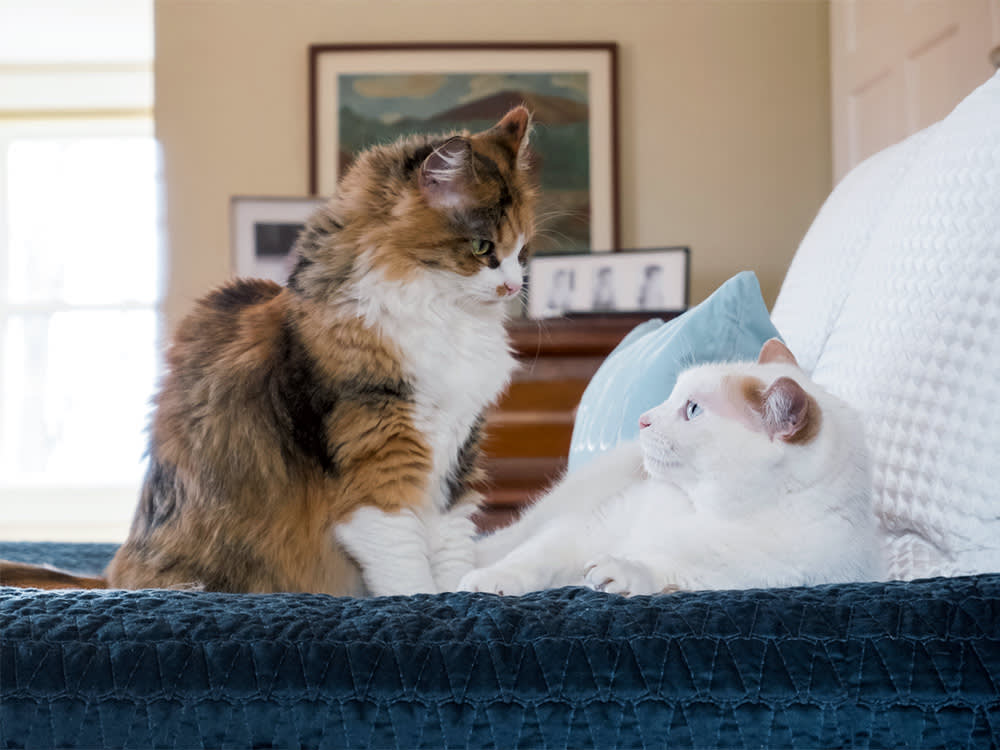
Cats have spent centuries being cast as loners, animals that tolerate each other at best. That reputation is getting harder to defend, and the latest dent in it came from an unlikely place: an artificial intelligence program watching hours of footage from a cat cafe, frame by frame, catching something the human eye kept missing.
The thing that happens in under a second
The behavior at the center of this is called rapid facial mimicry, or RFM. It is exactly what it sounds like. One individual sees another’s facial expression and, within roughly a second, produces the same one, without deciding to. You do it constantly. Watch someone break into a grin and feel your own face start to follow. That reflexive copying is tied, in humans and other social animals, to empathy and closeness. It has been documented in apes, dogs, and horses.
The open question was whether cats, supposedly too aloof to bother, did it too.
Brittany Florkiewicz, a psychology professor who had earlier found that cats can produce nearly 300 distinct facial expressions, went looking. Her team, with lead author George Martvel, fed an AI system the cafe footage and had it track tiny facial movements, defined carefully as a shift of facial muscles that one cat aims at another by orienting its body and fixing its eyes on it.
The cats mirrored each other. It happened most during play, it leaned heavily on ear movements and certain mouth movements, and it carried a payoff: after an instance of mimicry, the cats slid into friendly behavior, grooming or playing together, about 60 percent of the time.
The stereotype is that cats don’t really communicate, they just coexist. This is the opposite. A cat matching another cat’s face in under a second is doing fast, fluent social work. We couldn’t see it before because it’s happening at a speed built for cats, not for us.
Why an AI had to find it
There is a reason this took a computer. A cat’s expressions are subtle by our standards, and the meaningful ones flash past in a fraction of a second. A human observer trying to log which cat moved which whisker, and whether the second cat matched it within a second, across hours of tape, would drown. The AI could timestamp every micro-movement and line up who copied whom.
That is worth flagging because it hints at how much cat social life we have simply been unequipped to notice. We call cats hard to read partly because their signals are quiet and quick, not because the signals are not there. Give the footage to a system that does not blink, and a whole layer of feline conversation shows up.
What this changes for a multi-cat home
The most useful part of the finding is practical. If mirroring clusters around play and predicts friendly follow-up, then relaxed, mutual, playful face-watching between two cats is a real signal that things are going well, not just wishful thinking on your part.
That reframes what to look for when cats share a space. The old advice fixates on the negative markers: hissing, flattened ears, a stare-down. Those matter. But the mimicry research says there are positive markers too, and they are subtle. Two cats loosely tracking each other’s faces during a play bout, ears and mouths moving in a back-and-forth, are showing you the good version of a relationship, the one you want more of.
For anyone introducing cats, it argues for patience over force. You cannot make two cats mirror each other. What you can do is create low-pressure chances for play near each other and watch whether that easy, mutual attention shows up on its own. When it does, the cats are telling you, in their own fast language, that they are starting to get along.
What newer research adds
This study sits inside a fast-moving stretch of feline science. In just the last few years, researchers have used similar computer-vision tools to catalog cats’ hundreds of facial expressions, to measure pain from the face alone, and now to catch cats mirroring one another. The common thread is that machine analysis keeps finding social and emotional complexity in cats that older, human-only observation missed.
The researchers themselves see a concrete use ahead. If a system can flag which cats show mimicry, and therefore which pairs are bonding, shelters could make smarter housing and adoption choices, pairing cats that read each other well and sparing ones that do not the stress of a bad match. That is still developing rather than deployed, so treat it as a promising direction, not a tool you can download today. But it is a real one, and it grew straight out of watching cats make faces at each other.
References
- Martvel, G., Florkiewicz, B., et al. Study on rapid facial mimicry in domestic cats, 2025. science.org
- Florkiewicz, B., et al. “Feline Faces: Unraveling the Social Function of Domestic Cat Facial Signals.” Prior research on cat facial expressions. nature.com
Common questions
What is rapid facial mimicry in cats?
It is when one cat copies another cat's facial expression within about a second of seeing it. In many social animals, this fast, automatic copying goes along with feeling connected, and in cats it tends to happen during play and is often followed by friendly behavior like grooming.
Does my cat mirroring another cat mean they're bonded?
It is a positive sign. In the study, cats that showed rapid facial mimicry moved into friendly interaction, such as grooming or continued play, about 60 percent of the time afterward. It suggests the two cats are reading each other well, which is a good foundation for a bond.
Can this help me introduce two cats?
Indirectly. The research points to play and relaxed, mutual face-watching as markers that two cats are getting along, rather than tension or avoidance. Watching for loose, playful back-and-forth, instead of forcing contact, is a reasonable read on whether an introduction is going well.
Dr. Kohl is a board-certified veterinary dentist with a particular interest in preventive oral care. She reviews all dental health content at The Pet Times and contributes practical guides on home dental routines, professional cleaning, and oral disease prevention.
Meet our experts ↗Keep reading
 TrainingThe Cat-Lover Paradox: Why Loving Cats Makes You Worse at Meeting ThemLeila Torres · 6 min
 Health & WellnessYour Male Cat Isn't Being Spiteful. He's Leaving You a Note.Dr. Mara Chen · 7 min
 TrainingYour Sleeping Cat Purrs for a Reason. Usually a Good One.Dr. Priya Nair · 6 min
 TrainingWhich Paw Your Cat Leads With Is a Readout of Its PersonalityDr. Mara Chen · 5 min
 Training'My Cat Doesn't Like to Play' Is Almost Always a You ProblemDr. Lena Park · 8 min
 LivingYour Cat Has Been Asking for the Same 7 Things. You Keep Hearing 'More Cuddles.'Dr. Priya Nair · 8 min