


Your Male Cat Isn't Being Spiteful. He's Leaving You a Note.
Spraying gets read as a male-cat vice or a litter box protest. It's neither. It's a message, and once you learn to read it, most spraying is fixable, whether your cat is male or female.

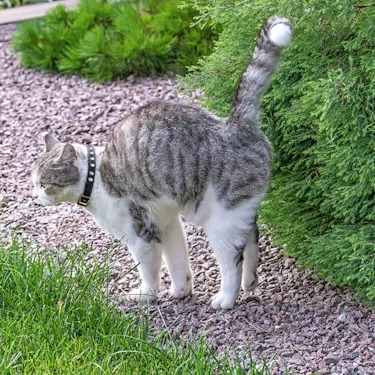
Somewhere in your house there is a baseboard you have scrubbed more times than you can count, and a cat you are starting to resent for it. Before that resentment hardens, here is the reframe that changes everything: your cat is not vandalizing your home. He is writing on it.
Spraying is the single most common reason cats get surrendered to shelters, and it is also one of the most misread behaviors in all of cat ownership. People treat it as a male-cat character flaw or a litter box grudge. It is neither. Spraying is scent communication, and the substance is ordinary urine carrying an extraordinary amount of information. Once you stop asking “how do I punish this” and start asking “what is he telling me,” the problem usually becomes solvable.
Spraying is a message, not a mess
When a cat sprays, he backs up to a vertical surface, lifts a quivering tail, and deposits a small amount of urine loaded with pheromones. The posture is the giveaway. He is not relieving himself. He is posting a notice, for you, for the cat across the household, or for the cat he can see through the window.
That last part matters more than most people realize. A cat does not have to have a housemate to feel crowded. The tomcat lounging on your porch railing, the new smell you tracked in on your shoes, the cardboard box that rearranged the living room, any of these can read to your cat as a border being tested. Spraying is how he answers.
The mistake I see most is people reading spraying as defiance, when it is almost always distress. The cat is not making a point about you. He is trying to make his own world feel a little more predictable, and urine is the tool he was born with.
Rule out the body before you blame the behavior
Here is the part of this article worth tattooing on the inside of your eyelids: the first stop is your veterinarian, not the pet store.
Spraying and straining and frequent small trips to mark can all shadow a medical problem, a urinary tract infection, bladder inflammation, or simple pain. A cat in discomfort near the litter box may start associating the box with hurting, and take his business elsewhere and upward. If you skip the vet and go straight to behavior fixes, you can spend weeks managing stress while an infection quietly gets worse. Get the body cleared first. Everything else in this article assumes you have.
Who sprays, and why
Any cat can spray. But some are far more likely than others, and the reasons cluster into a handful of drivers.
Hormones. Intact males top the list. Testosterone turns spraying into a broadcast, sexually available to females, keep-away to rival males, and the odor is famously, memorably awful: strong, frequent, and persistent until he is neutered.
Territory. This is the big one in multi-cat homes, where cats feel their space, food, or resting spots are being contested. It also fires in single-cat homes when outdoor cats are visible or when unfamiliar smells arrive from outside. You will often notice the same doors, windows, and thresholds getting hit again and again. He is reinforcing a boundary he feels is under pressure.
Stress and change. A new couch, a shifted schedule, construction noise, a visitor, a new pet, none of it registers as trivial to a creature built on routine. Spraying is a self-soothing behavior. Marking a space with his own scent makes it feel familiar again.
Social conflict you cannot see. In multi-cat households, one cat quietly blocking another’s access to food, water, or a favorite windowsill can be invisible to you and glaringly obvious to the cats. The cat on the losing end of that silent standoff may start to spray. Too few litter boxes, too little vertical space, and too much competition all feed it.
Spraying versus missing the box
Because the fixes differ, telling these apart is worth a minute.
Spraying usually means a small amount of urine, on a vertical surface like a wall or door, delivered from a standing posture with the tail upright, often quivering, sometimes with a little tread of the back feet. The smell tends to be stronger because of the pheromones packed into it.
Inappropriate urination usually means a larger puddle, on a horizontal surface, delivered squatting. That points you toward litter box aversion, substrate preference, or a medical issue rather than territorial marking. If your guests wrinkle their noses the moment they walk in, you are probably dealing with spraying.
What actually works
Neuter, ideally before he starts. For intact males, neutering is the single highest-impact move. Most stop or dramatically cut back afterward, and it carries the bonus of preventing testicular cancer, reducing roaming and fighting, and not adding to the shelter overflow.
Fix the environment, not just the cat. The standard behaviorist arithmetic is a box for every cat in the house and then one more on top, and the placement matters as much as the count. Do not bank them all in the basement. Put boxes on each level, in quiet spots, so no cat can guard the whole supply. Add feeding stations, resting perches, and vertical territory like cat trees and shelves. Giving each cat a way to own space without contesting someone else’s is how you drain the pressure that drives marking.
Clean like it matters, because it does. Use an enzymatic cleaner on any spot, every time. If a trace of urine scent survives, it is an invitation, and he will come back to freshen his note. Ordinary household cleaners often leave exactly the molecules his nose is hunting for.
Layer in calming tools. Synthetic pheromone diffusers, deliberate behavior modification, and, when nothing else moves the needle, anti-anxiety medication under veterinary guidance. Medication is a last resort, not a first reach, but it is safe and often effective when the case warrants it.
What newer research adds
Modern feline behavior work keeps pointing in the same direction: spraying responds better to reducing conflict than to correcting the cat. Reviews of spraying treatments have found that the biggest, most durable gains come from environmental changes, more and better-distributed resources, calmer households, fewer triggers, rather than from any single product. Pheromone therapy shows a modest, real benefit as one layer among several, not a standalone cure.
The other durable finding is patience. Marking that has been rehearsed for months does not vanish in a weekend. Households that treat it as a slow negotiation, cleaning thoroughly, adding resources, lowering the temperature, tend to win. Households looking for an overnight switch tend to give up right before it would have worked.
And the point that bears repeating because it is so often missed: this is not a male-only problem. Females spray too. Anyone treating spraying as a boys-will-be-boys hormone quirk is skipping straight past the stress, the conflict, and the possible illness underneath it.
The bottom line
A spraying cat is not being spiteful, or stubborn, or vengeful. Those are human stories, and they are not what is happening. What is happening is stress, territory, conflict, or a health problem, usually more than one at once. Clear the medical causes with your vet, then read the message: what feels threatened, what feels scarce, what changed. Answer that, and the writing on your walls usually stops.
References
- Frank, D., et al. “Urine Spraying in Cats: Presence of Concurrent Disease and Effects of a Pheromone Treatment.” Applied Animal Behaviour Science, vol. 61, no. 3, 1999, pp. 263–272. https://doi.org/10.1016/S0168-1591(98)00195-6
- Horwitz, D. F. “Common Feline Problem Behaviors: Urine Spraying.” Journal of Feline Medicine and Surgery, vol. 21, no. 3, 2019, pp. 209–219. https://doi.org/10.1177/1098612X19831203
- Mills, D. S., et al. “A Meta-Analysis of Studies of Treatments for Feline Urine Spraying.” PLoS ONE, vol. 6, no. 4, 2011, e18448. https://doi.org/10.1371/journal.pone.0018448
Common questions
Will neutering stop my male cat from spraying?
Usually it helps a lot. Most intact males stop or sharply reduce spraying after neutering, and neutering before he ever starts is the best prevention. But neutering does not fix spraying that is driven by stress, territorial conflict, or a urinary problem.
How do I tell spraying from just peeing outside the box?
Spraying is a small amount of urine on a vertical surface, delivered standing with the tail up and quivering. Litter box avoidance is usually a larger puddle on a horizontal surface, delivered squatting. The two have different causes and different fixes.
Not a substitute for your vet. Our guidance is educational. For urgent symptoms, contact a vet or emergency clinic right away. Editorial standards
Dr. Chen is a small-animal veterinarian who leads health and safety coverage at The Pet Times. She writes and reviews the bulk of our illness, condition, and safety content, translating clinical guidance into clear, practical advice owners can act on at home.
Meet our experts ↗Keep reading
 TrainingYour Cat Isn't Being Naughty. The Chewing Is a MessageDr. Nina Kohl · 9 min
 TrainingYour Cat Screams at 3am Because You Never Let It Finish the HuntDr. Mara Chen · 8 min
 TrainingThat Sound Isn't a Meow. And It Isn't Good News.Dr. Lena Park · 8 min
 Health & WellnessYour Cat Eating Your Shoelaces Isn't a Quirk. It Might Be Pica.Dr. Mara Chen · 7 min
 TrainingThat Belly Is Not an Invitation. It's a Sentence.Dr. Nina Kohl · 6 min
 TrainingYour Cat Is Trying to Bury Something. The Question Is What.Dr. Lena Park · 8 min