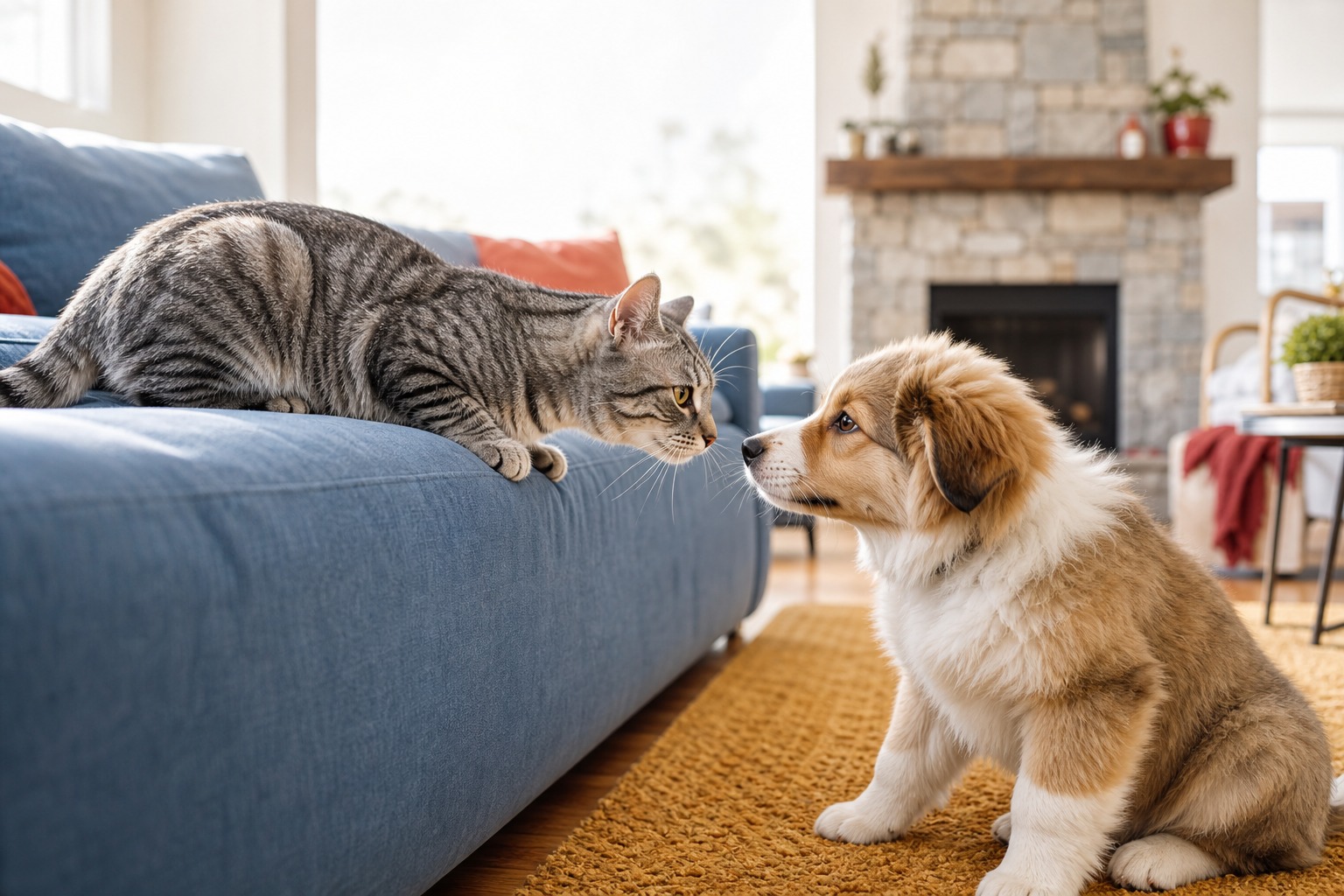
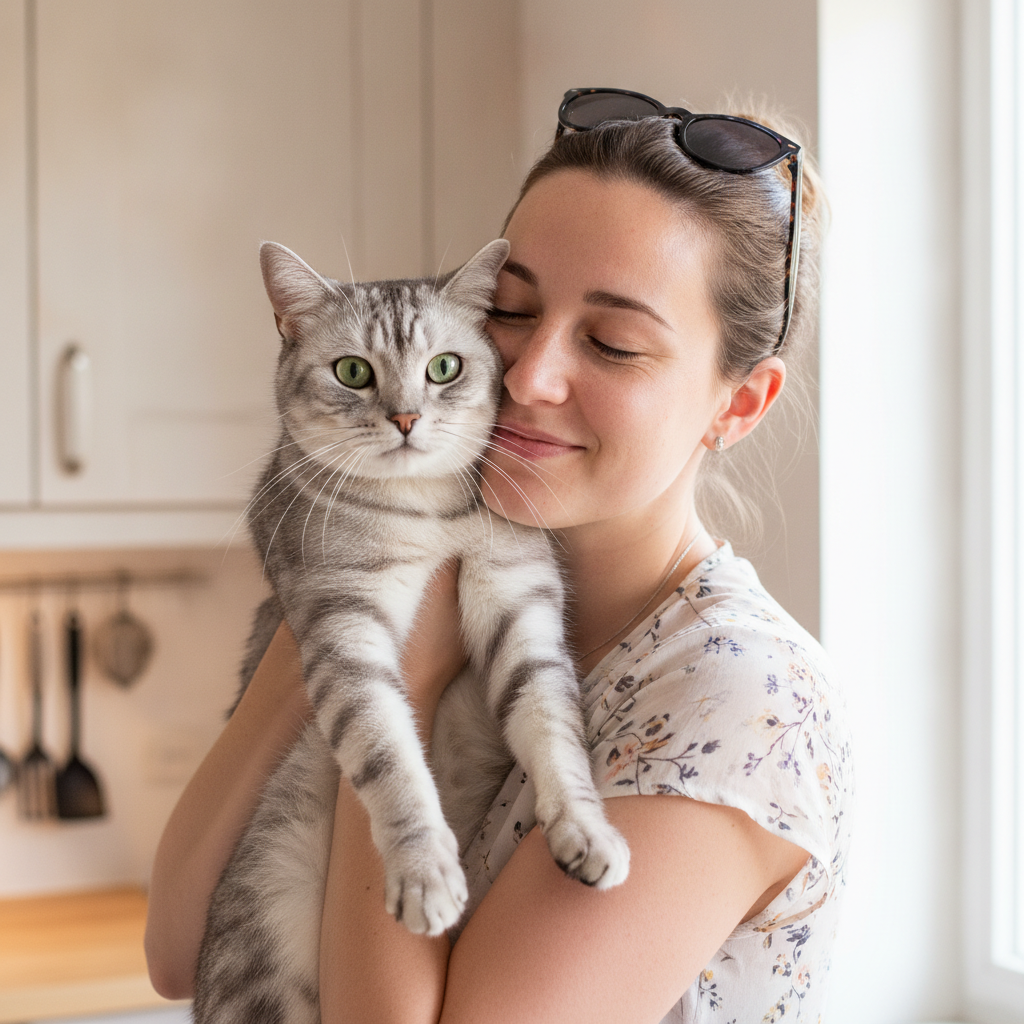
You know the look. Half-lidded eyes, head turned slightly away, the slow blink that lands like a verdict. Then they turn from you in what feels like slow motion, and you are eleven years old again and someone has just said something devastating in a hallway.
Every cat owner reads that expression the same way: you are being judged, and you have lost.
You are not being judged. And the reason this matters is not that it lets you off the hook. It is that “my cat is judging me” is an appealing story that quietly gets your cat wrong, and getting your cat wrong is how people end up mystified when a friendly animal starts hiding, or spraying, or scratching the sofa after years of not doing that.
Cats do not run the value judgments we do. Cool, cringe, embarrassing, impressive: these are not categories in your cat’s mind. Feline behavior consultants who work with these animals for a living say the same thing consistently, which is that cats find plenty of what we do strange, without attaching anything like moral weight to it.
What cats do run, constantly, is a different assessment. Is this safe, and is this normal for here? Cats are creatures of habit and routine, and routine is what makes them feel secure. Which means the thing that gets a reaction is rarely the behavior itself. It is the behavior being new.
So the side-eye is not contempt. It is a query. Here are eight things you do that your cat has almost certainly filed as bizarre, and what the query underneath each one actually is.
1. You shower
Consider what this looks like from four inches off the floor. You voluntarily enter a small room, and then you make water fall on yourself.
Water, to a great many cats, is something to be avoided with real commitment. And the whole exercise is redundant, because you could simply lick yourself clean, as any reasonable animal does.
Then the genuinely baffling part: you use soap. You take your own scent, which is a core part of how your cat identifies you, and you scrub it off. Cats communicate through odor. They scent-mark, they rub against you to lay their smell down and pick yours up, and they use that mutual scent signature as a marker of who belongs.
You come out of the bathroom having erased it, and then you add perfume, which is a scent from nowhere, belonging to nothing. From a cat’s perspective this is the equivalent of coming home with a different face.
The real query: do you still smell like mine? Which is why they will often rub against your legs immediately after a shower. They are not greeting you. They are re-labeling you.
2. You talk to yourself
Cats do not wander around meowing at nobody. You do the human equivalent constantly: pacing the apartment, running both halves of an argument you already lost, delivering the comeback you should have used in 2019.
Add phone calls, which look identical except you are somehow more animated. Add singing. Add, God help us, singing while dancing, which must present as a full behavioral emergency.
The real query: is this vocalization directed at me, and does it mean anything? Cats do learn to distinguish speech aimed at them from speech aimed elsewhere, which is why yours may ignore an entire phone call and then snap to attention the instant you say their name.
3. You stay awake for sixteen hours straight
Cats are polyphasic sleepers. They sleep and wake repeatedly across the day and night, in a pattern of short blocks rather than one long consolidated stretch.
You do the opposite. You remain grimly upright for sixteen hours, hunched at a desk, visibly deteriorating, and then you attempt to solve it with one enormous unbroken sleep at night, which is its own oddity.
The cat, watching this from a sunbeam, has never once been tempted to imitate it.
The real query: why are you burning through your reserves like that? Your cat is not judging your work ethic. Your cat’s ancestors were ambush predators for whom conserving energy between hunts was survival.
4. You obsess over screens
You already know your cat finds this weird, because they keep intervening. They walk across the keyboard. They sit in front of the television. They will, with a look of genuine intent, reach up and push a phone away from your face.
There is a temptation to read this as jealousy of the device. It is much more likely to be simpler: you have become still and unresponsive while remaining awake, which is a strange state, and there is a warm flat surface in front of you that is clearly a bed.
The real query: you have gone non-responsive while conscious, and I would like that resolved. Sitting on the laptop is not sabotage. It is the most efficient known method of restoring your attention, and it works every single time, which is why they keep doing it.
5. You close doors
Cats hate this, they are extremely vocal about hating it, and the aversion is close to universal.
The reason is not stubbornness. It is that a cat wants to see what is coming and wants an exit. A closed door removes a route. This is the same instinct behind cats who dislike covered litter boxes: an enclosed space with one entrance is a place you can be cornered.
And then you go into a small room, shut the door behind you, and flush away perfectly good scent-marking material. They let this one slide, because they have noticed that you also handle the removal of their waste and, on balance, they appreciate a clean box.
The real query: why have you removed an escape route, and are you coming back?
6. You exercise
Cats understand hunting. Cats understand physically active play, chasing, pouncing, ambushing. Every one of those things has an obvious purpose attached.
What cats do not understand is the repeated lifting and lowering of heavy objects that are going nowhere. Or cycling furiously on a bicycle that is bolted to your floor. Or a yoga position named after a dog.
This is why a cat will come and sniff the exact spot on the floor where your face keeps arriving during push-ups. They are checking. There must be something down there. Why else would you keep going back?
The real query: what are you hunting, and where is it?
7. You insist on being loud
Sudden loud noise is a threat signal, full stop. A raised voice, a slammed door, a shout of excitement at a television, all of it lands in the same category, which is something has gone wrong nearby.
Then there is the appliance problem: the vacuum, the blender, the hair dryer. Enormous, unpredictable, roaring things you seem to choose to activate. They cannot fathom why you would voluntarily do this to a room, let alone to a cat trying to take a pre-bedtime nap before the 5 a.m. breakfast shift.
The real query: is that a danger, and are you also worried about it? Which is precisely why your reaction matters. A cat watching a calm human during a loud event learns something different from a cat watching a startled one.
8. You rearrange things
This one is not on the classic list, and it should be at the top of it.
You buy a new sofa. You move the litter box eight feet. You come back from a trip with a suitcase that smells like four airports and someone else’s dog. You start a new job and your schedule shifts by two hours.
To you, none of this is behavior at all. To your cat, this is the only category that genuinely matters, because it is the one that changes the map. And this is where feline behavior experts consistently locate the real reaction: not in the routine strangeness of the average human day, which cats have long since absorbed, but in the moment things depart from the norm.
The clinical evidence backs this. Environmental and routine change is one of the most reliable triggers for feline stress behaviors, including litter box avoidance, over-grooming, hiding, and stress cystitis. A cat that suddenly starts peeing outside the box is very often a cat whose map moved.
The real query: the world changed and nobody consulted me. Is it still safe?
“Owners come in convinced their cat is angry with them, and what I usually find is a cat responding to a change the owner had entirely forgotten about,” says Dr. Mara Chen. “New work schedule, a bathroom renovation, a houseguest three weeks ago. The cat isn’t holding a grudge. It’s still checking whether the new version of the house is safe, and it will keep checking until the routine settles.”
So what is the side-eye?
Attention management, mostly.
Cats are observant and they are strategic. If your cat wants something from you, it will make sure that whatever you are doing instead of providing it becomes difficult to continue. The keyboard gets sat on. The phone gets pushed. The book gets closed by a paw. This is not commentary. It is a working method with an excellent success rate.
And they do know you are not a cat. Behavior consultants are firm on this. We do not look like cats, we do not smell like cats, and we conspicuously fail to do cat things such as competing over territory. Whatever your cat has concluded you are, it has not concluded you are a large hairless one of them. Something closer to a companion, in a relationship with genuine give and take, in which you are variously parent-like or staff-like depending on the individual cat and the individual day.
Which means you can go ahead and be as weird as you like. Sing in the shower. Do the push-ups. Talk to yourself.
Just be a bit thoughtful about moving the litter box. That is the one they actually mind.