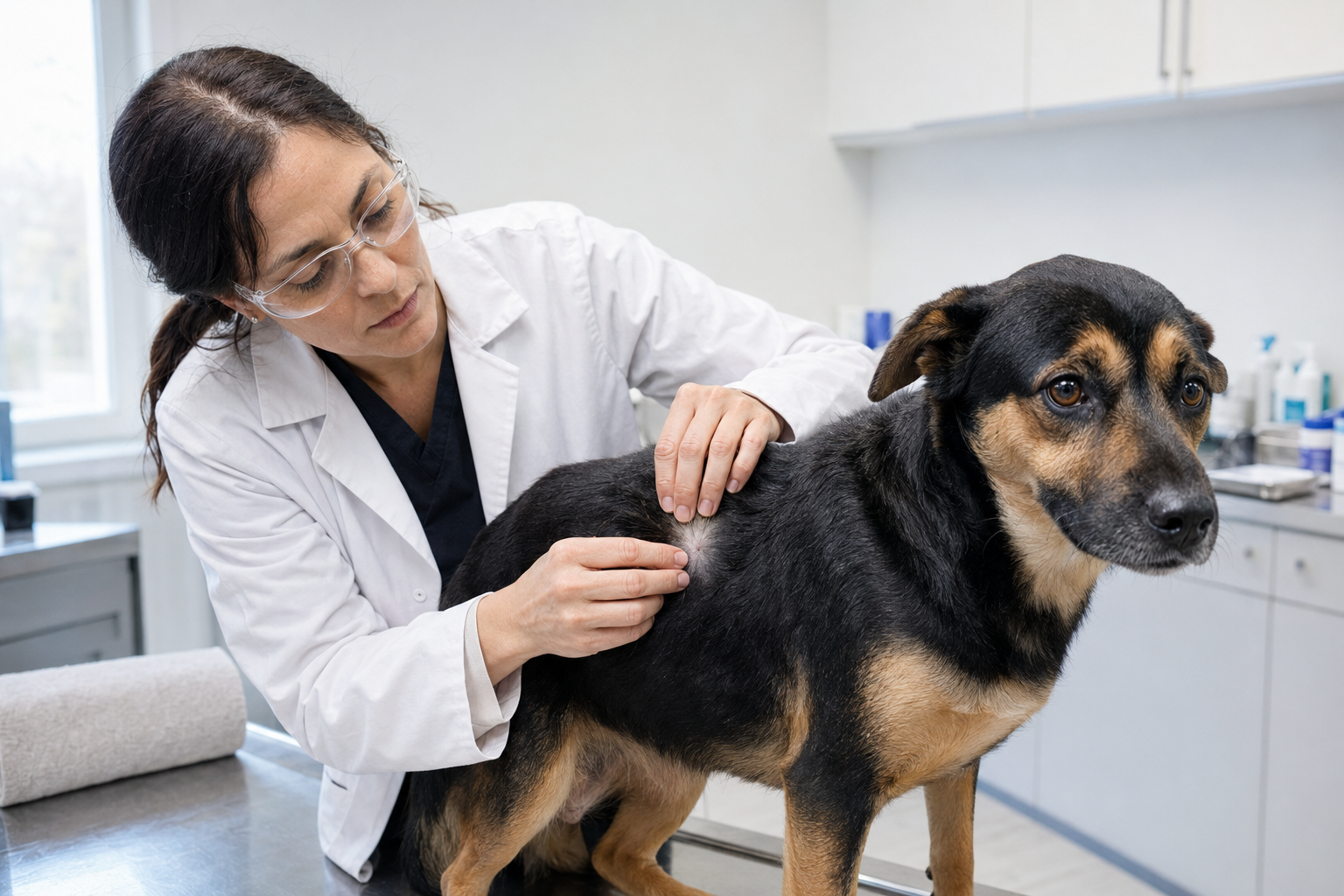
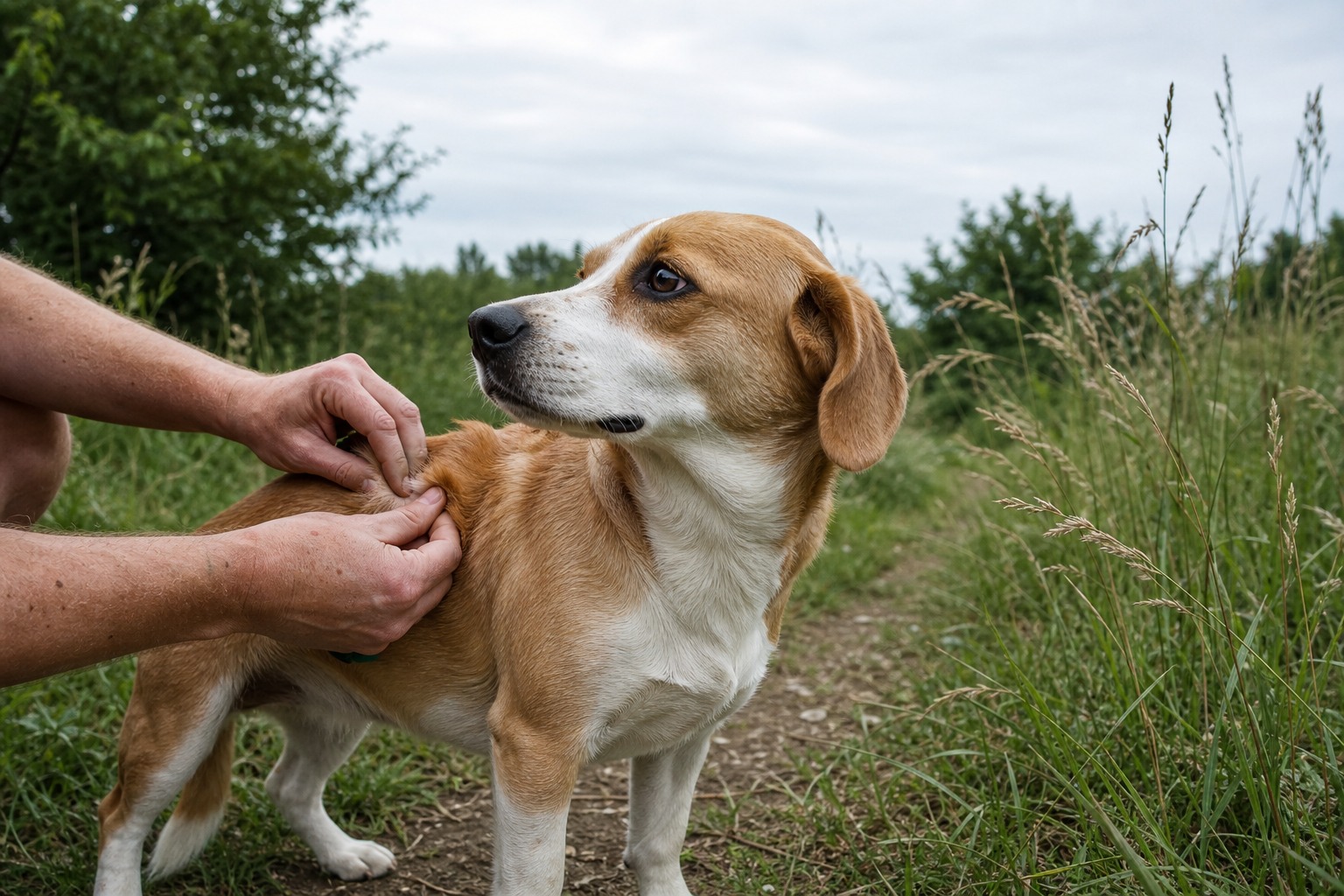
If you are picturing Lyme disease as a dog who gets bitten on Monday and falls ill by Friday, unpicture it. Lyme is a disease of delay and disguise. Most dogs bitten by an infected tick never get sick at all, and the small share who do usually don’t show a symptom for months, and then the symptom is a vague, shifting limp that looks like a dozen other things. That is what makes it dangerous. The skill that protects your dog is not spotting a dramatic illness. It is preventing the bite and recognizing the quiet, mobile lameness when it finally arrives.
What Lyme actually is
Lyme is an infection triggered by a bacterium, Borrelia burgdorferi, that rides in on Ixodes ticks, the ones you have heard called deer ticks or black-legged ticks. They are heavily concentrated in the Northeast, they can be as tiny as a poppy seed, and they gravitate to the folds where you are least likely to look: behind the ears, between the toes, in the armpits, around the neck, and in the groin.
Two facts clear up most of the confusion around it. First, Lyme spreads only through a tick bite. Your dog cannot give it to another dog or to you, and you cannot give it to your dog. Second, ticks are not a summer-only problem. Any stretch where temperatures sit at 50 degrees or warmer can put them in play, which in much of the country now means most of the year. Their numbers have exploded over the past decade and a half, spreading them into places they never used to be.
The bite: what to do the moment you find one
Speed matters, because in most cases a tick has to stay attached for 24 to 48 hours to pass Lyme along. Find it and pull it early and you have likely won.
To remove a tick, use fine-point tweezers and grip it right at the head, where the mouthparts sit in the skin. Draw it straight up in one slow, even motion so the mouthparts don’t snap off and stay lodged, and do not squeeze the body, which can force infectious material into the bite. If you can’t get it out cleanly, hand the job to your vet.
“The mistake I see most is people twisting, panicking, or reaching for a lit match,” says Dr. Ravi Mehta. “None of that helps and some of it makes things worse. Slow and boring wins here: steady tweezers, one straight pull, and then just keep an eye on the spot for a few weeks.”
Why the symptoms are so easy to miss
Here is the reassuring part and the tricky part in the same breath. The majority of dogs exposed to Lyme fight the infection off on their own and never need treatment; only roughly 5 to 15 percent of infected dogs develop clinical illness. But because the signs are delayed and mimic so many other conditions, the ones who do get sick are genuinely hard to diagnose.
The first thing owners usually notice is generalized pain, limping, or a change in eating habits. The lameness is the tell. It can appear out of nowhere, migrate between legs, and even fade for a stretch before coming back. Some owners describe their dog as “walking on eggshells.”
Beyond the shifting limp, watch for:
- Fever
- Swollen lymph nodes
- Joint swelling
- Limping or lameness
- Fatigue
- Loss of appetite
In rare cases, Lyme attacks the kidneys, producing a serious form of the disease marked by increased drinking and urination and a dropping appetite. Left untreated, Lyme can be fatal, most often through kidney failure and, rarely, through damage to the heart or nervous system. The delay is real: dogs that develop clinical signs typically don’t show them until two to five months after infection, though a blood test can flag exposure long before that.
Treatment, and what recovery looks like
Lyme is treated with an extended course of an antibiotic, usually doxycycline. Dogs with the typical picture, the fever-and-shifting-lameness version, often improve within days, and the course generally runs up to 28 days total. The exception is the kidney form, which demands aggressive treatment and carries a guarded prognosis. That gap between the usual quick response and the rare severe case is exactly why early attention beats waiting it out.
Prevention is the whole ballgame
Because a treated dog can still take a hit and an untreated kidney case can be devastating, prevention does more for your dog than any therapy.
Check the fur, every time. After any walk through woods or tall grass, go over your dog thoroughly, paying special attention to between the toes, under the tail, and around the mouth, eyes, and ears, including inside the ears.
Remove ticks immediately. The faster a tick comes off, the less likely it transmits anything.
Use a flea and tick preventive. Worth knowing: most of these products don’t stop a tick from climbing on or even biting. They kill the tick after it bites. Since Lyme usually needs that 24-to-48-hour attachment window, a preventive that kills quickly can shut the transmission down before it happens. Ask your vet which product fits your dog.
Keep grass short and stay on the path. Avoid wading into tall grass, and on trails, keep to the cleared center away from the brushy edges.
Consider the vaccine. Vaccination can prevent Lyme, but it is a noncore vaccine that isn’t right for every dog, so it is a conversation to have with your vet based on where you live and how your dog spends its time.
To gauge your own area’s risk, you can check your state health department’s website, save a removed tick and have it lab-tested, photograph it and submit it to the TickEncounter Resource Center for identification, or consult the Companion Animal Parasite Council’s parasite prevalence maps.
What’s new since this was written
The map of where ticks live keeps shifting, and it is shifting outward. The Companion Animal Parasite Council’s most recent forecast still puts the Upper Midwest and the Northeast at the highest risk, but those two zones are increasingly bleeding into each other as risk climbs across Indiana, Illinois, Michigan, and Ohio, pushes south into eastern Tennessee and northern North Carolina, and stays elevated across North Dakota, northeastern South Dakota, and southeastern Iowa. The black-legged tick that carries Lyme is expanding its range south and west in the United States and north into new parts of Canada. In plain terms: if you have assumed Lyme is “an East Coast thing” and you don’t live on the East Coast, that assumption is aging badly.
The other update is a matter of timing rather than news. Both tick preventives and the Lyme vaccine only work when they are already on board before your dog meets a tick. Neither is a treatment you start after a scary bite. If you live anywhere in or near the expanding risk zones, the move is to have the protection in place first, then enjoy the hike.
References
- Littman MP, et al. ACVIM Consensus Update on Lyme Borreliosis in Dogs and Cats. Journal of Veterinary Internal Medicine, 2018.
- Centers for Disease Control and Prevention. Lyme Disease.
- Companion Animal Parasite Council. Annual Pet Parasite Forecasts.
- Cornell Feline Health Center. Lyme Disease in Cats.
- TickEncounter Resource Center, University of Rhode Island. Tick identification and prevention.
Lyme disease and tick-borne illness are medical topics; this article is general information, not a substitute for veterinary care. If you suspect your dog has been exposed, talk to your vet about testing and treatment.