


Brush the Ones You Want to Keep: The Dog Dental Rule Nobody Says Out Loud
Most owners quit at the toothbrush and feel guilty about it. The bigger problem is the stuff already in your house quietly cracking your dog's teeth, and the one cleaning too many people skip. Here's what actually saves teeth.

Here is the confession most dog owners share: they tried to brush their dog’s teeth exactly once. The brush came out, the dog clamped shut, the peanut butter did nothing, and the whole project got quietly filed under “things good owners do that I am apparently not.” If that is you, I want to move your guilt somewhere more useful.
Because the toothbrush is the famous part of dog dental care. It is not the part that is silently costing dogs their teeth. That part is happening in your living room right now, in the toy basket and the treat jar, and almost nobody warns you about it.
Let’s fix the whole picture, in the order that actually protects teeth.
The disease is nearly universal, and it hides
Periodontal disease is the most common disease in dogs, affecting the large majority of them by the age of three. It is an infection of the tissues holding the teeth in place, and it is sneaky because it lives below the gumline where you cannot see it. By the time a tooth looks obviously bad or the breath turns rank, the disease has usually been working for a while.
That last clue is the one to burn into memory: bad breath is not just a dog thing to shrug off. A healthy dog’s mouth should not smell foul. When the breath gets worse and it is not because your dog ate something gross, that odor is bacteria, and bacteria is dental disease talking.
People wait for a tooth to look broken or rotten, but periodontal disease is an under-the-gum problem, so the mouth can look fine while bone is being lost. The nose gives it away long before the eyes do. If the breath has turned, that is your cue to book an exam, not buy a stronger mint.
The teeth-wreckers hiding in plain sight
Here is the part I most want owners to hear, because it prevents the fractures that send dogs into surgery.
Anything as hard as or harder than a tooth can crack that tooth. That includes some of the most popular “dental” products on the shelf: nylon bones, antlers, cow hooves, and real bones. They are sold in the dental aisle, which is maddening, because a slab-fractured tooth is one of the most common serious dental injuries veterinary dentists see. The rule of thumb is simple. If you cannot make a dent in it with your thumbnail, or it would hurt to be hit in the knee with it, it is too hard for your dog’s teeth.
The other quiet offender is the tennis ball. On its own it is fine. But once it is coated in sand or grit, the fuzzy surface turns into sandpaper, and a dog who carries or chews one all day grinds their teeth flat over time. A game of fetch on the weekend is not the problem. A tennis ball used as an all-day pacifier is.
Safer chewing lives in tough rubber toys you can flex, rubber toys you can stuff and freeze, and chews that carry the Veterinary Oral Health Council (VOHC) Accepted seal, which means they were actually tested to reduce plaque or tartar rather than just marketed that way.
Small dogs, bigger problem
If you have a little dog, this is your section. The largest study of its kind, drawing on more than three million veterinary records, found periodontal disease in about 18 percent of dogs overall, and the risk climbed sharply as body size dropped. The smallest breeds, under roughly 15 pounds, were up to five times more likely to be diagnosed with periodontal disease than giant breeds.
The likely reason is mechanical. Toy and small breeds often carry near-standard-size teeth in a much smaller jaw, so the teeth crowd together, trap plaque, and sit in less supporting bone. If you own a Dachshund, a Yorkie, a Chihuahua, a Poodle mix, or any pocket-size dog, treat dental care as a core part of their health plan, not an optional upgrade.
Brushing, made survivable
Now the brush. It matters, and it is more doable than your first attempt suggested, because most first attempts skip the ramp-up and go straight to combat.
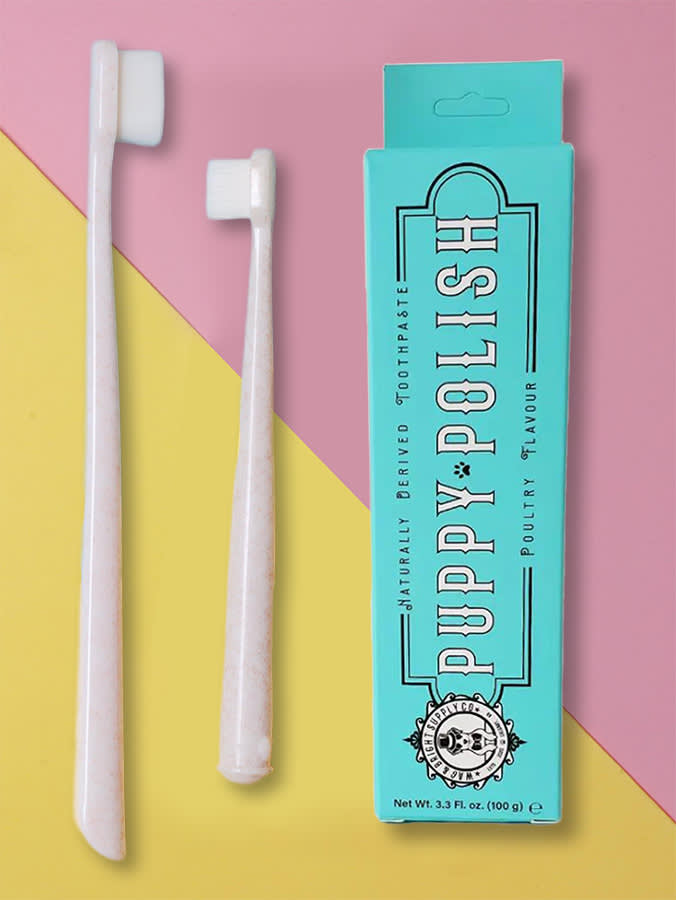
You do not need a fancy brush. Any soft-bristled brush works, a longer-handled one for a big muzzle, a child’s brush for a flat or tiny face. You do need a dog-specific toothpaste, never human paste, but understand that the paste is mostly there to make the whole thing taste good. The bristles do about 95 percent of the actual cleaning. Focus on the outer surfaces of the teeth, the ones facing the cheek, because that is where plaque collects and where your dog will tolerate the brush.
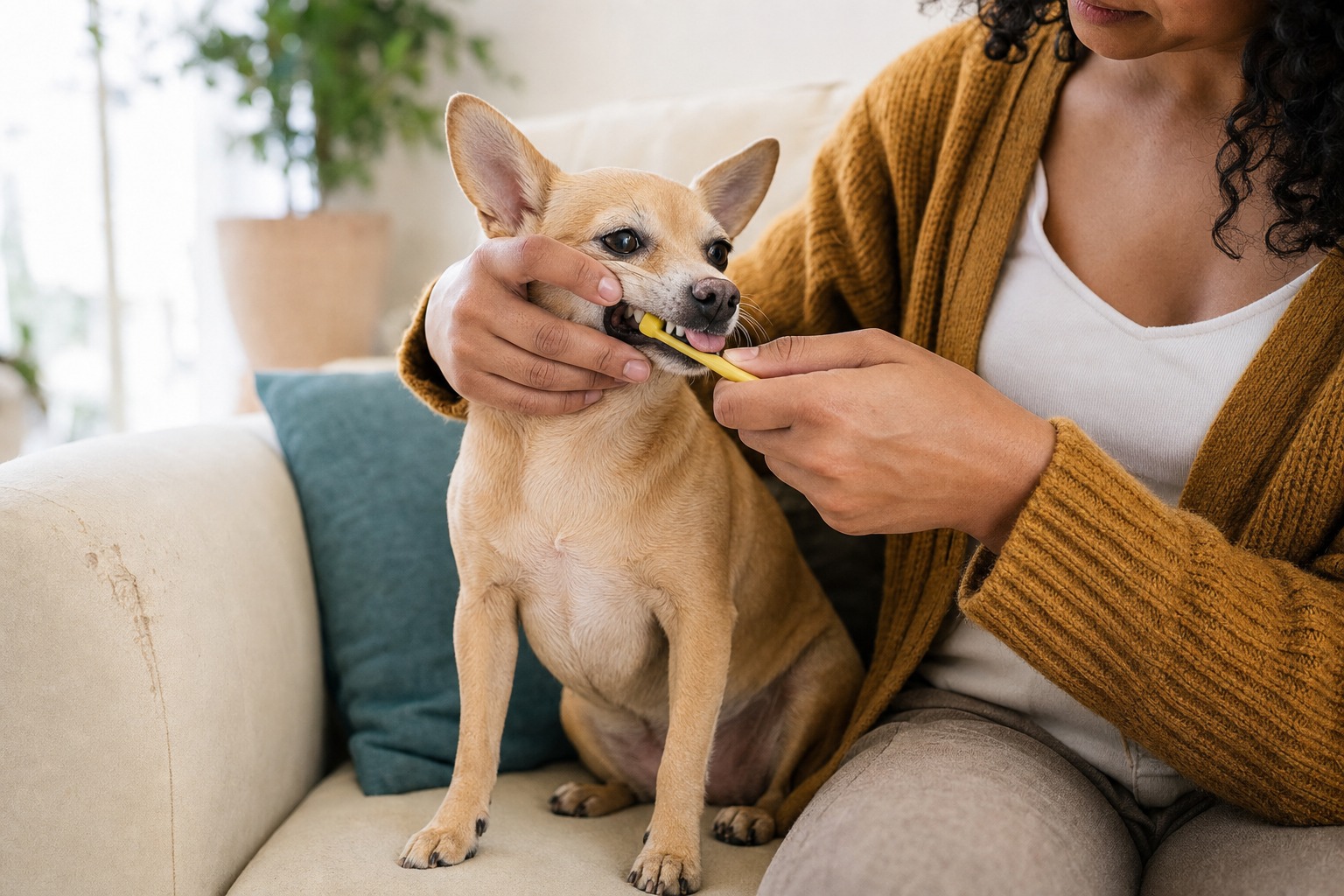
The trick is to build the habit over days, not to win the whole mouth in one sitting. Handle the mouth with no brush for a few days. Let your dog lick the paste off your finger, then the brush. Then brush a few teeth and quit while you are ahead. Puppies are easiest to start, but plenty of adult and senior dogs come around with patience. If you adopted an older dog who already has sore or loose teeth, do not force a brush into a painful mouth. Get a veterinary exam first.
The cleaning people skip, and the one they should
Once tartar has hardened and disease has set in below the gumline, no toothbrush can undo it. That is what a professional cleaning is for. A proper veterinary dental cleaning is done under general anesthesia so the whole mouth, all 42 adult teeth, can be probed for pockets and hidden disease, X-rayed to see the two-thirds of each tooth that lives below the gumline, scaled clean above and below the gum, polished, and, where a tooth is beyond saving, extracted. Most dogs do well with a cleaning about once a year, though small dogs and dogs with existing disease often need them more often.
You will see cheaper “anesthesia-free” cleanings advertised, sometimes at groomers or pet stores. Be skeptical. Without anesthesia, a person can only scrape the visible crown of the tooth. They cannot clean below the gumline, which is the only place periodontal disease actually lives, and they cannot take X-rays. The teeth look whiter, the real disease continues, and you walk out falsely reassured. Veterinary dental organizations are clear that it is not a substitute for the real thing.
What newer research adds
The size-and-risk finding above is itself the freshest and most useful update in dog dentistry, and it changes how attentively small-dog owners should treat this. It reframes brushing a Yorkie or a Poodle mix from “nice if you get around to it” to “this breed is genetically pre-loaded for tooth loss.”
The other shift worth knowing is why vets have grown more insistent about mouth care in general. A dog’s mouth is not a sealed compartment. The chronic low-grade infection of advanced periodontal disease keeps bacteria and inflammation circulating, and researchers continue to link poor oral health to strain on the heart, kidneys, and liver. You do not need to memorize the biology. The practical takeaway is that keeping the mouth healthy is not vanity or fresh-breath convenience. It is part of keeping the rest of your dog healthy, which is a much better reason to pick up the brush tomorrow than guilt ever was.
References
- Wallis, C., et al. “A Longitudinal Assessment of Periodontal Disease in 52 Miniature Schnauzers.” BMC Veterinary Research, 2019, https://doi.org/10.1186/s12917-019-1923-8.
- O’Neill, D. G., et al. “Periodontal disease in dogs under primary veterinary care in the UK.” Royal Veterinary College VetCompass, Journal of Small Animal Practice, 2021.
- Waltham Petcare Science Institute. “Small dog breeds at highest risk for dental disease, largest study confirms.” https://www.waltham.com/news-events/oral-health/small-dog-breeds-highest-risk-dental-disease
- Veterinary Oral Health Council. “VOHC Accepted Products for Dogs.” http://www.vohc.org/accepted-products
- American Veterinary Medical Association. “Pet dental care.” https://www.avma.org/resources-tools/pet-owners/petcare/pet-dental-care
Common questions
Do I need special dog toothpaste?
You need dog toothpaste in the sense that you must never use human toothpaste, which often contains xylitol and fluoride that are unsafe to swallow. But the paste is mostly flavor to make brushing pleasant. The bristles do the real work, so a plain soft brush with a dog-safe paste your dog likes is plenty.
Are dental chews as good as brushing?
No, but the good ones genuinely help. Look for the VOHC Accepted seal, which means the product was tested and shown to reduce plaque or tartar. Treat chews as a supplement to brushing and cleanings, not a replacement.
Is anesthesia-free dog teeth cleaning a safe shortcut?
It is mostly cosmetic. Scaling the visible tooth surface without anesthesia cannot clean below the gumline, which is exactly where periodontal disease does its damage, and it can give owners false reassurance. Veterinary dental groups do not consider it a substitute for a proper anesthetized cleaning.
Not a substitute for your vet. Our guidance is educational. For urgent symptoms, contact a vet or emergency clinic right away. Editorial standards
Dr. Kohl is a board-certified veterinary dentist with a particular interest in preventive oral care. She reviews all dental health content at The Pet Times and contributes practical guides on home dental routines, professional cleaning, and oral disease prevention.
Meet our experts ↗Keep reading
 Health & WellnessHomemade Dog Toothpaste Is Solving the Wrong ProblemDr. Lena Park · 8 min
 Health & WellnessYou Can't Brush Off Tartar. You Have 72 Hours to Beat It.Dr. Mara Chen · 9 min
 Health & WellnessPuppy Breath Doesn't Go Bad. It Goes on Schedule.Dr. Mara Chen · 6 min
 Product PicksYou Didn't Fail at Brushing Your Dog's Teeth. You Started at the Wrong End.Dr. Mara Chen · 7 min
 Health & WellnessMost Dog "Longevity" Supplements Are Guesswork. 9 That Aren't.Dr. Priya Nair · 11 min
 Health & WellnessBad Dog Breath Isn't Cute. It's the First Sign of Disease.Dr. Mara Chen · 6 min