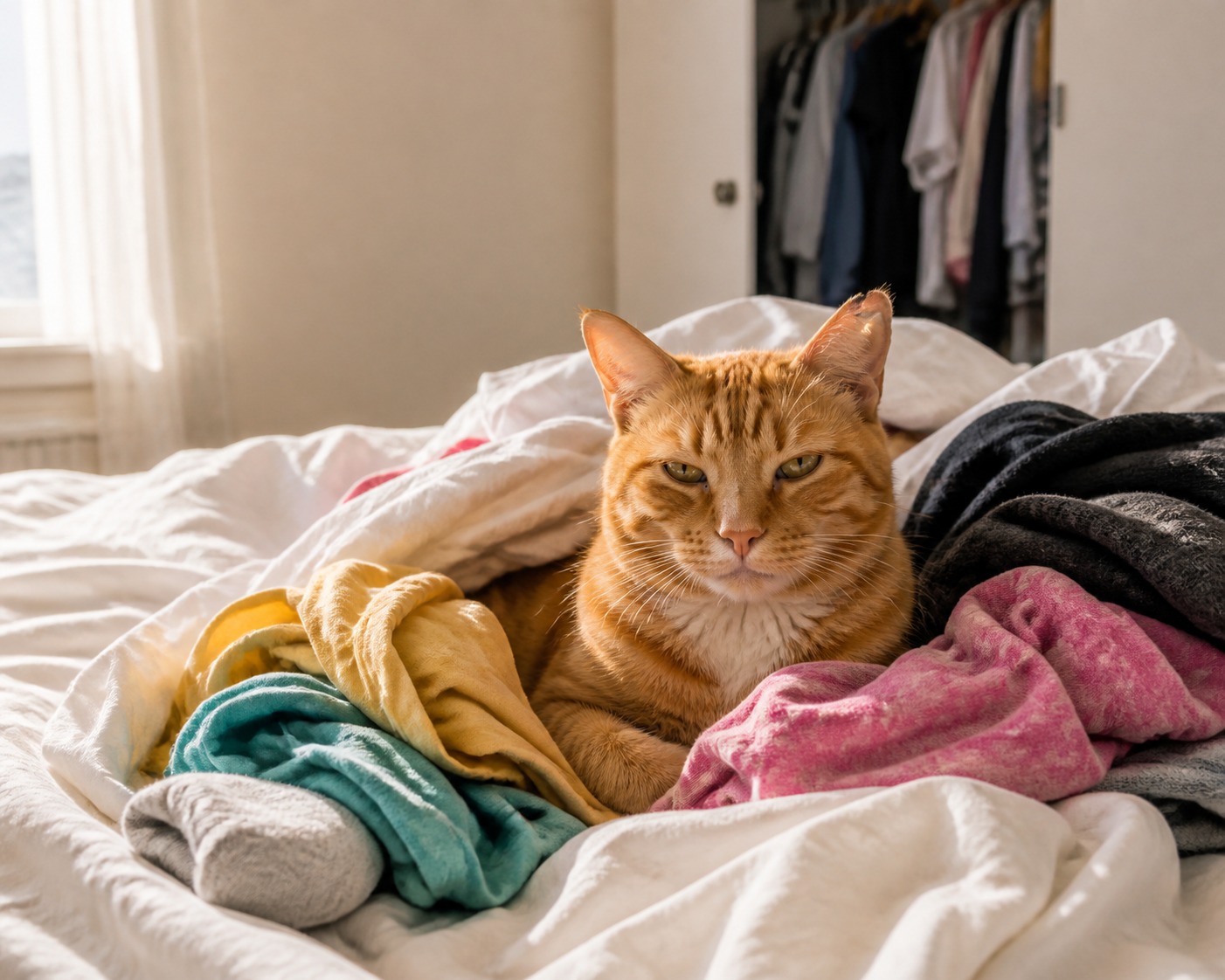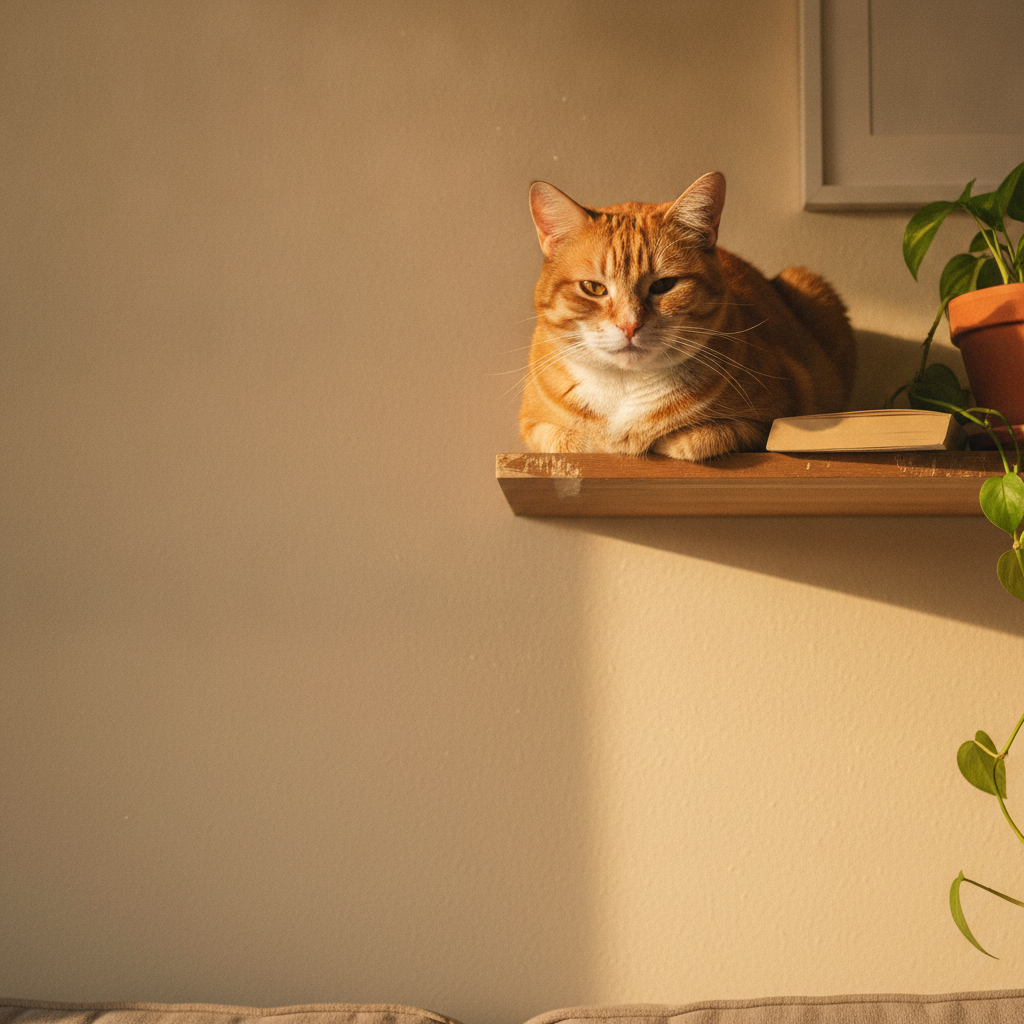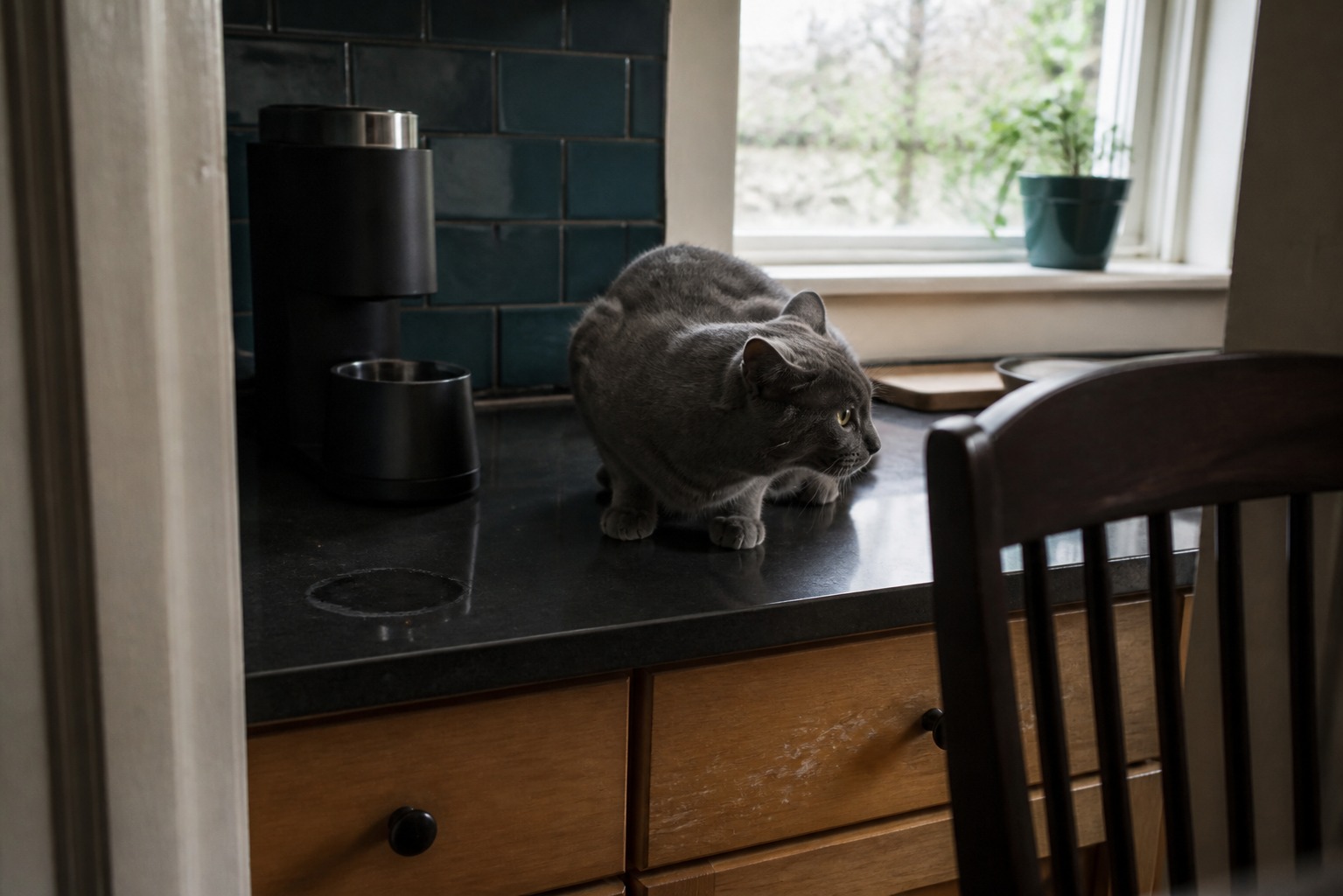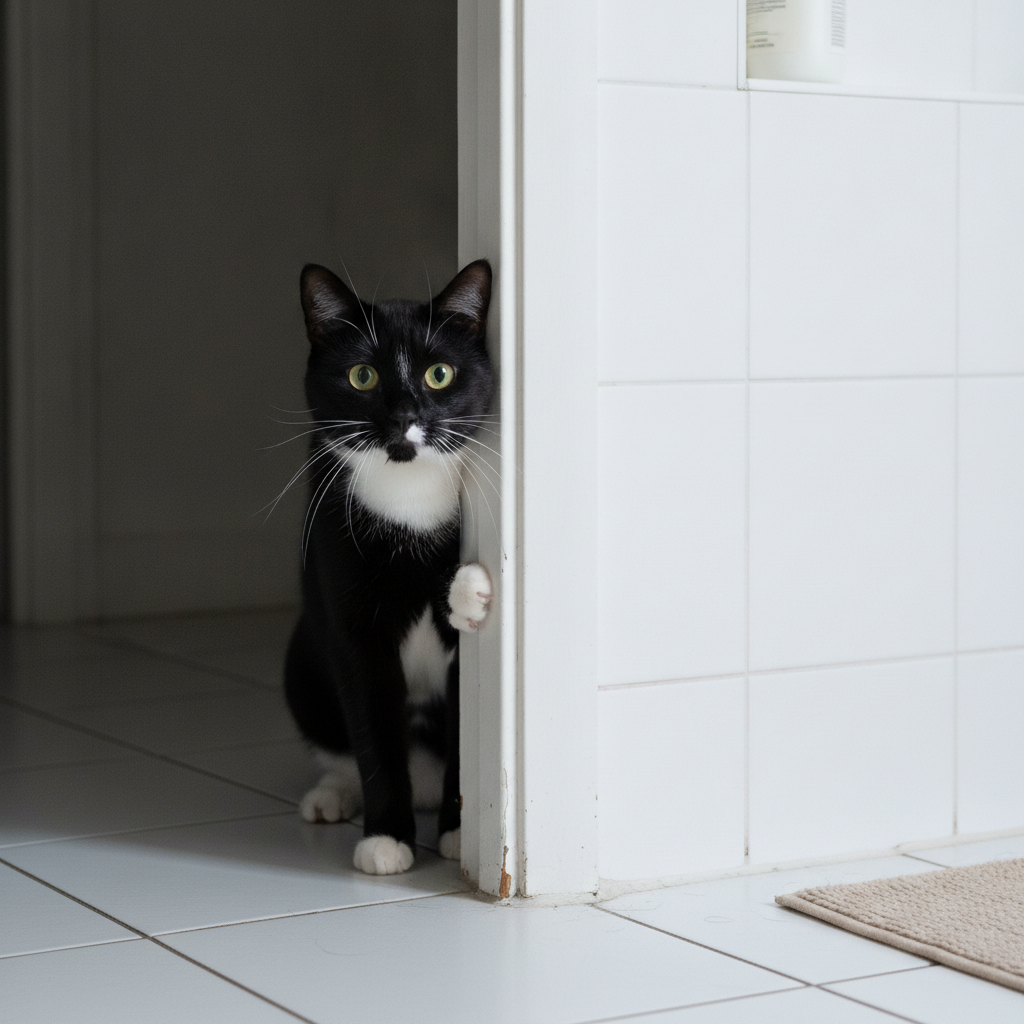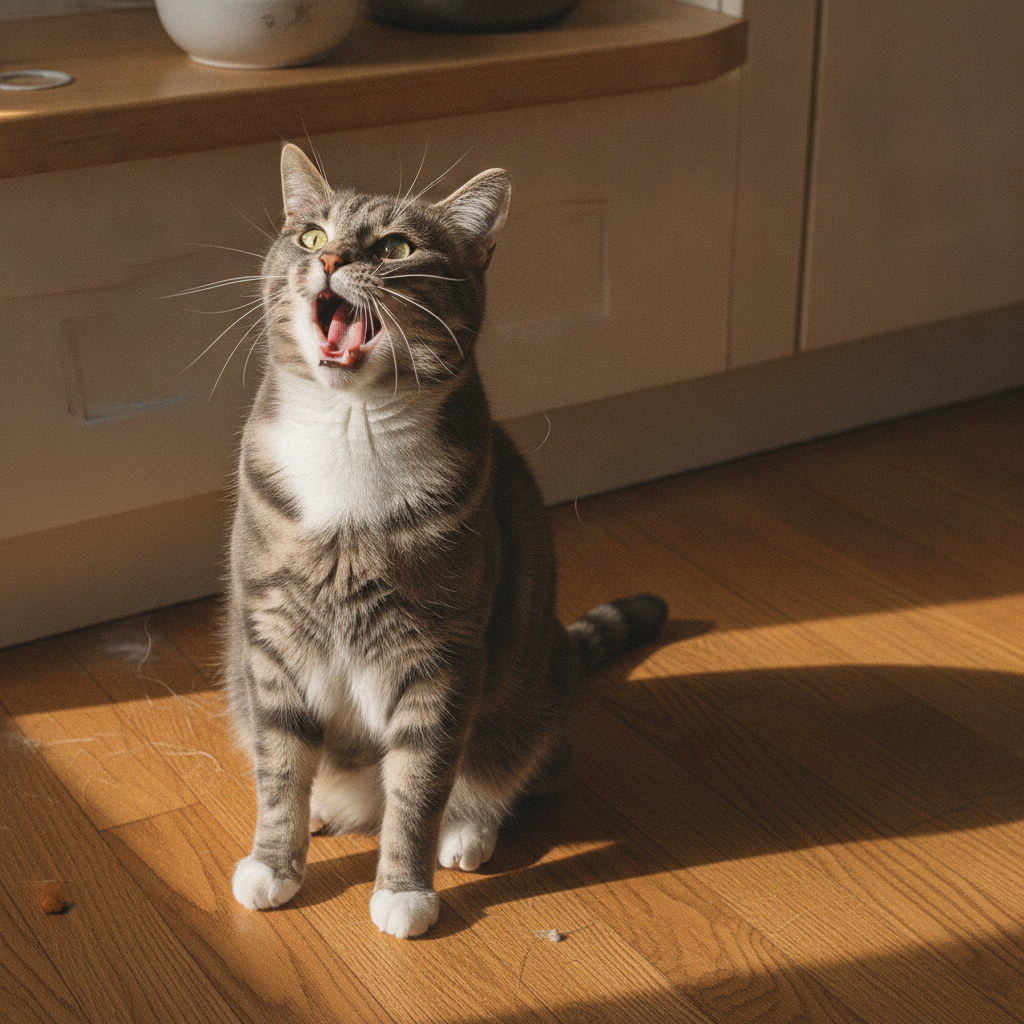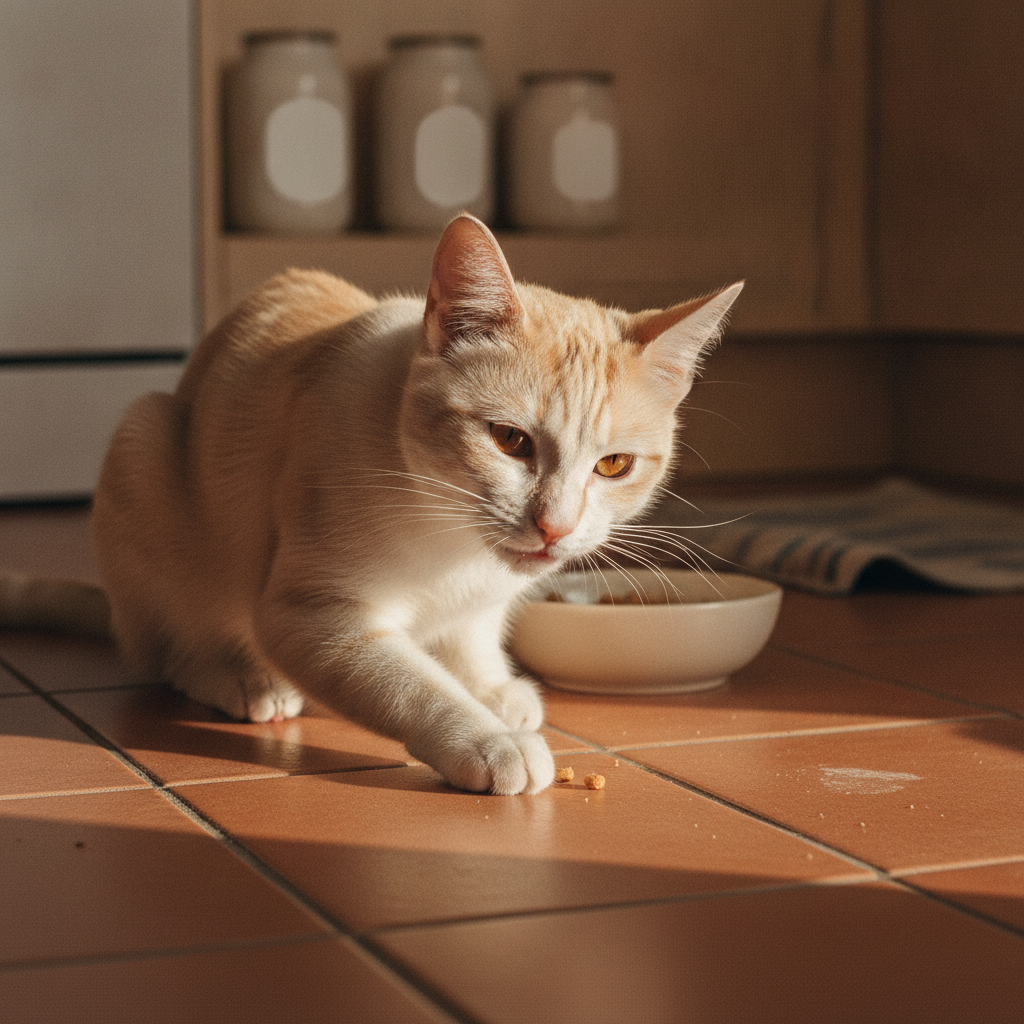
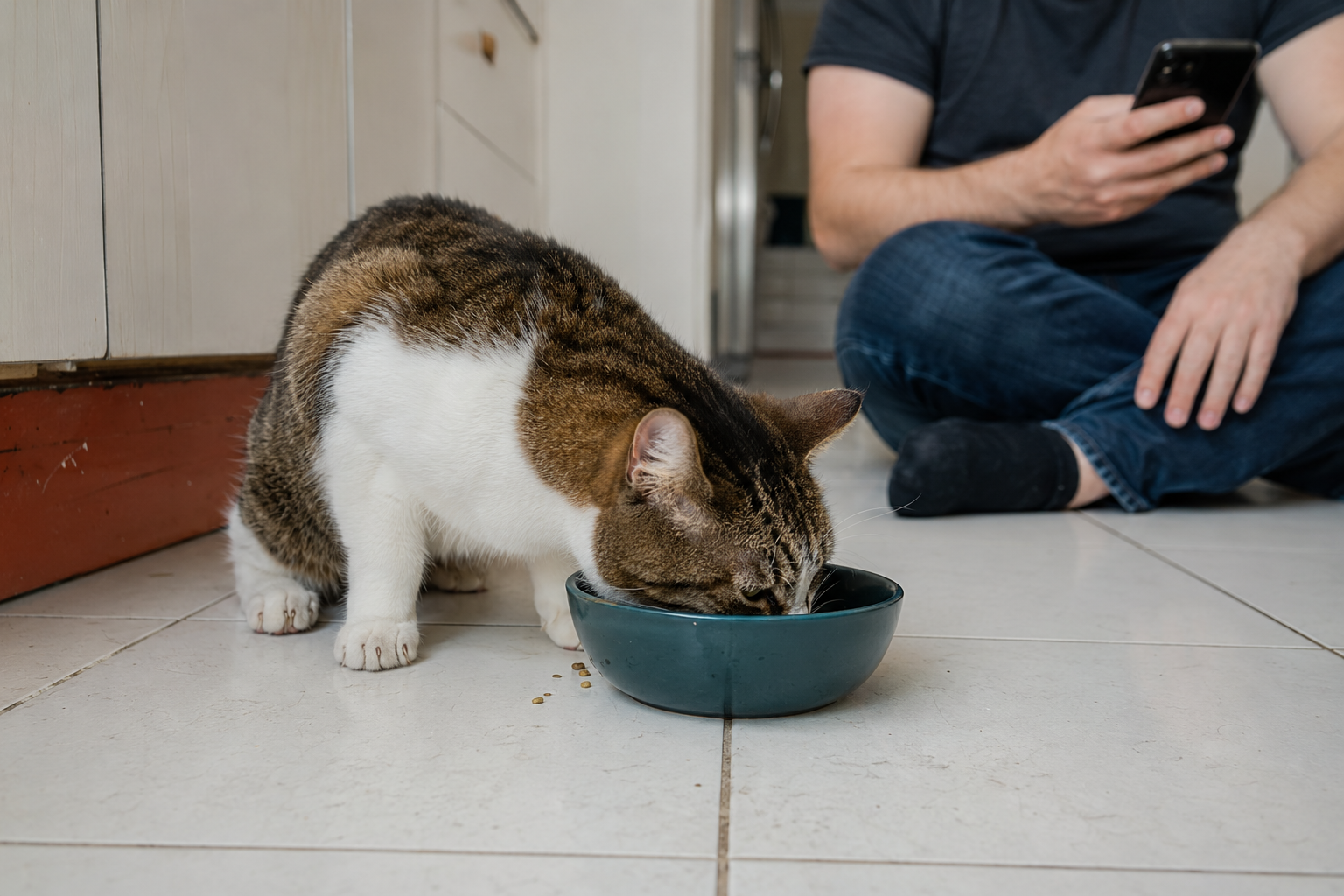
You put the bowl down, walk away, and hear nothing. You come back. Your cat is sitting next to the food, looking at you with the patience of someone whose dinner reservation was ignored. You stand there. They eat.
Everyone in your life will tell you this is adorable. It usually is. But the sweetness has been doing a lot of work covering up the useful distinction, so let’s make it plainly:
A cat who prefers your company at meals is showing a preference. A cat who cannot eat without your company is showing a dependency. The first one is a compliment. The second one is a welfare risk, because a cat who skips meals is a cat whose liver can be in trouble within days.
The behavior looks identical from the doorway. The difference is whether the food goes down when you don’t.
Why company at the bowl makes sense to a cat
Start with the position. To eat from a bowl, a cat lowers their head, breaks their line of sight, and gives up their peripheral view. In an animal that is simultaneously a hunter and a snack, that is a costly posture. Anything that lowers the cost of it, a wall at their back, a clear view of the door, or a trusted large primate standing guard, makes the food easier to commit to.
That’s the whole theory, and it explains the details neatly. It’s why a cat who won’t touch a bowl in the middle of the kitchen will happily eat the same food from a bowl tucked against a wall. It’s why the staring often stops the moment you sit down.
Layer three more ordinary things on top:
- They’re social, and we underrate it. The aloof-cat myth has been dying for years. Cats form real attachments, live in groups when resources allow, and treat their people as part of the group. Eating together is what groups do.
- It’s learned. If your presence has always coincided with food, your presence has become part of the meal. Cats build these associations quickly and hold them for years.
- Some cats are just anxious. Stress narrows a cat’s world, and an anxious cat looks for the safest version of every routine. If you are the safest thing in the house, you get invited to dinner.
The phrase ‘affection eating’ has done a lot of damage, because it makes the whole thing sound like a love language and stops the conversation there. Some of these cats are relaxed and social. Some of them are frankly worried, and their owner has become a coping mechanism. Those two cats need completely different things from you.
The test that tells you which cat you have
Don’t guess. Measure.
For one week, weigh the food or count the portions and note what actually gets eaten, in two conditions: when you’re in the room, and when you aren’t. You’re looking for one number, not a vibe.
- Eats fully either way, just prefers you there? Preference. Enjoy it, and stop reading anxious things into it.
- Eats less, or not at all, when you leave? Dependency. Intake is being shaped by your schedule, and that needs fixing, not admiring.
- Eats less in every condition, or has stopped eating well overall? That’s not a behavior article. That’s a vet visit, today.
That last one is not being dramatic. Cats handle fasting badly. An overweight cat who stops eating can develop hepatic lipidosis, in which the body mobilizes fat faster than the liver can process it, in a matter of days. Any sustained drop in appetite is a medical event until proven otherwise, and the “she’s just being picky” framing has cost cats their lives.
Fixing the dependency, without making mealtimes worse
The instinct is to leave and let them figure it out. Don’t. For a cat who eats because you’re there, walking out is removing the thing making eating possible, and you’ll get less food into them, not more.
Fade instead.
- Fix the environment first. Bowl against a wall or in a corner, with a view of the room’s entrance. Away from the litter box, away from the washing machine, away from a doorway a dog blasts through. Many “social eaters” are actually cats eating in a bad spot who need a bodyguard to tolerate it.
- Be present but boring. Stay in the room and stop performing. No petting during meals, no talking, no watching. Read something. Wash a dish. You are furniture with a pulse.
- Add distance in inches, not rooms. A few steps further away every couple of days. If eating stalls, back up a step and hold there longer.
- Then add absence in seconds. Leave for ten seconds. Come back. Twenty. A minute. You are teaching them that the room doesn’t become dangerous when you go.
- Move the affection. Play, groom, and cuddle at times that have nothing to do with food. A cat who gets a reliable attention budget elsewhere lobbies less at the bowl.
- Feed small and often. Cats evolved on many small meals, not two large ones. Multiple small portions lower the stakes of any single meal.
“Go slower than feels reasonable,” Dr. Kohl says. “The whole goal is that eating never becomes the moment your cat feels abandoned. If intake drops, you moved too fast. There’s no prize for getting there in a week.”
What newer research adds
The old picture of the solitary, indifferent cat keeps losing ground. Work on the human-cat relationship increasingly shows what most owners already suspected: cats attend closely to us, adjust their behavior to whether we’re paying attention, and form attachment patterns with recognizable secure and insecure flavors. A cat who wants you present to eat is doing something the science now expects, not something eccentric.
Two practical notes follow from that. First, the attentional-state research suggests these cats are not staring at the bowl, they’re monitoring you, which is why they’ll often eat happily while you scroll your phone but stop when you leave the room. Physical presence is doing the work, not attention. That’s useful, because it means you can be present and inattentive, which is exactly what the fading protocol asks of you.
Second, a sudden appearance of this behavior in a cat who never had it is worth a vet call rather than a training plan. New clinginess and changed eating habits arriving together, especially in a middle-aged or older cat, is a pattern that pushes pain, dental disease, hyperthyroidism, and nausea up the list. Behavior that changes is a symptom. Behavior that has always been there is a personality.
References
- Turner, Dennis C. “The Mechanics of Social Interactions Between Cats and Their Owners.” Frontiers in Veterinary Science, vol. 8, 2021. https://pmc.ncbi.nlm.nih.gov/articles/PMC8044293/.
- Zhang, Lingna, et al. “Feline Communication Strategies When Presented with an Unsolvable Task: The Attentional State of the Person Matters.” Animal Cognition, vol. 24, 2021. https://doi.org/10.1007/s10071-021-01503-6.
- Vitale, Kristyn R., Alexandra C. Behnke, and Monique A. R. Udell. “Attachment Bonds Between Domestic Cats and Humans.” Current Biology, vol. 29, no. 18, 2019. https://www.cell.com/current-biology/fulltext/S0960-9822(19)30987-6.
- Cornell Feline Health Center. “Hepatic Lipidosis (Fatty Liver Disease).” Cornell University College of Veterinary Medicine. https://www.vet.cornell.edu/departments-centers-and-institutes/cornell-feline-health-center/health-information/feline-health-topics/hepatic-lipidosis-fatty-liver-disease.
- American Association of Feline Practitioners. “Feline Environmental Needs Guidelines.” https://catvets.com/guidelines/practice-guidelines/environmental-needs-guidelines.
Common questions
Is affection eating a problem?
Only if it limits intake. A cat who eats fine but likes you nearby is showing a preference. A cat who skips meals when you're not there, or who eats less overall, has a problem, because cats are dangerously bad at going without food.
Why does my cat stare at me while eating?
Usually one of two things: they're checking that their lookout is still on duty, or they've learned that eye contact at the bowl produces attention, petting, or a top-up. Watch whether they keep eating while they stare. If they stop to stare, it's a request, not a security check.
How do I get my cat to eat alone?
Don't leave, fade. Stay in the room but stop engaging, then drift further away over days, then out of sight for short stretches. Move the bowl somewhere with a wall behind it and a view of the doorway, and put your affection anywhere in the day except the bowl.
When should I call a vet about a cat not eating?
Fast. A cat who eats little or nothing for more than about 24 to 48 hours, especially an overweight cat, is at risk of hepatic lipidosis, a serious liver condition. Any sudden drop in appetite deserves a call, not a wait.