


You've Been Walking Your Dog Wrong
A daily walk is the most underrated training session you get. Eleven tips on gear, pacing, and what a 2024 leash study reveals about why your dog still pulls.

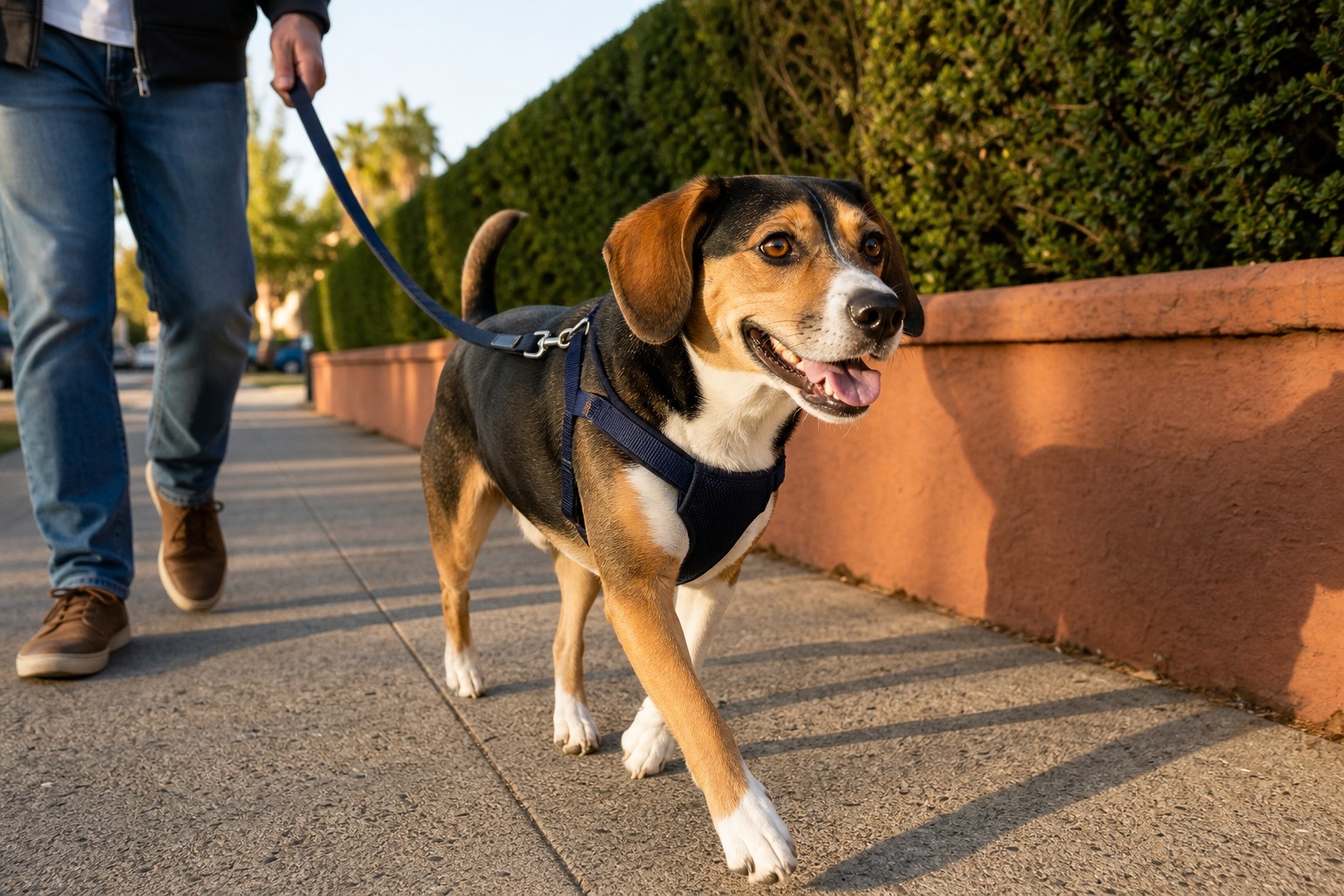
Here is the reframe that fixes most walking problems: the walk is not how your dog gets exercise. It is the longest training session you run all day, and almost nobody treats it that way. Every time your dog pulls and you follow, you teach pulling. Every time you let them drag you to a smell with no rules, you teach that the leash is a suggestion. Flip that, and the same twenty minutes becomes the most productive part of your dog’s day. These eleven tips are built around that idea, and one of them rests on a 2024 study that explains why your no-pull harness has not fixed the pulling.
1. Choose gear for the dog you have, not the dog you want
The first decision is mechanical, and it depends on your dog’s specific failure mode. A dog who pulls forward fights against anything that tugs them backward, which is why a back-clip harness can make pulling worse. A front-clip harness redirects them from the chest so there is nothing to brace against. A dog who does the opposite, who pancakes, spins, or panics, especially a newly rescued dog spooked by skateboards and strollers, is a flight risk, and a flat collar is the wrong tool entirely.
“On a martingale, the leash attaches to a small secondary loop, and tension closes the collar just enough to stop a slip without ever choking. That limited, self-releasing snugness is what makes it the default for dogs who reverse out of flat collars,” says Dr. Ravi Mehta, a veterinary behavior consultant. “It is a safety device for the escape artist, not a correction tool.”
2. The gear is a training aid, not a cure
This is the tip almost every walking guide gets wrong, and the research is now clear. A 2024 peer-reviewed study comparing four types of leash-walking equipment found that front-connection harnesses did reduce pulling force compared with other tools, but no piece of equipment eliminated pulling on its own. The harness changes the physics of the pull. It does not teach the dog anything. A dog in the best front-clip harness who never gets rewarded for a loose leash will still pull; they will just pull at a different angle. Buy the harness, then do the training it makes easier.
3. Start absurdly slow with puppies
New owners routinely overwalk puppies, and it matters more than most people realize because growth plates are still open. A useful rule of thumb is roughly five minutes of structured walking per month of age, once or twice a day, so a four-month-old puppy walks about twenty minutes at a stretch. Build up gradually as they mature. Sniffing, exploring, and play in the yard do not count against this budget; it is sustained leash walking on hard surfaces you want to ration.
4. Reward the position you want, the instant you get it
Walks are pure training opportunity: new people, new dogs, new sounds, all while you have a hungry, attentive dog on a six-foot tether. The trick is timing. The single most useful habit is to reward your dog the moment the leash goes slack and they are walking near your leg, not after they have already surged ahead. A dog learns from the consequence that immediately follows the behavior, so a treat delivered one second late teaches the wrong lesson. Carry high-value treats for exactly this and dole them out only for behavior you want to see again, never to bribe a dog out of a meltdown.
5. Let sniffing be the reward, not the rule-breaker
A walk where your dog drags you nose-first to every hydrant is a walk where the dog is training you. But sniffing is also deeply enriching, a “sniffari” is genuinely good for a dog’s brain, so do not ban it. Put it on cue instead. Walk in a structured heel for a stretch, then release your dog with a word like “go sniff” and let them investigate freely for a minute. Now the smell is a reward you control, and the dog learns that polite walking unlocks the fun.
6. Keep a routine while you build the habit
While your dog is still learning, walk at consistent times along familiar routes. Predictability lowers arousal, a dog who knows the plan is a calmer dog, and it makes the eventual jump to new environments far smoother. Once the basics are solid, start varying the route on purpose to keep things mentally fresh.
7. Match the workout to the breed
Your dog’s breed or mix sets the dial on how much they need to move. A retired greyhound may be thrilled with two short strolls; a young border collie or husky needs a real outlet or they will invent one in your living room. Do the homework on your dog’s drives, and remember that mental work, training games, scent work, puzzle feeders, tires a high-drive dog faster than distance alone.
8. Read the ground and the sky before you go
This is the most overlooked safety tip, and it is simple. Hot asphalt can climb well above air temperature in direct sun, hot enough to blister paw pads quickly. Use the seven-second test: press the back of your hand to the pavement, and if you cannot hold it comfortably for seven seconds, walk on grass or wait for evening. In cold, watch for ice-melt salt between the toes and consider a coat for thin-coated breeds. Heat is the bigger killer, so learn the early signs of heatstroke, heavy panting, bright-red gums, stumbling, and turn back at the first one.
9. Pack the four things that make a walk work
Beyond the leash, three items should never leave home without you, plus one that earns its place. First, poop bags; cleaning up is both courtesy and, in many towns, the law. Second, water on any warm day, because dogs dehydrate faster than people. Third, those training treats from tip four. The bonus fourth item is a throwable toy for dogs who love to chase, turning part of the walk into a sprint.
10. Consider a walker, and vet them like a sitter
Life does not always allow the daily walk your dog needs, and a good professional walker is a legitimate solution. Treat hiring one like hiring a sitter: ask about their equipment and handling philosophy (you want positive reinforcement, not corrections), how many dogs they walk at once, and whether they are insured and bonded. A walker who reinforces your training keeps your dog progressing; one who lets your dog pull undoes it.
11. Microchip and tag, because the best walk can still go wrong
The most important walking tip has nothing to do with the walk itself. A startled dog can slip a collar or bolt through an open gate, and a microchip is what gets them home. Register the chip and keep your contact details current, since an unregistered chip is just a number. Pair it with a physical tag carrying your phone number for the fastest possible reunion, no scanner required.
References
- Townsend, L., et al. “Comparing efficacy in reducing pulling and welfare impacts of four types of leash walking equipment.” Animals, 2024. National Library of Medicine, PMC11512810.
- American Kennel Club. “Puppy Exercise: How Much Is Too Much?” akc.org.
- American Veterinary Medical Association. “Hot Weather Safety for Pets.” avma.org.
- ASPCA. “Microchipping Your Pet.” aspca.org.
Common questions
How long should each walk actually be?
For most adult dogs, aim for a total of about an hour a day, split into walks. Puppies are the exception. Cap them near five minutes per month of age until they are fully grown to protect developing joints.
Why does my dog still pull even with a no-pull harness?
A 2024 leash-equipment study found harnesses reduce pulling but do not eliminate it without training. The gear changes the angle of the pull; only positive reinforcement teaches the dog not to pull in the first place.
What is the single most overlooked walking mistake?
Ignoring the ground and the forecast. Hot pavement can burn paw pads in seconds, and many owners never check it. Press the back of your hand to the surface for seven seconds; if you can't hold it, your dog can't walk on it.
What should I always bring on a walk?
Beyond the leash: poop bags, water on warm days, and high-value treats so the walk doubles as a training session. A throwable toy is a bonus for dogs who like to chase.
Marcus Webb writes about the gear, gadgets, and everyday choices that make life with a pet easier. His coverage runs from product picks to training and the causes worth paying attention to, always with an eye on what actually earns a place in your home.
Meet our experts ↗Keep reading
 TrainingYour Rescue Dog Isn't Being Difficult. They're Decompressing.Dr. Mara Chen · 8 min
 TrainingThere Are 6 Dog-Parenting Styles. The Research Only Likes One.Dr. Mara Chen · 7 min
 TrainingYour Dog Already Knows Your Name. This Game Makes Them Prove It.Dr. Mara Chen · 6 min
 LivingADHD Doesn't Make You a Bad Dog Parent. Your Reminder App Does.Leila Torres · 8 min
 LivingThe Only People Who Should Own a Husky Walk 11 Miles a DayMarcus Webb · 7 min
 LivingThe 'Trainer' Who Starved 133 Dogs Is Finally Going to Prison for 15 YearsNina Vasquez · 5 min