


The Only People Who Should Own a Husky Walk 11 Miles a Day
An artist with what she calls a walking addiction covers six to 11 miles daily with her Husky. That isn't a charming quirk. It's roughly the entry fee, and almost nobody pays it.

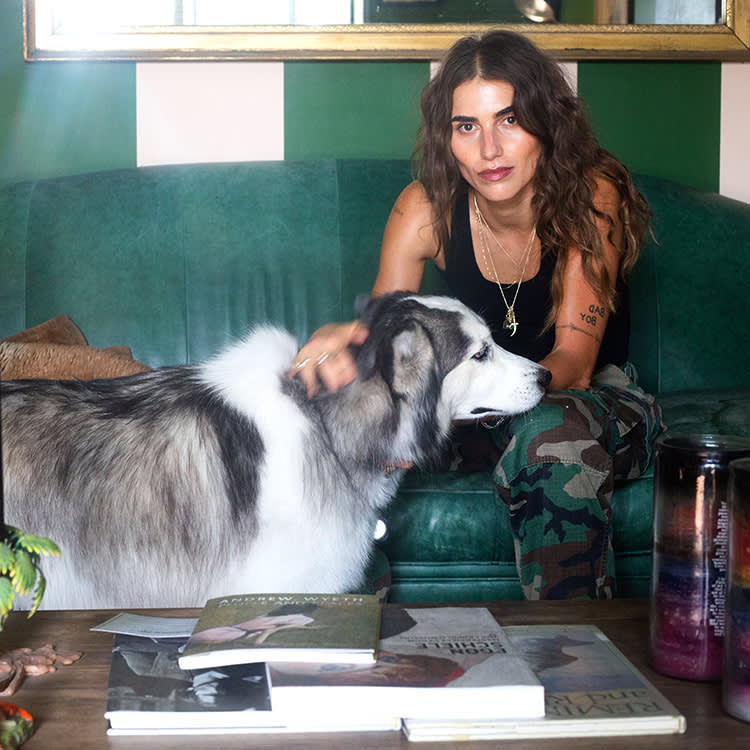
There is a specific kind of dog owner who makes the whole thing look effortless, and the reason it looks effortless is that they were, entirely by accident, the exact right person for that dog.
The artist Langley Fox is one of them. She lives with a Husky named Zeppelin. She also describes herself as having a walking addiction, and she and the dog cover somewhere between six and eleven miles a day, together.
She says this the way you would mention that you drink coffee. It is not presented as a sacrifice, or a training regimen, or evidence of virtue. It is just what happens.
That is the whole story of Husky ownership, and almost everybody gets it backwards.
The dog arrived by accident, which is the normal way
Zeppelin was a gift. Her first boyfriend gave him to her as a one-year anniversary present. He broke up with her a month later.
So: he handed her a child and left. Her words, roughly. The cutest child ever, she adds, which is both true and beside the point.
This is worth pausing on, because it is the most common origin story for a badly matched dog. Nobody sat down and assessed whether an artist in her twenties could meet the needs of a working sled breed. Somebody thought a Husky puppy would be a romantic gesture, and it happened to land on a person who walks eleven miles a day.
She got extraordinarily lucky. Most Huskies acquired that way do not.
What the breed actually asks for
Strip away the wolfish glamour and a Siberian Husky is a purpose-built endurance athlete. The breed was developed to pull light loads across long distances in brutal cold, for hours, cooperatively, day after day. That is not a historical footnote. That is the operating spec of the animal currently on your sofa.
Which produces four consequences that fill shelters:
They need real distance, not a walk. A twenty-minute loop around the block is a warm-up. An under-exercised Husky does not become a calm Husky; it becomes a destructive one, because the drive does not evaporate, it redirects.
They are escape artists with a job. A dog bred to keep moving forward regardless of conditions is a dog that will dig under, climb over, or simply leave. Fences are a suggestion.
Recall is genuinely hard. They were bred to run out and keep running, not to check in. A Husky off-leash in an unfenced space is a coin toss, and a lot of owners find that out once.
The coat. They blow their undercoat, twice a year, catastrophically. Fox vacuums every single day. That is not a complaint about her housekeeping; it is a factual description of living with a double-coated northern breed.
She notes that people constantly tell her Zeppelin looks and acts like a puppy, and that it pleases her. He is seven. That youthfulness is not a coincidence. It is what a Husky looks like when the mileage is actually being covered.
“The behavior problems I see in northern breeds are almost never behavior problems,” says Dr. Nina Kohl. “They’re arithmetic. The dog needed ninety minutes and got twenty, every day, for two years. Nothing is wrong with that dog. The dog is doing exactly what an unspent endurance athlete does. I can’t train that out. I can only ask the owner to walk further, and most of the time they won’t.”
The compatibility test, honestly
Before you get a Husky, or a Malamute, or any of the working northern breeds, answer these without flattering yourself:
- What is the smallest amount of exercise you will reliably give this dog on your worst week? Not your best. Your worst. February, sick, deadline, no help. That number is the dog’s actual life.
- Do you enjoy walking, or do you enjoy the idea of walking? Fox does not exercise her dog. She walks, compulsively, because she wants to, and the dog comes. That distinction is everything, because willpower runs out and preference does not.
- Is your yard a genuine enclosure or a polite fiction?
- Can you live with the hair? Every day. On everything.
- What is your plan for the next twelve years? Not the next two.
If the honest answer to any of those is uncomfortable, the kindness is to get a different dog. There are wonderful dogs who are thrilled with a thirty-minute walk and a nap. A Husky is not one of them, and no amount of love converts one into one.
What a well-matched dog actually looks like
The rest of Fox’s account of Zeppelin is, tellingly, boring. That is the point.
He does not really bark. He follows her around the house, and follows houseguests around too. When she draws, he sometimes parks himself under her desk, which she describes as less charming than it sounds, because he sits there panting his dog breath at her while she is trying to work.
That is it. That is the entire behavioral profile. No destruction, no escaping, no reactivity, no anxiety. A dog who is slightly annoying under a desk.
You do not get that from training. You get that from a dog whose needs are being met so completely and so unremarkably that there is nothing left over to become a problem.
The part that isn’t about exercise
Fox’s work is photorealist drawing, mostly of subjects she describes as eerie or dark: mimes, clowns, rural scenes, faces carrying a story. She wanted to be a clown as a kid, before anyone taught her clowns were supposed to be frightening. She went to school for fashion design, decided she did not want to be a fashion designer while she was in the middle of it, built an illustration career for brands including Marc Jacobs, Louis Vuitton, and Alice + Olivia, and then, in the pandemic, taught herself oil painting specifically because it frightened her.
Her stated principle is that you should not get too comfortable, and that oil painting scaring her is precisely the argument for doing it.
Here is the strange thing: she has drawn a great many dogs and never drawn Zeppelin. Her explanation is that she sees him every day and nobody is paying her to.
She says they will get to it. They have time. She intends to make him live for her entire life, and he does not, as she points out, get a say.
What’s new since this was written
Nothing about a Husky’s requirements has changed, but the conversation around them has.
The northern breeds continue to be over-represented in shelter intake relative to their popularity, and the pattern behind it is consistent enough that rescues can recite it: the dog is surrendered somewhere between eighteen months and three years old, for destruction, escaping, or “too much energy.” That is the exact window in which an under-exercised working dog stops being a puppy who is a handful and becomes an adult who is a problem.
The advice has not changed either, and it remains almost impossible to sell: the dog does not need better training. The dog needs a longer walk, every day, for the next decade, and you need to be the kind of person who would have taken that walk anyway.
References
- American Kennel Club. Siberian Husky Breed Standard and Care. akc.org
- Shelter Animals Count. 2025 Annual Data Report. shelteranimalscount.org
- Cornell University Riney Canine Health Center. Exercise and Canine Health. vet.cornell.edu
Marcus Webb writes about the gear, gadgets, and everyday choices that make life with a pet easier. His coverage runs from product picks to training and the causes worth paying attention to, always with an eye on what actually earns a place in your home.
Meet our experts ↗Keep reading
 TrainingYour Dog Doesn't Need a Longer Walk. It Needs These 6 Running Games.Dr. Amara Solis · 6 min
 TrainingSix Weeks of Crate Rest Will Break You Both. Give the Dog a Job Instead.Dr. Nina Kohl · 8 min
 LivingADHD Doesn't Make You a Bad Dog Parent. Your Reminder App Does.Leila Torres · 8 min
 TrainingYour Dog Doesn't Fail at Restaurants. They Fail in the First 90 Seconds.Dr. Nina Kohl · 7 min
 TrainingYes, Your Dog Can Learn to Skateboard. It's Just Shaping in Disguise.Claire Sutton · 5 min
 TrainingStop Chasing Your Dog. That's Why Fetch Isn't Working.Jordan Ellis · 9 min