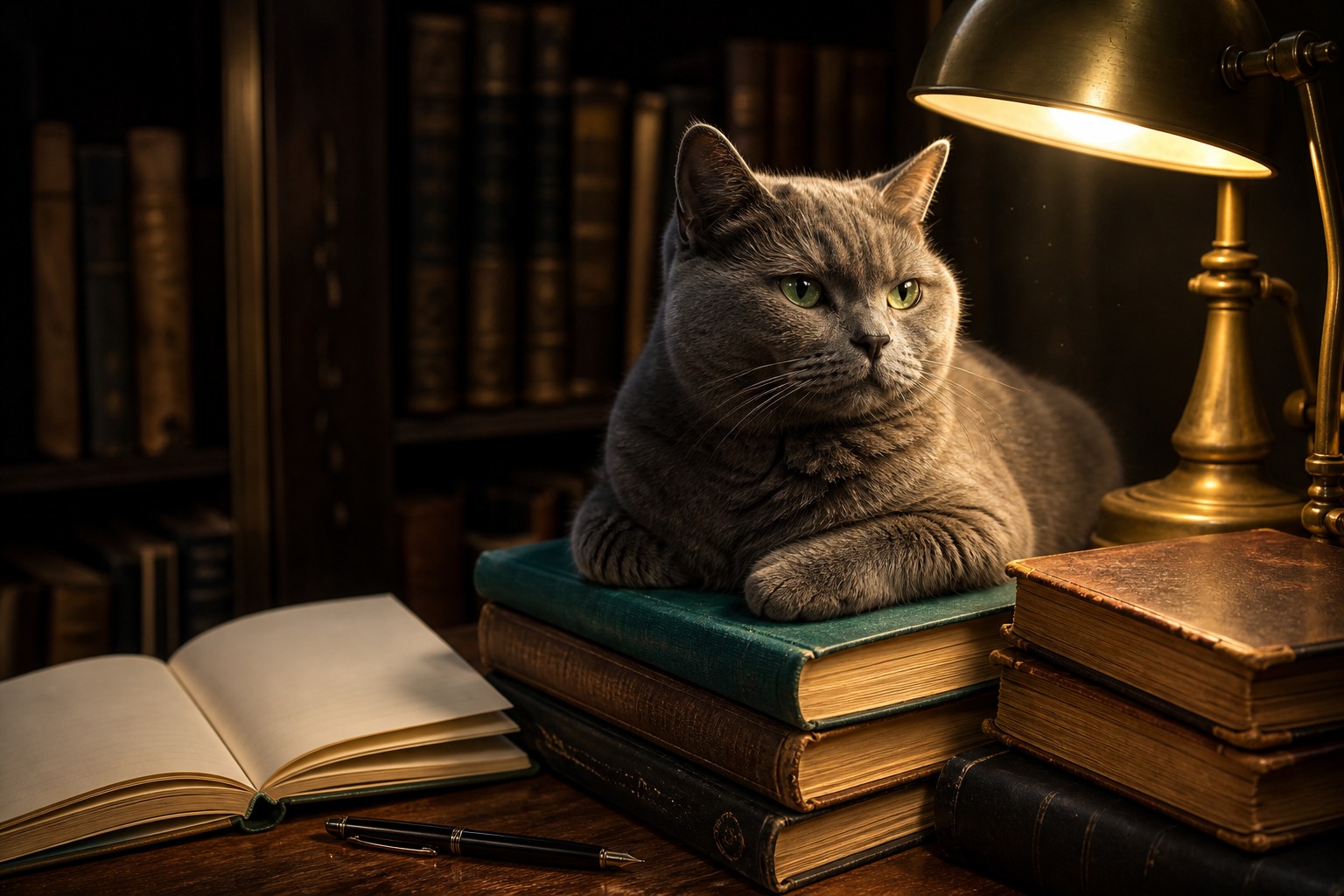
There’s a reason the image of the writer-with-cat has hardened into a cliché. Cats and writers run on similar operating systems: both are moody, both are easily distracted, both spend a lot of the day appearing to do nothing while something happens internally. A cat asks for very little, tolerates long silences, and radiates a calm that a spiraling brain can borrow. It is, frankly, the ideal co-worker for a job that is mostly sitting alone in a room trying to think.
So it tracks that the literary canon is crawling with cats. But the writers below didn’t merely own cats. They built their days around them, wrote them into their books, gave them absurd names, and in a few cases behaved in ways that would raise eyebrows at any modern vet’s office. Grouped not by fame but by what the cat actually did for them, here are nine.
The collaborators: cats who earned their spot at the desk
For some writers, the cat wasn’t decoration. It was part of the working method.
Edgar Allan Poe wrote some of the bleakest pages in American literature with a tortoiseshell cat named Catterina, who was famously devoted to him and would reportedly perch on his shoulder while he worked. The devotion ran the other way, too. When Poe’s young wife, Virginia, was dying of tuberculosis in a freezing cottage, the family was too poor to heat the house, and Catterina is said to have lain on her chest to keep her warm. It’s a detail that tells you more about the household’s love for the cat than any essay could.
Patricia Highsmith, the mind behind The Talented Mr. Ripley and The Price of Salt, was famously hard on people and correspondingly soft on cats. She once told an interviewer that her morning ritual was to make coffee and announce to her cat that they were going to have a great day, and that her imagination worked far better when she didn’t have to talk to humans. After her death in 1995, Spider passed to a fellow novelist, Muriel Spark, who said you could tell he’d been a writer’s cat: he would sit gravely beside her as she worked while her other cats drifted off.
Muriel Spark, best known for The Prime of Miss Jean Brodie, had been a devoted cat person long before Spider arrived. She built her belief about cats and creativity right into her fiction: in A Far Cry from Kensington, she wrote that a cat’s tranquility slowly seeps into you as you sit at your desk, composing the jittery parts of your mind and handing back the concentration you’d lost. She called the effect on focus remarkable and a little mysterious, which is about as close as anyone has come to explaining it.
Colette, the French novelist the London Review of Books once dubbed “the frizzle-headed Cat Woman of 20th-century French writing,” went further than most. She wrote an entire novel, La Chatte, around a love triangle between two people and one cat named Saha, and she left behind some of the most quotable cat lines in literature. “Time with cats is never wasted,” she said, a sentiment now printed on roughly every gift-shop dish towel in existence. Asked once to name what she considered priceless, she came up with exactly three things: her cat, her resolve to travel, and her solitude.
The collectors: writers who did not stop at one
Then there are the writers for whom a single cat was never going to be enough.
Ernest Hemingway is arguably history’s most famous cat guy. At his home in Key West he founded a colony of polydactyl, or six-toed, cats, and for all the hard, spare prose he’s known for, he went completely to pieces over them, calling them “purr factories” and “love sponges.” Over the years he shared his homes in Key West, Paris, Cuba, and Idaho with dozens of cats bearing names like Fatso, Friendless, Feather Kitty, and Uncle Woofer. Writing to his first wife while living with his third and eleven cats in Cuba, he admitted that one cat just leads to another, and that the place was so big you didn’t really register how many cats there were until they all moved at once toward the food at feeding time.
Shirley Jackson, who terrified readers with “The Lottery” and charmed them with her domestic essays, kept at least six cats at a time and had a strategy for cat math. Legend holds that she preferred black cats in part so her cat-averse husband couldn’t quite tell how many were actually living in the house. Jackson, who reportedly enjoyed the idea that neighbors might take her for a witch, let the black cats slink around and did nothing to discourage the rumor.
Mark Twain loved cats so much he couldn’t stand to be without them even on the road, so he simply rented them. His biographer Albert Bigelow Paine explained the logic: Twain didn’t want to own a traveling kitten, because then he’d have to abandon it when he moved on, so instead he paid to borrow one and paid enough to ensure it would be cared for after he left. At home he leaned into the same appetite for ridiculous names he showed everywhere else, calling his cats things like Blatherskite, Sour Mash, Zoroaster, and Pestilence. He also wrote, in a line cat people quietly agree with, that a home without a cat may be a perfectly fine home, but it has a hard time proving title.
The eccentrics: devotion that got a little strange
Finally, the writers whose love for cats tipped into the memorable and the macabre.
T.S. Eliot gave Hemingway a run for his money on the naming front and then some. His Old Possum’s Book of Practical Cats, the collection that eventually became the long-running musical Cats, is populated by Rum Tum Tugger, Mr. Mistoffelees, Mungojerrie, Rumpleteazer, and Old Deuteronomy. In the poem “The Naming of Cats,” Eliot laid down the law that every cat requires not one but three names: an everyday name, a fancier formal one, and a secret name known only to the cat. If you’re stuck naming a kitten, the man built you a whole system.
Charles Dickens loved cats with an intensity that produced one of literature’s strangest keepsakes. He was so charmed when one of his cats kept snuffing out his reading candle with a paw to demand notice that, once the animal died, he had its paw preserved by a taxidermist and fashioned into a letter opener. Different era, granted, Victorian England had an odd habit of turning departed pets into functional objects, but the gesture, macabre as it reads now, was pure affection. He simply couldn’t bear to be without his little troublemaker.
Why the pairing works
Strip away the era and the eccentricities and you’re left with the same quiet mechanism these writers kept describing in their own words: a cat lowers the temperature of a busy mind. That instinct has a plausible basis. Cats offer a form of companionship that makes almost no social demands, which is exactly what a person deep in solitary, cognitively draining work can tolerate when they can’t tolerate another human.
“A cat gives you presence without pressure,” says Dr. Ravi Mehta. “There’s a warm, breathing creature in the room who doesn’t need you to perform, explain yourself, or hold a conversation. For anyone doing focused, solitary work, that low-demand company can be genuinely regulating, and I think that’s what all these writers were circling around when they talked about a cat ‘calming’ them.”
You don’t have to be writing the next Ripley to get the benefit. You just need a desk, a deadline, and a cat willing to supervise, ideally from your shoulder, or the warm patch of sun nearest your keyboard.