


The Eclipse Won't Freak Your Dog Out. You Might.
With a total solar eclipse crossing the globe on August 12, 2026, expect the usual worry about panicked pets. Here's the twist scientists found at the last one: the anxiety wasn't the eclipse. It was the crowds of excited humans.

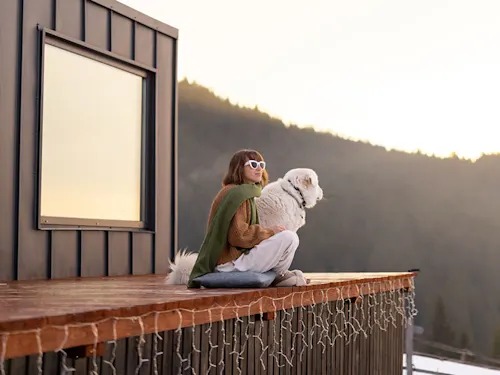
There is a total solar eclipse coming on August 12, 2026, and with it, the reliable seasonal worry: will it terrify the dog? You will see the usual advice about calming anxious pets and shielding their eyes. Most of it overstates the danger.
Here is the more interesting finding, and it comes from watching animals during the last big eclipse: when pets got anxious, the eclipse usually wasn’t the cause. The excited, nervous, crowd of humans around them was.
A dog barely notices
To understand why your dog probably won’t care, think about how a dog experiences the world. Dogs don’t lead with their eyes the way we do. Smell and hearing run the show. An eclipse might register as the light dimming, but it carries none of the significance for a dog that it does for us, no cultural weight, no scientific awe, no sense that something cosmic is happening. A dog lives in the immediate present: the scent on a tree, the rustle of a squirrel. A darkening sky is just weather.
And crucially, dogs don’t try to look at the sun on an ordinary day, so they won’t on this one either. That is the whole basis for the reassurance that pets don’t need special eye protection. Astronomers who study exactly this point out that animals are, if anything, smarter than we are about not staring at the sun. There is no reason to reach for pet eclipse glasses, and no safe way to use them on an animal regardless.
Dogs and cats simply don’t gaze up at the sun, so there’s nothing to protect their eyes from during an eclipse. The eye-safety warnings are for the humans. If you’re wearing certified eclipse glasses to look up, your dog looking at you looking up is not at risk.
The real variable is the humans
So if the eclipse itself is a non-event for most pets, why do we keep hearing stories of spooked animals? This is where recent science reframed the whole question.
During the 2024 total eclipse, researchers observed zoo animals and expected another round of the odd behaviors, nocturnal activity, anxiety, restlessness, that earlier eclipses had produced. Some animals did notice something was off. But the anxiety was noticeably milder than in past events, and the researchers connected the difference to the crowds. Where the 2017 eclipse drew huge, keyed-up gatherings, the 2024 viewing crowds were calmer and better behaved, and the animals were calmer too. The conclusion was striking: a good share of the “eclipse anxiety” attributed to animals over the years may actually have been a response to excited, agitated people, not to the sky.
That flips the practical advice. The best thing you can do for your dog during the 2026 eclipse is manage your own energy. If you gasp, cheer, and crane upward in alarm, your dog reads your body language, not the sun, and may decide something is wrong. Dogs take their cues from us. Stay relaxed, and there is little for them to catch.
Keep them safe anyway
None of this means ignore your pet. A few sensible steps cover the small real risks, most of which have nothing to do with the eclipse and everything to do with the disruption around it.
Stick to the routine. Keep feeding, bathroom breaks, and playtime on their normal schedule. Predictability is calming.
Check ID and microchip. Make sure your dog has an updated collar tag and a registered microchip. Crowds, unfamiliar settings, and general commotion raise the odds of a pet slipping away, so this is really about the event, not the eclipse.
Offer comfort, not fuss. If your dog does seem uneasy, give them a comfortable spot, a familiar toy, a few calm pets, a treat as a gentle distraction. Reassurance in a normal tone beats anxious coddling.
Consider staying in. Even a dog who is entirely unbothered by the eclipse might be better off indoors, away from the crowds and the general strangeness of humans behaving out of the ordinary.
What’s new for 2026
The August 12, 2026 eclipse won’t bring totality to the contiguous United States, the path of totality crosses Greenland, Iceland, northern Russia, the Atlantic, Spain, and a small corner of Portugal. But a broad swath of the northern U.S. will see a partial eclipse, from Alaska across to New England and the mid-Atlantic, including states like New York, Michigan, Minnesota, Maine, Pennsylvania, and the Dakotas. In the northern contiguous states, the partial eclipse begins around midday and lingers into the afternoon farther east.
For pets, a partial eclipse is even less of an event than a total one, the light barely dims. So the same advice applies, only more so: your dog will almost certainly not care, the eye-safety rules are for you (use viewers that meet the ISO 12312-2 standard), and the main thing worth watching is whether the humans stay calm. If you want to turn it into something, the 2024 research grew partly out of citizen-science projects inviting people to log animal behavior during eclipses; watching how your own dog responds, or doesn’t, is a small, fun way to be part of that.
References
- NASA Science. “Total Solar Eclipse on August 12, 2026.” https://science.nasa.gov/eclipses/future-eclipses/total-solar-eclipse-on-august-12-2026/
- Hartstone-Rose, A., et al. “Total Eclipse of the Zoo: Animal Behavior during a Total Solar Eclipse.” Animals, vol. 10, no. 4, 2020, 587. https://doi.org/10.3390/ani10040587
- American Astronomical Society. “Eye Safety During a Total Solar Eclipse.” https://eclipse.aas.org/eye-safety
Common questions
Will my dog be scared during a solar eclipse?
Most dogs barely register it. They may notice the light dimming, but an eclipse holds no meaning or threat in a dog's world. When pets do seem anxious, it's often a response to excited or nervous humans nearby rather than the eclipse itself.
When is the next solar eclipse?
A total solar eclipse occurs on August 12, 2026, crossing Greenland, Iceland, Spain, and a corner of Portugal. Parts of the northern United States, from Alaska across to New England and the mid-Atlantic, will see a partial eclipse.
Not a substitute for your vet. Our guidance is educational. For urgent symptoms, contact a vet or emergency clinic right away. Editorial standards
Dr. Nair is a veterinarian focused on diet and feeding. She covers everyday nutrition, treats, and the many "can they eat this?" questions owners ask, grounding each answer in what is actually safe and sensible for dogs and cats.
Meet our experts ↗Keep reading
 Health & WellnessYour Dog Isn't Scared of Your Relatives. He's Scared of the Schedule.Dr. Nina Kohl · 8 min
 FoodThe Christmas Food That Sends Dogs to the ER Isn't Chocolate. It's the Gravy.Dr. Priya Nair · 8 min
 LivingDon't Teach Your Dog to Swim. Teach Them to Get Out.Dr. Priya Nair · 8 min
 First DaysIf Your Dog Needed Emergency Surgery Tomorrow, Could Your Sitter Say Yes?Claire Sutton · 7 min
 LivingTied Up for a Few Minutes, Gone in Seconds: A Chicago Dog's Close CallJames Okafor · 5 min
 LivingYour Dog Doesn't Hate Fall. It Hates Your Calendar.Dr. Mara Chen · 8 min