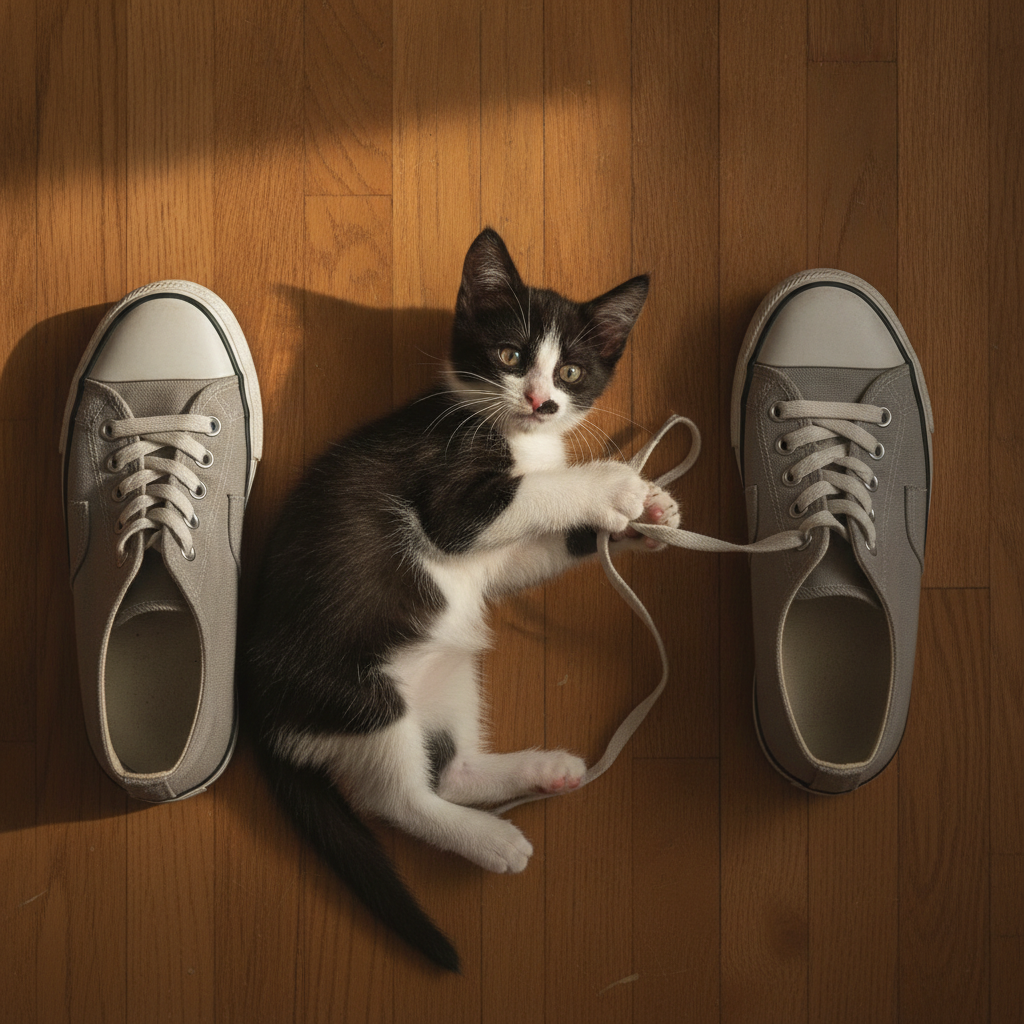
If you’ve ever come home to find your cat curled up on your sneakers, rolling beside your boots, or gnawing thoughtfully on a lace, you may have filed it under “unexplained cat weirdness” and moved on. It’s stranger than a lot of cat quirks, and the grosser versions, the chewing, the occasional puddle in a loafer, can feel almost personal. Here’s the reframe that makes all of it click: to your cat, your shoes aren’t random. They’re the most information-dense object you own, and nearly everything your cat does to them is an attempt to read you, or reach you.
Your shoes are a scent document
Cats experience the world primarily through smell, and by that measure your shoes are a masterpiece. They carry your scent, but concentrated, stronger and more pungent than the rest of you, because they spend all day pressed against the part of you that sweats the most. For a cat, that’s not off-putting. It’s you, in high definition.
Then there’s the second layer. Shoes are one of the few things that constantly leave the house and come back carrying the smell of the outside world, soil, grass, pavement, wherever you’ve been. So a single shoe delivers two stories at once: the inside smells intensely of you, and the outside smells of everywhere you go. A cat investigating your shoes is essentially catching up on your whole day. Owners often notice their cat gets extra interested in a pair right after a walk in the park, and that’s exactly why.
As for napping on them, the logic is almost mundane. A cat hanging around something long enough eventually gets sleepy and just sleeps where it is, and a soft, worn-in shoe can be molded to fit a curled body. Cats often gravitate to the pairs you wear least, the broken-in sneakers you can’t bear to toss, precisely because those are the most moldable and the most saturated with familiar smell.
When “obsession” turns into peeing
Not every shoe behavior is cute, and peeing in them is the one that tends to test a relationship. The instinct is to read it as punishment, especially if it happens after you’ve been away or shaken up the routine. That’s almost never what’s going on.
Cats sometimes engage in what’s called associative marking, depositing their scent on belongings that leave and re-enter the house, shoes, bedding, clothing, as a way to mix their smell with yours and, counterintuitive as it sounds, improve and strengthen the bond between you. It reads as an insult to us because we don’t like it, but that’s a human interpretation laid over a very different feline motive.
This is the key thing to hold onto about cats generally: they have a limited toolkit for communicating with us. Just because a behavior annoys us, peeing on a shoe, chewing our things, nipping our toes through the blanket, doesn’t mean annoyance was the point. A cat’s brain doesn’t really do spite. It’s more accurate, and frankly kinder, to read these acts as clumsy bids for connection than as revenge.
That said, litter box lapses and marking can also be a stress signal or a medical red flag. If your cat is regularly peeing outside the box or on your things, don’t just wait it out, a vet visit to rule out a urinary issue is the responsible next step.
The lace-chewing question, and when it’s a flag
Plenty of cats go after laces, pouncing when you tie them or when they trail along the floor, and worrying at the plastic tips. A lot of that is straightforward play, a lace moves like prey. Some of it may be about texture or taste; leather is animal skin, after all, which can be appealing to a cat.
But chewing on non-food objects is also worth watching, because it can shade into pica, the eating of non-nutritive materials like plastic. Pica occasionally points to an underlying nutritional deficiency, and in some cases it’s a behavioral issue that may warrant veterinary help, sometimes including medication. It’s not usually an emergency, but a cat that’s genuinely eating bits of shoe, not just batting the laces around, is a cat to mention to your vet.
More often, though, persistent chewing is a cat asking for something it isn’t getting. Enrichment is frequently the missing piece. Cats who chew and pester tend to settle noticeably once they get regular, real play, a daily session with a wand toy that lets them stalk and pounce can drain the restless energy that was going into your footwear.
“When a cat is fixated on your shoes, my first question isn’t ‘how do I stop it,’ it’s ‘what’s the cat getting out of it,’” says Sasha Ford. “Nine times out of ten it’s scent and boredom, and the fix is more play, not more scolding. But if a cat is actually eating shoe, not just wrestling the laces, that’s the version I’d have a vet look at, because chewing non-food things can be the body flagging something.”
How to live with it
If the shoe fixation has crossed from charming into maddening, there are really two clean solutions.
The first is management: put your shoes somewhere your cat genuinely cannot get to them. Lock them away if that’s what it takes.
The second is a trade. Set aside one pair, ideally a favorite of your cat’s, as a permanent offering. Give it one last good, sweaty wear, then hand it over for good. Once a cat has a designated pair to sniff, sleep on, and attack whenever it likes, it will often leave the rest of your collection in peace. The cost of that peace is usually a light dusting of fur on every shoe that comes through the door, which, weighed against the alternative, is a pretty small tax on being adored.
The takeaway
Your cat isn’t being strange about your shoes so much as being extremely on-brand: following the strongest, most interesting scent in the house, which happens to be you plus the whole outdoors. The napping is comfort, the marking is a garbled attempt to bond, and the chewing is usually play, occasionally a health flag worth a vet’s eye. See it that way and the “feline foot fixation” stops being a mystery and starts being one more way your cat keeps tabs on the person it likes best.
References
- International Cat Care. “Why Does My Cat… Scent and Communication.” https://icatcare.org/advice/
- Cornell Feline Health Center. “Feline Behavior Problems: House Soiling.” Cornell University College of Veterinary Medicine. https://www.vet.cornell.edu/departments-centers-and-institutes/cornell-feline-health-center
- ASPCA. “Common Cat Behavior Issues: Pica.” https://www.aspca.org/pet-care/cat-care/common-cat-behavior-issues