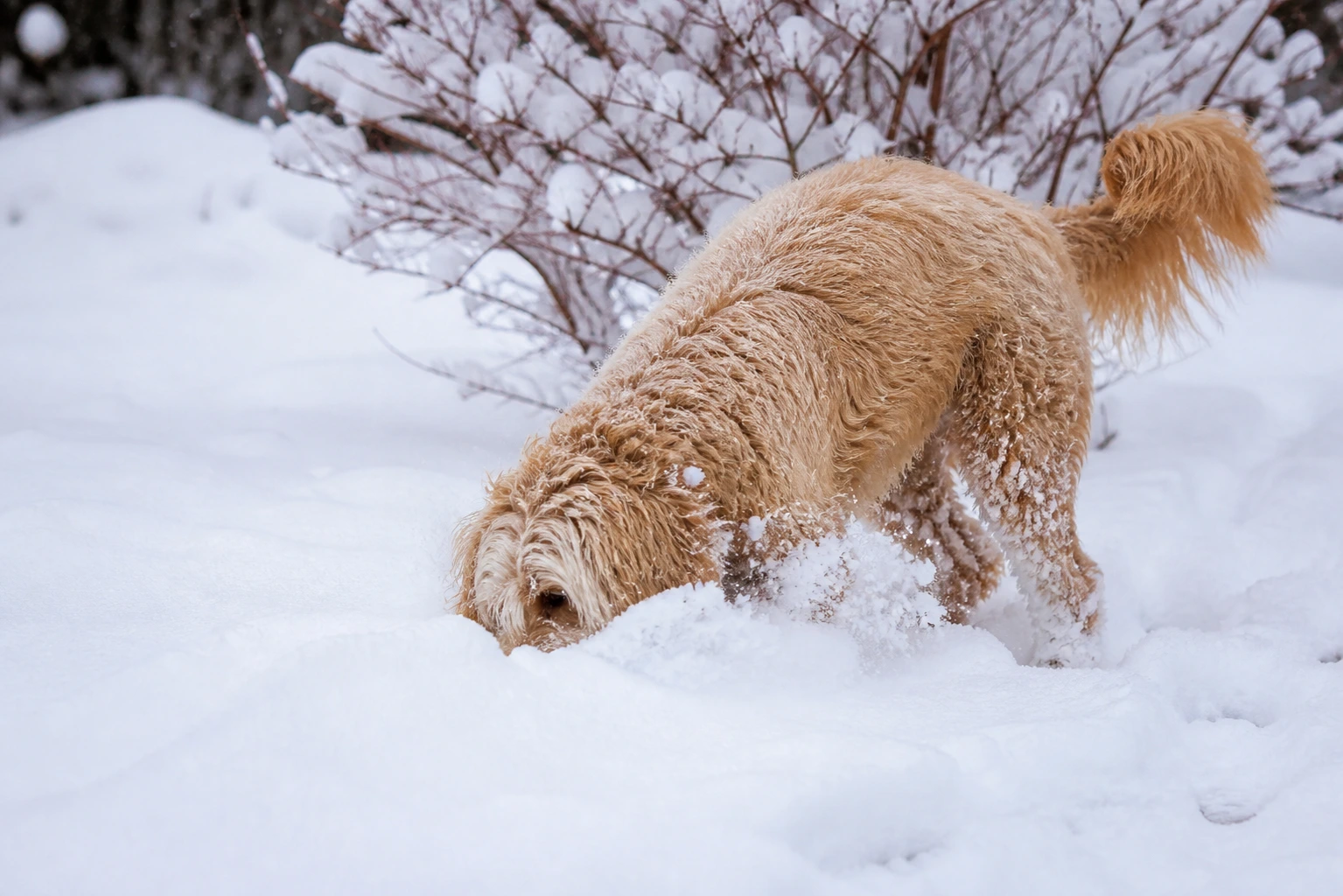
Anyone who has shoveled a serious snowfall knows the split-screen scene on a winter street. The people trudge past looking weary and resigned, faces in their phones or lost in the middle distance. The dogs, meanwhile, are having the time of their lives, gleeful and energetic, noses plunged straight into the snow. Even people who love winter find three feet of it exhausting. Dogs seem to take the opposite view: more snow is simply more to explore.
If your dog is one of those who will not stop sniffing the snow, dragging out every walk to inhale another drift, they are in excellent company. It is extremely common. And it is not stubbornness or a failure of recall. There is a real reason snow turns an ordinary dog into a scent-obsessed detective, and once you understand it, you may find yourself a lot more patient standing in the cold. The short version: snow is a scent time capsule, and your dog knows it.
What snow does to smells
To grasp why snow is so intoxicating, it helps to ask not what is in it, but what snow does to what is already there. Start with the basic science: snow is frozen water, and it is wet. Moisture holds onto smells and keeps them from dissipating into the air. So instead of scents scattering on the breeze the way they would on a dry day, snow locks them in place and preserves them. That is the whole lesson, really. Dogs sniff to experience the world, and snow is a landscape absolutely stuffed with preserved things to experience.
We already know dogs love sniffing grass for the buffet of smells it holds. Snow amplifies that. Anything a dog can detect tends to linger longer and hit stronger in snow than in grass. Even better, tracks and trails stay intact. If a squirrel, deer, cat, or another dog crossed the yard and fresh snow fell over the path, that trail survives far longer than it otherwise would, and a dog can follow it with a clarity they rarely get. The delight of finding multiple scent trails crisscrossing above and below the surface, all over their usual territory, is exactly what fuels the snow-sniffing obsession.
Why you should let them do it
It is tempting, when you are cold and dreaming of hot cocoa by the fire, to hurry your dog along. Try to resist. Dogs need opportunities to engage in their natural behaviors; it is genuinely important to their wellbeing. When we build in situations that let dogs be dogs, they are happier and live fuller lives. Sniffing is one of the great canine joys, and it delivers something exercise alone cannot.
That last point matters most in winter. Dogs need daily stimulation, and cold weather often shrinks the walks and outings that provide it, leaving many dogs more cooped up than usual. This is precisely when letting your dog sniff the snow for what feels like an eternity pays off. The mental work of sniffing through most of a walk does far more to leave a dog content and ready to rest than physical exercise does. Nose-led outings, sometimes called “sniffaris,” are one of the best ways to do right by your dog, and snow supercharges them. So let them keep sniffing, even if you spend the whole walk counting down the days to beach weather.
When it is time to head inside
Because your dog would happily sniff the snow indefinitely, you have to be the one who calls it. Two situations mean it is time to be the grown-up and go in.
Your dog is getting cold or uncomfortable. Watch for shivering, snow collecting in icy balls in their fur, prancing as if they do not want their feet touching the snow anymore, actual limping, or any other sign they are struggling with the cold. Ideally you bring them in before it gets to that point, but if you notice any of these, the fun is over and it is time to warm up.
You need to go in. If you are cold, bored, or need to get back to work, bring your dog in with you rather than leaving them out alone. It is not good to leave a dog outside on their own to contend with the cold and with winter hazards like de-icing salt, antifreeze, and falling ice. If you are lucky enough to have a fenced yard, you may be able to give them a bit longer, but only with constant supervision, watching for any sign of discomfort. In harsh conditions it is far better to be out there with them than to leave them to it. Some cold-loving dogs are genuinely built for it and are exceptions, but supervision is still the rule.
It is not only about the smell
Here is a wrinkle worth knowing. When your dog dives headfirst into a snowbank or plows their nose through a drift, that is not always about sniffing at all. Many dogs love the other sensory sides of snow, the cold, the fluffy strange texture, the sheer novelty of it. They seek out that feeling, which is why they also roll in it and toss it around. It is fun and interesting and unlike anything they meet on an ordinary day.
There is a scientific thread here. Unlike a lot of wild animals, domestic dogs are neophilic, meaning they are drawn to new things. This is not universal, but most behaviorally healthy, well-socialized dogs like the unfamiliar, and snow fits the bill perfectly. Even a dog who saw snow last winter meets it fresh this year, since it is new again to any dog who does not live somewhere permanently frozen. Exploring snow is simply fun, and because dogs explore the world through their noses, that combination so reliably produces a snow-sniffing obsession that it is well worth indulging.
What newer research adds
The case for letting your dog sniff has only gotten stronger. A growing body of research on scent enrichment finds that nose work measurably improves canine welfare and can leave dogs calmer and more optimistic, and a widely cited rule of thumb among behavior professionals is that roughly fifteen minutes of dedicated sniffing can tire a dog out as much as a much longer walk. Studies on canine neophilia also confirm that dogs show a real, if sometimes short-lived, pull toward novel stimuli, which helps explain why fresh snow, new every time it falls, is such a reliable source of joy. Behaviorists now actively encourage owners to lean into seasonal enrichment, letting dogs explore snow in winter the way they explore leaves in fall or grass in summer, because each season offers its own textures and scents. In other words, the science has caught up to what your snow-obsessed dog has been telling you all along: standing in the cold while they sniff is not wasted time. It is some of the best mental exercise they will get all season.
References
- Duranton, Charlotte, and Alexandra Horowitz. “Let Me Sniff! Nosework Induces Positive Judgment Bias in Pet Dogs.” Applied Animal Behaviour Science, vol. 211, 2019, pp. 61–66, www.sciencedirect.com/science/article/pii/S0168159118303372.
- Kaulfuß, Peter, and Daniel S. Mills. “Neophilia in Domestic Dogs (Canis familiaris) and Its Implication for Studies of Dog Cognition.” Animal Cognition, vol. 11, no. 3, 2008, pp. 553–556, pubmed.ncbi.nlm.nih.gov/18183436.