Most people know the rule. Xylitol is poison to dogs, and the sugar-free gum in your bag is the classic culprit. That part has been drilled into pet owners for a decade.
The rule is also not much use anymore, because the word “xylitol” may never appear on the package. It shows up as birch sugar. It shows up as birchbark extract, d-xylitol, xylite, anhydroxylitol, or xylitylglucoside. Very often it is folded into a single line that says nothing more specific than “sugar alcohols.” A careful owner can read an entire label, see no xylitol, and hand over something that could put their dog on an IV drip by dinner.
So the useful version of this article is not “xylitol is bad.” It is: here is what the word looks like when it is in disguise, here is the amount that actually matters for your dog’s weight, and here is what the first hour looks like.
The label is the trap
Xylitol is a sugar alcohol. On a package it can be listed by its chemical relatives or by the family name, and none of those spellings look alarming to a person skimming an ingredient panel in a grocery aisle.
The aliases to memorize:
- Birch sugar
- Birchbark extract
- d-Xylitol
- Xylite
- 1,4-anhydro-d-xylitol
- Anhydroxylitol
- Xylitylglucoside
- “Sugar alcohol,” as a catch-all
Placement is the second half of the trap. Xylitol frequently lives under “Other ingredients” or “Inactive ingredients,” the small print people skip because it sounds like packaging filler. In supplements it can appear inside the Supplement Facts panel itself. No product in the United States is currently required to carry a warning that its sweetener can kill a dog.
The practical rule that follows from all of this is short. If a product is sugar-free and you cannot positively rule xylitol out, store it as though it contains xylitol.
“Owners tell me they read the label, and they did read it. They just read it looking for one word,” says Dr. Amara Solis. “Birch sugar sounds like something you’d find at a farmers market. It is the same molecule, and it will do the same thing to a dog.”
The dose math, by your dog’s actual weight
This is the part almost no one gets told, and it is the difference between panic and a plan.
Two thresholds matter. At roughly 100 mg of xylitol per kilogram of body weight (about 45 mg per pound), dogs start crashing their blood sugar. At roughly 500 mg/kg, the liver is at risk, and liver injury can be fatal even when the blood sugar crisis is handled.
A single piece of sugar-free gum typically carries somewhere between about 0.3 and 1 gram of xylitol, depending on the brand. Do the arithmetic and the picture is ugly:
| Dog’s weight | Hypoglycemia risk starts around | Liver risk starts around |
|---|---|---|
| 10 lb (4.5 kg) | ~0.45 g (roughly one piece of gum) | ~2.3 g (a few pieces) |
| 20 lb (9 kg) | ~0.9 g | ~4.5 g |
| 40 lb (18 kg) | ~1.8 g | ~9 g |
| 70 lb (32 kg) | ~3.2 g | ~16 g |
Which is why the old line holds up: one stick of gum really can kill a 20-pound dog. It is also why a Labrador who eats a whole pack is not “a big dog, he’ll be fine.” He is a big dog who ate a very large dose.
You will not always be able to find the milligrams on the package. That is fine. Bring the package to the vet anyway. The ingredient order alone tells a toxicologist a great deal, and a rough overestimate beats a guess.
What xylitol actually does inside a dog
In people, xylitol barely moves insulin. In dogs, the pancreas reads it as a huge sugar load and dumps three to seven times the normal amount of insulin into the bloodstream.
The insulin goes hunting for sugar that is not there. Blood glucose falls, sometimes within 30 to 60 minutes of the dog eating. That is the weakness, the wobbling, the tremors, and the seizures. Untreated, it is how dogs die from a piece of gum.
The second injury is slower and separate. At higher doses, xylitol damages liver tissue. Liver enzymes climb over the next 12 to 48 hours, and liver failure can follow in 24 to 48 hours. A dog can be stabilized on dextrose, look bright and happy overnight, and still be in liver trouble the following day. This is why “he ate it and seemed fine” is not an outcome, it is a checkpoint.
The signs, and the honest timeline
Early on, watch for:
- Weakness
- Vomiting
- Lethargy
- Loss of coordination, a drunk-looking walk
- Rapid breathing
- Tremors
- Seizures
- Collapse
Here is the caveat that matters more than the list: the absence of signs is not reassurance. Hypoglycemia can be delayed with some formulations, and liver damage announces itself on its own schedule. Waiting to see whether symptoms appear is the single most common way this goes badly.
It stopped being a gum problem years ago
Sugar-free gum is still the number-one source of xylitol calls. But xylitol has migrated into the parts of the house nobody thinks to childproof.
Products that may contain it:
- Sugar-free gum and mints
- Cookies, brownies, and other baked goods
- Some specialty peanut butters
- Sugar-free candy and chocolate
- Flavored waters and energy bars
- Ketchup
- Ice cream and sugar-free desserts
- Cough drops and dry-mouth lozenges
- Toothpaste and mouthwash
- Gummy vitamins and melatonin sleep gummies
- Some over-the-counter nasal sprays
- Laxatives, digestive aids, and allergy medicines
- Deodorant, hair gel, and cosmetics
- Baby wipes
Two of those deserve special alarm. Sleep and vitamin gummies are sweet, chewy, kept on a nightstand or in an unlocked kitchen drawer, and a dog can eat the whole bottle in under a minute. Specialty peanut butter is the cruelest one, because peanut butter is what we put in a Kong, smear on a lick mat, and bake into homemade treats. No major national brand has been found to use xylitol, but small-batch and “keto” jars are a real category and the only way to know is to read the jar. Every jar. Every time you buy a new one.
And a note about the survey number that gets quoted constantly: a 2015 Preventive Vet survey found more than half of respondents did not know what xylitol was or that it was dangerous to dogs. It is a decade old, and the ingredient has spread into far more products since.
The first hour
If your dog ate something with xylitol, the sequence is simple and there is no room in it for improvisation.
- Take the package. Wrapper, bottle, box, ingredient panel, all of it.
- Call first, drive second. Your vet, an emergency hospital, or an animal poison control line. Give them your dog’s weight, what was eaten, how much, and when.
- Do not induce vomiting on your own. In a dog whose blood sugar is already dropping, it can make things worse.
- Go in even if your dog seems fine. See above. Fine is not an outcome.
- Expect a stay. IV dextrose, repeat glucose checks, and liver bloodwork run over 24 to 72 hours. A quick discharge is not the win it feels like.
“Time is the only variable you control,” says Dr. Lena Park. “A dog who arrives before the blood sugar bottoms out usually walks home. A dog who arrives after the first seizure is a much harder case, and it is almost never because the owner didn’t care. It’s because they waited to see what happened.”
Prevention, without turning your house into a vault
- Read the “Other” and “Inactive” ingredient lines, not just the main panel, and read the Supplement Facts box on anything you swallow.
- Treat every sugar-free, low-calorie, keto, or artificially sweetened product as a controlled substance in a house with a dog.
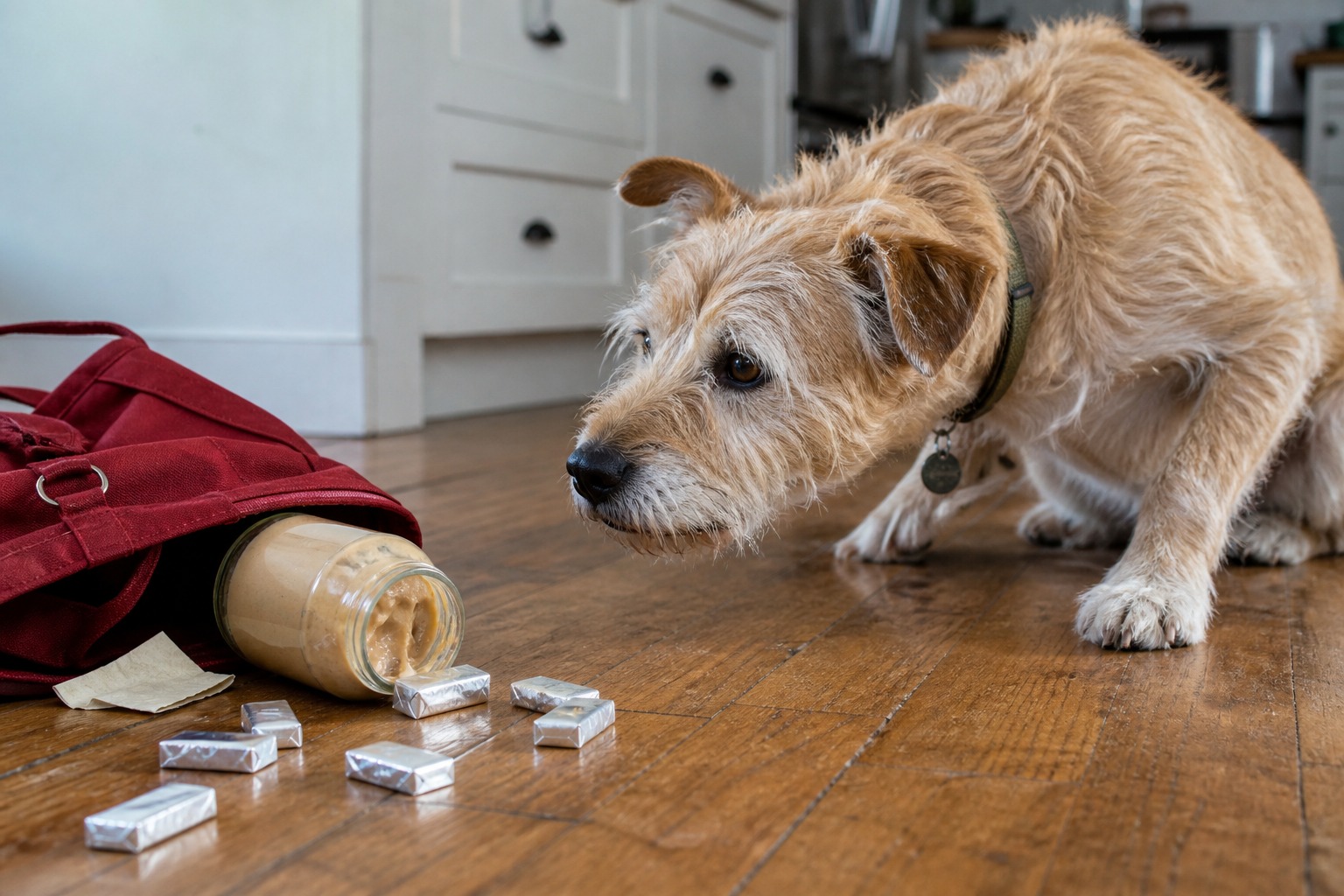
- Get gum, mints, and gummies out of handbags, backpacks, coat pockets, and nightstands. A bag on the floor is a self-serve counter.
- Never use human toothpaste on your dog’s teeth. Buy a dog-specific enzymatic paste.
- Keep one jar of dog-safe peanut butter, check it when you buy it, and do not swap in whatever’s in the pantry.
- Save your nearest emergency vet’s number and an animal poison control number in your phone now, not while your dog is shaking.
What’s new since this was written
The problem has gotten worse, not better. Pet Poison Helpline reports that xylitol cases are running roughly 75% higher than they were in 2020, and xylitol was the fourth-most-common dog poisoning call the helpline took in both 2024 and 2025. The reason is not that owners got careless. It is that the ingredient kept moving into new aisles, especially supplements and sleep aids.
There has also been a push to fix the label itself. The Paws Off Act, introduced in Congress in 2025, would require products containing xylitol to disclose it plainly, so a shopper does not have to know six chemical synonyms to keep a dog alive. It has not become law. Until it does, the reading is on you.
One piece of good news worth knowing: erythritol, the other sugar alcohol you will see everywhere, does not trigger the same insulin dump in dogs. The catch is that both hide under the same “sugar alcohols” heading, so the heading still tells you nothing. You have to find the actual name.
References
- Xylitol Toxicosis in Dogs — Merck Veterinary Manual
- Paws Off Xylitol: Protecting Your Pet From This Toxic Sweetener — U.S. Food and Drug Administration
- Xylitol Poisoning in Dogs — VCA Animal Hospitals
- Xylitol toxicities — Cornell University Riney Canine Health Center
- Xylitol Poisoning in Dogs — UC Davis School of Veterinary Medicine
- Updated Safety Warning on Xylitol: How to Protect Your Pets — ASPCA
- Xylitol labeling legislation would promote pet safety — American Veterinary Medical Association
- Xylitol Products List — Preventive Vet