


The Hot Car Isn't What Gets Most Dogs. The Walk Is.
The biggest summer danger to your dog isn't a parked car. It's the ordinary exercise you'd give them on any other day. Ten things dogs actually struggle with in summer, ranked by what the data says will hurt them.

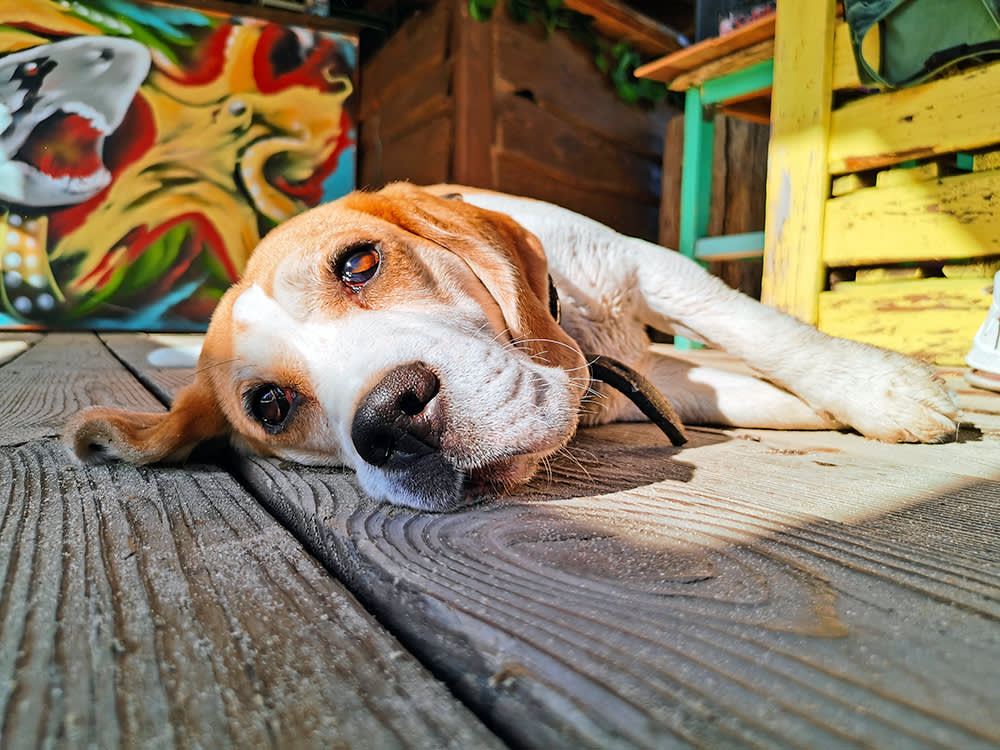
Every summer, the same photo goes around: a dog in a parked car, a warning about how fast the inside temperature climbs. The warning is true. It is also, statistically, not the thing that is going to hurt your dog.
When researchers at the Royal Veterinary College went through the records of more than 900,000 UK dogs and pulled out every case of heat-related illness, they found that vehicles accounted for 5.2 percent of them. Exercise accounted for 74.2 percent. Not a parked car in a supermarket lot. A walk. A game of fetch. A hike you have done a hundred times.
Roughly one in seven of those dogs died.
So this is a list of what dogs genuinely struggle with in summer, but it is ordered honestly, with the thing most likely to kill them at the top rather than the thing most likely to go viral.
1. The exercise you would give them on any other day
This is the whole ballgame. Dogs do not sweat the way we do. They shed heat by panting, and when the air is hot and humid, panting stops keeping up. Once core temperature climbs past a certain point, the damage cascades: gut, kidneys, clotting, brain.
The risk factors in that RVC data are worth memorizing, because they describe an enormous number of ordinary dogs. Flat-faced breeds sit at the top, as expected. But so do Chow Chows, Greyhounds, English Springer Spaniels, Cavalier King Charles Spaniels, and Staffordshire Bull Terriers. Dogs over two years old are at higher risk than puppies. And dogs carrying more weight than the average for their breed and sex are at higher risk than lean ones, which is a quiet, uncomfortable finding for a lot of households.
What to do: move exercise to the coolest hours, early morning and late evening, and mean it. Cut the duration on hot days, not just the pace. Carry water and a collapsible bowl. Learn the early signs, which are not dramatic: heavy panting that does not settle, bright red gums, thick drool, a wobble in the back end, a dog who lags behind or lies down and will not get up. If you see those, stop everything, get them into shade, and start cooling them with cool (not ice-cold) water while you call the vet. Do not wait to see if it passes.
2. Hot pavement
The classic test still works: press the back of your hand flat on the ground and hold it. If you cannot keep it there for a few seconds, your dog cannot walk on it. Asphalt holds heat long after the air has cooled, so a 7 p.m. sidewalk can still burn paw pads.
What to do: walk on grass, walk in shade, or walk later. Booties help if your dog will tolerate them, and paw balm helps a pad that is already sore. If your dog is small enough and the ground is scorching, pick them up.
3. Heat inside the house
The car gets all the attention, but the RVC data put environmental heat, meaning hot buildings, conservatories, and dogs trapped under blankets or in unventilated rooms, ahead of vehicles as a cause. A house with no air conditioning on a still 95-degree day is not a safe default.
What to do: leave the coolest room of the house open and accessible, with water in more than one place. Tile and bathroom floors are your friend. If your dog burrows under blankets, check on them.
4. The actual sun
Dogs get sunburned, and dogs get skin cancer. Light-coated dogs, pink noses, thin coats, and hairless breeds are the most exposed, and the burn shows up on ears, nose, and belly.
What to do: use a sunscreen made for dogs. Do not use a human formula containing zinc oxide, which is toxic if they lick it off, and they will lick it off. Ask your vet which product they recommend rather than gambling.
5. Water they did not ask to be in
Plenty of dogs have no interest in swimming, and that is a fine trait to have. Forcing a nervous dog into a lake to “get them used to it” is how you build a dog who panics near water.
The dogs who do love water carry their own risks. Drinking sea water can cause salt toxicity. Warm freshwater lakes can bloom toxic blue-green algae, which can kill within hours.
What to do: test the water question with a cheap kiddie pool in the yard first. If your dog steps one paw in and looks miserable, you have your answer, and you have an adorable landlubber. At the beach, bring fresh water so they are not tempted to drink the ocean. At a lake, look for scum, foam, or a paint-like slick on the surface, and if you see it, do not let them in, do not let them drink, and do not let them lick their coat afterward.
6. Sand
Less dangerous, deeply annoying. It sticks in fur, wedges into paw pads, and grinds. That frantic full-body shake and the hours of paw-licking after a beach day are your dog telling you about it. Swallowed sand, in quantity, can cause a genuine intestinal blockage.
What to do: rinse them properly before you leave, paws included. Do not let them dig-and-eat at a wet tideline for an hour.
7. Fireworks
Not surprising, still worth planning around. Loud, unpredictable, and repeated over multiple nights, fireworks panic even dogs who are otherwise unshakeable, and dogs bolt on the Fourth of July more than any other night of the year.
What to do: build a den indoors: interior room, blackout curtains, white noise or a fan, something long-lasting to lick. Check that the microchip details are current before the holiday, not after. If your dog has a real noise phobia, talk to your vet in June, not on July 3rd. There are effective medications, and they need to be trialed in advance.
8. Bugs
Mosquitoes transmit heartworm. Fleas and ticks transmit a whole catalogue of disease, and the bites themselves are itchy enough to drive a dog into scratching hard enough to open a skin infection.
What to do: year-round parasite prevention, not seasonal. Check for ticks after every walk in long grass, and know how to remove one properly. Screens on the windows your dog naps under are a small, real upgrade.
9. Fans, AC units, and other things that turned on by themselves
This one is comedy from the outside and not funny from the dog’s side. A ceiling fan is a large, silent object that was stationary for a year and is now spinning above their head. Some dogs go into full crouch-and-creep mode. New AC units make new noises at unpredictable intervals.
What to do: pair the scary appliance with something good. Turn it on at low speed, feed them near it, turn it off. Repeat until it is boring. Do not drag them under it to prove it is safe.
10. Crowds, festivals, and hugs from strangers
Music in the summer means dense crowds, thumping bass, and food on the ground your dog should not have. Grapes and raisins can cause kidney failure. Stone fruit is a double problem: the flesh is usually fine, the pit is a choking and obstruction risk and contains cyanide compounds.
And hugs, in general, are a human idea. A hot, overstimulated dog often wants less contact, not more, and a squeeze from a stranger at a block party is the opposite of comfort.
What to do: most dogs should stay home from the festival. If yours comes, a bright “do not pet” harness or leash sleeve does real work, both for their space and for the hot dog someone is about to feed them.
“The dogs I lose to heat aren’t the ones locked in cars, they’re the ones who went on their normal walk on an abnormal day,” says Dr. Ravi Mehta. “If it’s hot, the safest walk is the one you didn’t take. Nobody’s dog has ever been harmed by a skipped afternoon.”
What newer research adds
The picture has sharpened since that first big study, and not in a reassuring direction. A follow-up analysis of UK emergency caseloads found heat-related illness presenting to out-of-hours clinics in numbers that track with hotter summers, and the same exertional pattern kept showing up: dogs who collapsed during ordinary activity, not dogs abandoned in cars.
The other finding worth carrying with you is about first aid. The old advice to avoid cooling a dog too aggressively, for fear of causing shock, has not held up. Current veterinary guidance is to start cooling immediately and on the spot, with cool water poured over the dog and air moving across them, before and during transport to the clinic. Cooling early is associated with better survival. Waiting until you arrive is not neutral. It costs minutes that matter.
The bottom line
Your dog does not need to be rescued from a parked car this summer. They need you to look at the temperature, look at their face, and decide that today’s walk is short, shaded, and at 6 a.m. That is a boring decision. It is also the one that keeps them alive.
References
- Hall, E. J., Carter, A. J., & O’Neill, D. G. (2020). Incidence and risk factors for heat-related illness (heatstroke) in UK dogs under primary veterinary care in 2016. Scientific Reports, 10, 9128.
- Hall, E. J., Carter, A. J., & O’Neill, D. G. (2020). Dogs Don’t Die Just in Hot Cars: Exertional Heat-Related Illness (Heatstroke) Is a Greater Threat to UK Dogs. Animals, 10(8), 1324.
- Hall, E. J., et al. (2022). Risk Factors for Severe and Fatal Heat-Related Illness in UK Dogs: A VetCompass Study. Animals.
- Hall, E. J., et al. (2024). Epidemiology of heat-related illness in dogs under UK emergency veterinary care in 2022.
- Centers for Disease Control and Prevention. Harmful Algal Blooms and Pets. Accessed September 2026.
Not a substitute for your vet. Our guidance is educational. For urgent symptoms, contact a vet or emergency clinic right away. Editorial standards
Dr. Nair is a veterinarian focused on diet and feeding. She covers everyday nutrition, treats, and the many "can they eat this?" questions owners ask, grounding each answer in what is actually safe and sensible for dogs and cats.
Meet our experts ↗Keep reading
 LivingBefore You Bring Your Dog to the Cookout, Answer 8 Honest QuestionsTom Hadley · 9 min
 LivingA Wolfdog Is Not a Fluffier Husky. Nobody Can Tell You What You Actually Own.Dr. Ravi Mehta · 8 min
 TrainingBefore You Cut a Hole in Your House, Answer This: What Else Can Fit Through It?Marcus Webb · 8 min
 LivingYour City Dog Isn't 'Reactive.' The Sidewalk Is Screaming at Them.Dr. Mara Chen · 8 min
 LivingTo Your Dog, the Elevator Feels Like an Earthquake. That Changes How You Should Ride It.Dr. Amara Solis · 6 min
 LivingYour Dog Doesn't Need a Longer Walk. They Need a Backpack.Marcus Webb · 6 min