


The Fruit Is Never the Problem. It's the Pit, the Skin, and the Seasoning.
Spring produce is the cheapest, freshest treat aisle you'll ever shop, and almost nothing on it is dangerous on its own. What hurts dogs is the part you forget to cut off. Here are 9 in-season crops and the prep that makes them safe.

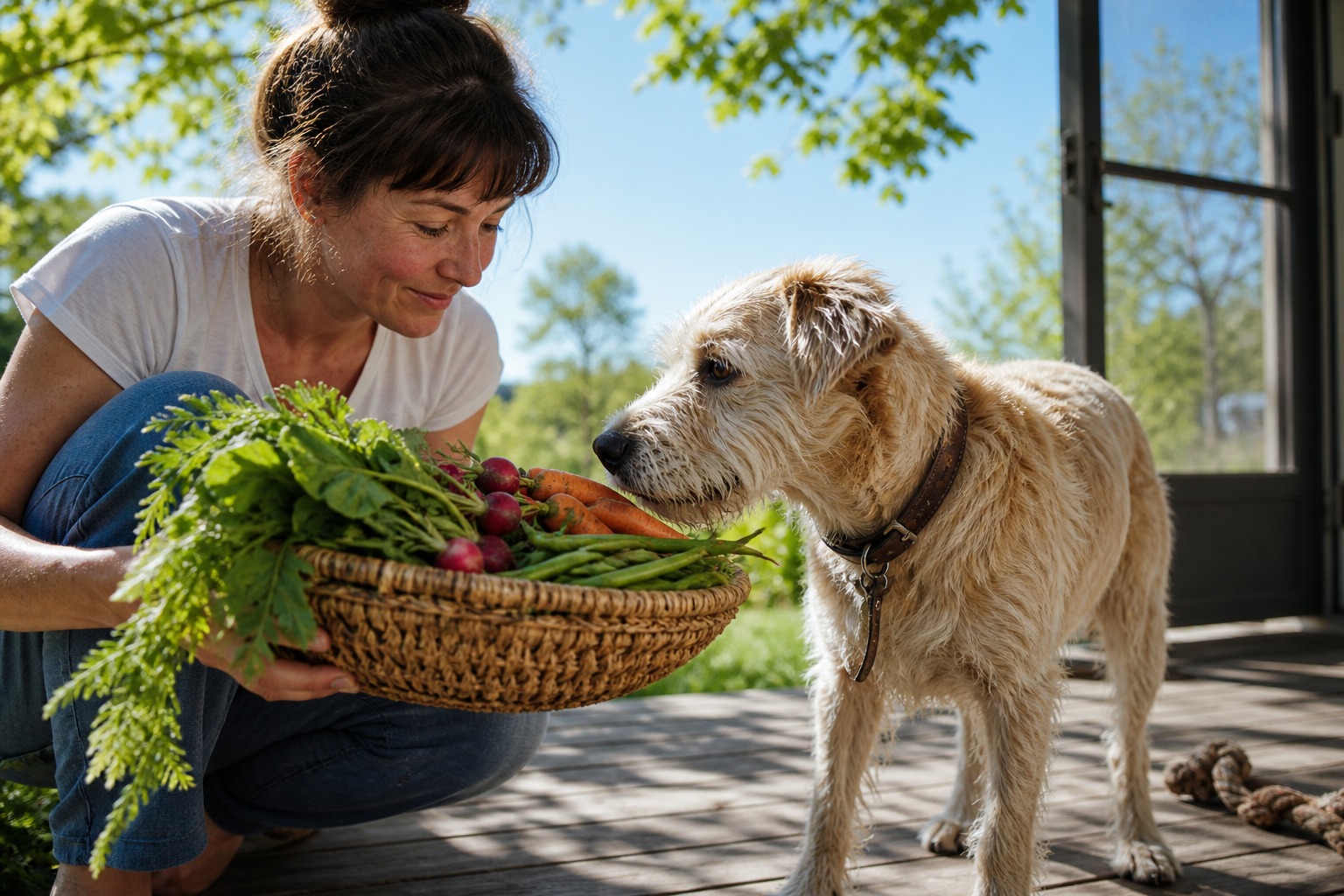
Walk through a farmers’ market in April and you are looking at the best treat aisle your dog will ever have access to. It is fresher than anything in a bag, it is cheaper by the handful, and most of it is genuinely good for a dog. Here is the part that surprises people: with almost every fruit and vegetable that gets called “toxic to dogs,” the flesh is fine. What sends dogs to the vet is the pit nobody removed, the green skin nobody checked, or the butter and salt somebody added to make it taste better for a human.
So this is less a list of scary foods to avoid than a short course in prep. Get the prep right and spring’s harvest becomes a rotating, low-calorie snack drawer. Get it wrong and even a healthy fruit turns into a problem.
Two rules cover most of it. First, treats of every kind, produce included, should stay under roughly 10 percent of your dog’s daily calories, with a complete and balanced food making up the rest. Second, introduce anything new in a small amount and watch for a day, because every dog’s gut is a little different.
People assume the danger with dog produce lives in the fruit, when it almost always lives in the packaging nature gave it, the stone, the skin, the seeds. Learn to prep, and the list of ‘forbidden’ foods gets a lot shorter than the internet makes it look.
One more trick worth stealing before the weather turns hot: puree a handful of dog-safe fruit and vegetables with water and freeze it in an ice tray. You get a summer treat that costs pennies and takes ten minutes.
Here are nine crops that come into season from spring into early summer, and exactly how to serve each one.
Carrots
Carrots turn up at the market not just in orange but in purple, red, yellow, and white, and their true season runs from late spring through fall. They are a low-calorie standby packed with vitamin A, which supports skin and coat health. A raw carrot also doubles as a rough dental tool, the hard surface helps scrape away soft plaque before it hardens into tartar, so it makes a lower-calorie swap for a packaged dental stick.
Prep note: carrots contain cellulose, which dogs barely digest, so steaming or pureeing unlocks more of the nutrition. If you feed them raw, cut them into size-appropriate sticks to cut the choking risk, and supervise.
Green beans
Crisp and in season from roughly May to October, green beans are one of the easiest wins here: low in calories and carrying protein, fiber, calcium, potassium, phosphorus, and vitamins A, C, and K. Serve them raw, steamed, blanched, or plain canned. If you buy canned or prepared, read the label and pick the version with no added salt or seasoning. A true green-bean allergy is uncommon, but if your dog develops itchy skin or hives after eating them, stop and check with your vet.
Snap and garden peas
Garden peas, snap peas, and snow peas all peak from spring into early summer, and they punch above their size: high in protein and fiber, sweet enough that most dogs treat them as candy, and low enough in calories to sprinkle over a meal as a topper. They also bring vitamins A, B, and K plus zinc and magnesium. Serve them fresh or steamed. If you use snap or snow peas, pop them out of the pod before serving.
Cucumber
In season from May through August, cucumber is a warm-weather crop that’s almost entirely water, which makes it a refreshing, crunchy, near-zero-calorie snack, and a solid option if your dog is on a weight-management plan. Slice or cube it small and feed it plain. Do not reach for pickles as a shortcut: the brine, salt, dill, and garlic that make a pickle a pickle are all things your dog does not need, and some pickle additives are genuinely harmful.
Asparagus
Asparagus comes into its short, glorious season in spring, and it is safe for dogs in moderation, with a useful load of fiber, folate, and vitamins A, C, and K. The catch is texture: raw asparagus is tough and stringy enough to be a choking risk and hard to digest, so trim off the woody ends and lightly steam it until it softens, then cut it into bite-sized pieces. No butter, no oil, no salt.
Strawberries
The first berries of the warm season, strawberries are safe, sweet, and rich in fiber and vitamin C, and they contain an enzyme called malic acid that can help brighten a dog’s teeth. Because they carry natural sugar, keep the portion small, especially for smaller or diabetic dogs. Wash them, cut off the leafy tops, and slice larger berries so they are easy to chew.
Cherries
Sweet cherries like Bing and Rainier are the first stone fruit of spring, and the flesh is a fine, juicy treat, so long as you respect the pit. Cherry pits are a choking and intestinal-blockage hazard, and they contain cyanide, which can be lethal. De-stem and pit every cherry before it goes anywhere near your dog, and never offer maraschino cherries, which are essentially candy. Cherries belong to the drupe family alongside apricots, nectarines, and peaches, so the same pit rule applies across all of them.
Apricots
Apricot season runs from May to July, and about 75 percent of the U.S. crop grows in California, with most of the rest from Washington. The fruit is a good sweet treat carrying potassium, beta-carotene, and fiber, but like every drupe, the stem, leaves, and pit contain cyanide and have to come out first. Wash the apricot, remove the pit and any greenery, and slice the flesh into bite-sized pieces. Feed in moderation, because too much can loosen a dog’s stool and send them asking for extra trips outside.
Potatoes
Spring brings the long white and baby potato varieties, which carry vitamin C, vitamin B6, iron, and magnesium. Potatoes are the one crop here that is genuinely unsafe raw: they belong to the nightshade family and contain solanine, a compound concentrated in green skin. Check tubers for greening before you buy, then scrub and thoroughly boil or bake them with no seasoning, no oil, and definitely no onion or garlic, both of which are toxic to dogs.
What newer research adds
You may have seen potatoes, peas, and lentils named in scary headlines about heart disease in dogs. That worry comes from the FDA’s long-running look at a link between certain “grain-free” and boutique diets, which lean heavily on those ingredients, and non-hereditary dilated cardiomyopathy. As of the agency’s most recent public statements, it has stopped issuing routine updates, and it has never concluded that any single food is definitively unsafe, because the picture involves genetics, formulation, and processing all at once.
Here is what that means for your farmers’-market habit, in plain terms: the concern is about pulses making up the bulk of a dog’s day-in, day-out kibble, not about a few slices of steamed potato or a spoonful of peas as an occasional topper. A handful of real vegetables on top of a complete diet is a different thing entirely from a food built mostly out of legumes. If your dog eats a grain-free food and you have questions about the recipe, that is a conversation for your vet, not a reason to skip the produce aisle.
References
- U.S. Food and Drug Administration, FDA Investigation into Potential Link between Certain Diets and Canine Dilated Cardiomyopathy
- American Kennel Club, Fruits and Vegetables Dogs Can and Can’t Eat
- ASPCA, People Foods to Avoid Feeding Your Pets
Common questions
Is it safer to feed produce raw or cooked?
It depends on the crop. Hard, fibrous vegetables like carrots and asparagus are easier to digest lightly steamed. Cucumber and most fruits are fine raw. Potatoes must always be cooked. When you cook, skip all oil, salt, onion, and garlic.
Which parts of fruit are the real hazards?
Pits and stones from cherries and apricots contain cyanide and are choking and blockage risks, green or raw potato skin contains solanine, and any added seasoning, sugar, or brine is the problem far more often than the fruit itself.
Not a substitute for your vet. Our guidance is educational. For urgent symptoms, contact a vet or emergency clinic right away. Editorial standards
Dr. Nair is a veterinarian focused on diet and feeding. She covers everyday nutrition, treats, and the many "can they eat this?" questions owners ask, grounding each answer in what is actually safe and sensible for dogs and cats.
Meet our experts ↗Keep reading
 FoodChicken Feet Are Safe for Your Dog — Until You Watch How They ChewDr. Mara Chen · 7 min
 FoodThe Real Problem With Ritz Crackers Isn't the Salt. It's the Whole RecipeDr. Priya Nair · 5 min
 Food7 Foods the Internet Swears Are Bad for Dogs. They Aren't.Dr. Amara Solis · 6 min
 FoodScrambled Eggs Are Great for Dogs. Your Skillet Is the Problem.Dr. Mara Chen · 6 min
 FoodThe Potato Is Fine for Your Dog. Everything You Do to It Isn't.Dr. Mara Chen · 7 min
 FoodLettuce Does Almost Nothing for Your Dog. Here's When It's Still Worth Feeding.Dr. Amara Solis · 5 min