


The Shelter Dog Everyone Called 'Aggressive' Just Needed a Playground
A huge share of dogs labeled dangerous in shelters are simply falling apart from stress. Daily playgroups, the method behind Dogs Playing for Life, keep undoing that label and pushing live-release rates past 95 percent.

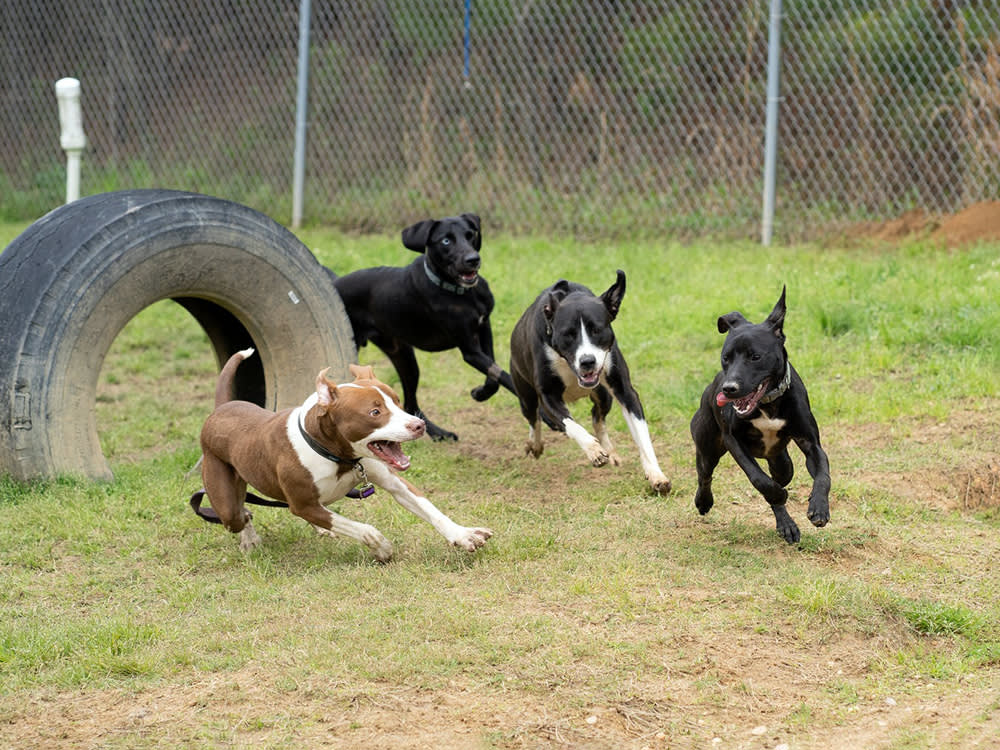
Here is an uncomfortable truth about animal shelters: a lot of the dogs marked “aggressive” are not aggressive. They are unraveling. A kennel is loud, cramped, and relentless, and a dog who has been stuck in one for weeks starts lunging at the bars, freezing, or snapping in ways that look like temperament but are really just a nervous system that has run out of room. Get that same dog onto grass with a few other dogs, and the label often evaporates in about ninety seconds.
That gap, between how a dog behaves in a cage and who a dog actually is, is the whole reason shelter playgroups exist. And the best-known name in that world is Dogs Playing for Life (DPFL), the nonprofit built by trainer Aimee Sadler to get dogs out of kennels, into a yard, and then out the front door with a new family, as fast as possible.
A death sentence, undone in a morning
Consider the kind of dog these programs are built for: a stocky, cropped-ear stray who fails a dog-to-dog temperament test at a high-intake city shelter and lands on the wrong list. Under the old logic, that is close to a death sentence. Under the playgroup model, it is a first draft.
On a good morning, that same dog gets walked out to a play yard where a dozen or more dogs are already tearing around, taking breaks in a kiddie pool. He is muzzled at first, as a precaution, then released into a pen. He greets the volunteer trying to fit the muzzle with a lick. He is reunited with a sibling, gets jumped on by an unneutered male, and does nothing but stand there calmly. Muzzle off, he romps with the group and reads as exactly what he is: a sweet, social dog who tested badly in an artificial setup. Dogs like that get adopted days later instead of being written off. Multiply that across a whole kennel and you start to understand why shelters keep paying to build these programs.
Why a cage lies about a dog
Whether it is a stressed giraffe in a zoo or a shut-down dog in a shelter, enrichment is not a luxury for an animal in captivity; it is what keeps the animal recognizably itself. Behavior experts who work with captive animals make a specific point about dogs: they need two different kinds of play, dog-to-human and dog-to-dog, and the two are not interchangeable. A person tossing a ball can give a dog attention and exercise, but people cannot replicate what dogs give each other. We still do not fully read the fast, tumbling grammar of canine play, all the chasing and body-checking and course corrections that happen between two dogs in a second. Dog-to-dog play is rougher, less about the object, and it teaches social skills no human handler can hand out.
That is the mechanism underneath the results. A play yard is not just exercise. It is a place where an under-socialized dog learns by copying confident dogs, where a “barrier reactive” dog who screams at every passerby turns out to be perfectly friendly once the barrier is gone, and where staff finally see the dog’s real personality instead of the caged version of it.
Most of what we call aggression in a kennel is a dog who has lost the ability to cope, not a dog who wants to hurt something. Put that dog in a yard with good canine role models and you are not medicating the fear away, you are giving it somewhere to go. Nine times out of ten the dog you meet in the grass is the real one.
What daily playgroups actually do for a shelter
Run consistently, playgroups deliver a specific list of wins:
- Cut reactivity, both between dogs and on the leash.
- Reduce territorial behavior inside the kennels.
- Sharpen a dog’s ability to focus during training.
- Free up staff time, since kennels can be cleaned while the dogs are out playing.
- Burn off physical and mental energy through hard social play.
None of that requires a celebrity trainer on site every day. It requires a method, and that is what DPFL sells.
From three hours and 25 dogs to a national program
Sadler did not set out to become the shelter-playgroup expert. She came up as a private trainer with a long, unusual résumé working with domestic and wild animals, and the program was almost an accident of scheduling. Hired to train dogs at a Long Island shelter, she found herself with three hours and 25 dogs, and asked herself the only practical question available: what is the fastest way to get all that pent-up energy out so these dogs can actually learn? She let them play together in the yard first. The training went better, and the dogs went back to their kennels quieter and calmer than before.
She kept refining it at larger shelters, and the thing that convinced her it could scale was not her own data, it was the reaction of shelter staff, who saw the change with their own eyes and became believers, which mattered far more than any argument she could make. Her reputation grew through animal-welfare conferences, and shelter directors trying to drive down euthanasia rates began hiring her to train their people. Shelters that could not afford the training or a play yard often got grants from foundations that back this kind of work, including longtime advocates for pit-bull-type dogs.
Deciding who plays with whom is an art
A DPFL training starts in a classroom with the theory, then moves to the yard for hands-on work. Runners bring dogs from the kennels; a lead handler calls the shots, shuffling dogs between pens when the chemistry is off. Matching dogs is judgment, not a formula. Handlers watch a newcomer’s body language and, just as closely, watch how the dogs already in the yard respond to it. Dogs telegraph a lot about each other, and anyone who needs smoothing out gets pulled and reintroduced later. Because many shelters take in new dogs daily, a dog with any question mark goes in muzzled.
Two things make a playgroup work: a human leader who stays calm, sure of themselves, and ready to get firm when a moment calls for it, and a handful of canine “rock stars,” the confident, friendly, fluent dogs who teach the fearful and the pushy how to read the room. The leader watches hard but lets dogs be dogs, allowing them to settle minor squabbles themselves. Mounting, bared teeth, and raised hackles are all normal canine communication, not emergencies; the leader steps in only at genuine signs of aggression, and comes prepared, with an air horn, a shaker can of coins, and a filled spray bottle ready to interrupt trouble.
Not everyone in animal welfare loves this approach. The use of corrections, not just rewards, draws real criticism. The program’s counterargument is that dogs correct one another constantly, effectively, without doing damage, and that a good yard uses rewards to grow the behaviors you want and mild aversives to shrink the ones you do not. And yes, if you run daily playgroups, you will occasionally have scuffles; that is part of working with animals. Programs that track it report that serious injuries to dogs and people stay very rare over years of daily play.
The numbers are hard to argue with
The payoff shows up in live-release rates, the share of dogs who leave a shelter alive through adoption or foster:
- Longmont Humane Society ran a 76 percent canine live-release rate in 2004; after operating playgroups, it has held a rate above 95 percent.
- Southampton Animal Shelter sat at 73 percent in 1998. After it was privatized and added a playgroup in 2010, it has stayed above 95 percent.
- Edmonton Humane Society in Canada saw its live-release rate climb 8 percent within the first month of adopting the method.
- Austin Pets Alive! credits the program with keeping its citywide numbers up, estimating that without it, the local live-release rate would fall from above 90 percent to under 85 percent.
There is a softer metric too, and shelter staff bring it up unprompted: the play yard changes how the public experiences a shelter. People who walk a row of kennels tend to go quiet and hold back tears. People who watch a playgroup laugh, and they go home with dogs, often the older, plainer, less obviously adoptable ones who never would have caught an eye through the bars. Fairfax County’s shelter used its playgroup to move dogs faster, take in several hundred from other shelters, and cut its reliance on rescue groups by half, which freed those rescues to pull dogs from somewhere else.
What’s new since this method took off
The approach has kept spreading. Dogs Playing for Life now reports having brought playgroups to nearly 300 shelters, up from roughly 180 to 230 organizations less than a decade ago, and it has drawn grant support from national funders to expand shelter enrichment further. Independent research and large welfare organizations have piled on evidence in the same direction, documenting that structured playgroups reduce kennel stress and measurably improve adoptability.
The practical takeaway for anyone who loves a scruffy, overlooked shelter dog: the dog you meet in a kennel is not the whole story, and increasingly, shelters know it. If your local shelter runs playgroups, ask to watch one. It is the most honest look you will get at who a dog really is.
References
Dr. Chen is a small-animal veterinarian who leads health and safety coverage at The Pet Times. She writes and reviews the bulk of our illness, condition, and safety content, translating clinical guidance into clear, practical advice owners can act on at home.
Meet our experts ↗Keep reading
 First DaysThe 3-3-3 Rule Is Two-Thirds Made UpDr. Mara Chen · 10 min
 LivingThe Dire Wolf Fantasy Is Filling Shelters With Real HuskiesMarcus Webb · 6 min
 Living'Will My Dog Ever Love Me?' Is the Wrong Question. Watch What They Choose.Dr. Priya Nair · 9 min
 LivingThe ADA Has No Breed List. Your Landlord's Insurance Does.Dr. Priya Nair · 6 min
 Living'Unadoptable' Is a Description of the Building, Not the DogDr. Amara Solis · 7 min
 TrainingYour Rescue Dog Isn't Being Difficult. They're Decompressing.Dr. Mara Chen · 8 min