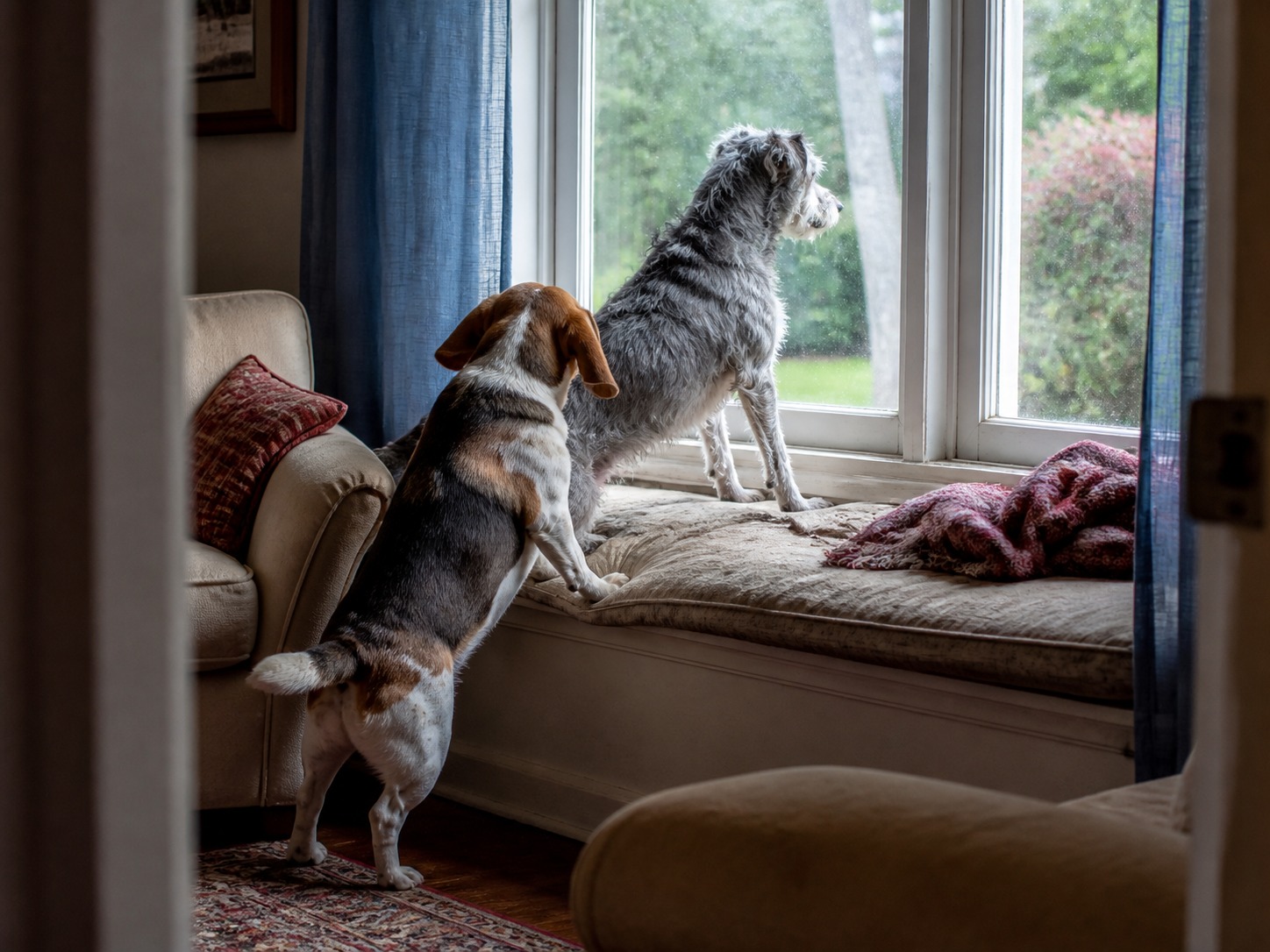
People adopt a second dog and expect a training discount. The reasoning sounds airtight: dogs learn by watching, the first dog already knows the rules, so the new one will pick them up for free.
The first half is true. Dogs are genuinely good social learners. The problem is what comes with it. A dog who can learn “wait at the door by watching” can also learn “lose your mind at the mailman by watching,” and nothing in the mechanism sorts the good lessons from the bad. Whatever your resident dog does most confidently is the curriculum, and you did not write it.
The copying is real, and it has a name
The behavior has a technical label, allelomimetic behavior, which just means doing what your companions are doing. It runs deep. Wolf pups learn to hunt by watching adults, and the ability to acquire a skill by observation instead of trial and error is not a party trick, it is survival.
Working dog programs lean on this deliberately. Puppies in some detection programs watch an experienced dog find a target scent and get paid for it, rather than starting from a blank slate. Novice herding dogs learn a great deal by working alongside a veteran. Avalanche rescue dogs shadow a working team and absorb the shape of the job.
At home, the same effect is what makes people say the second dog “trained himself.” He watched a dog he trusts sit before a meal, come when called, walk up the stairs, and ask to go out. Then he did those things.
The research is more specific than “dogs copy dogs,” though, and the details matter. In one study of puppies learning from a demonstrator, the pups paid more attention to an unfamiliar dog than to their own mother. And in work on overimitation, dogs copied pointless, unnecessary actions more when the demonstrator was their own person than when it was a stranger. Copying is not indiscriminate. Dogs pick a model, based on relationship and salience, and then follow that model closely.
Which raises the question you should actually be asking.
Who did your dog pick?
The dog who was there first usually becomes the reference. A newcomer treats the resident as the one who knows where things are, when food happens, and what the noise at the front of the house means. That is convenient when the resident is a calm, well-mannered dog. It is expensive when the resident barks at every delivery, guards the sofa, or has figured out how to lift the gate latch with a nose.
There is one real, documented case of a puppy learning to open a backyard gate by watching the older dog do it. Nobody trained that. It came free with the arrangement.
Adult dogs do this too. Two adults who move in together will often synchronize within weeks: napping at the same times, following each other room to room, adopting each other’s noises. A quiet dog can start barking again. A dog terrified of the bath can watch the other one climb in and decide the bath is survivable.
“The second dog is not learning your house rules. He is learning your first dog,” says Dr. Ravi Mehta. “So before you bring anyone home, be honest about what your current dog would teach a student, because that is the lesson plan.”
Where the free training runs out
The most common question veterinary behaviorists get is whether a second dog will fix the first dog’s problem. The honest answer is that it might, and it might not, and it is not something to bet a household on.
There is a specific failure mode worth naming: emotional contagion. One dog’s overreaction lights up the other. A single dog spinning up at a sound pulls the second into it, and now you have two dogs at a nine instead of one dog at a six. That is the opposite of the calm you were hoping to buy.
It also makes training sessions harder. Working one dog at a time, with the other one out of the room, is nearly always more productive. The second dog is a distraction, a competitor for reinforcement, and a live emotional broadcast, all at once.
And a dog who has a real behavior problem, separation distress, reactivity, resource guarding, has a problem that a second dog cannot treat. Adding a dog to that house adds a variable, not a solution.
Sometimes it is not copying at all
Before you build a whole theory around your dogs’ synchronized routine, consider the boring explanation. Two dogs acting in unison may simply be two dogs reacting to one shared cue, independently, at the same moment.
Both dogs stare at the floor when you point at it. Both dogs appear when the peanut butter jar opens. Both dogs go to the door when a car turns into the driveway. These look choreographed. In fact each dog learned the association on their own, and one event is now pulling both levers at once. Dogs spend most of their waking attention scanning the environment for what is about to happen, especially anything involving food. Two dogs watching the same room will often reach the same conclusion at the same moment.
It is still delightful to watch. It just does not require a theory.
How to use this on purpose
If you already have two dogs, or are about to:
- Audit the model. List what your resident dog does reliably, good and bad. That list is the syllabus. If barking at the window is on it, expect the new dog to enroll.
- Train separately, live together. Do the actual teaching one dog at a time, in a quiet room, then let the shared habits form in daily life.
- Interrupt the chorus early. The first few times the new dog joins the resident’s alarm bark, that habit is still soft. Redirect it then, before both dogs have rehearsed it a hundred times.
- Do not adopt as therapy. Get a second dog because you want a second dog. Fix the first dog’s problem with a plan, not with a housemate.
- Give the newcomer their own wins. A dog who only ever follows can stay stuck in follower mode. Short solo sessions build a dog who can think without a copilot.
What newer research adds
The picture of social learning in dogs has gotten sharper, and less flattering to the “free training” story, over the last few years. Reviews of the field now stress that dogs copy selectively rather than automatically: they are more likely to imitate when figuring it out alone would be costly, and more likely to copy a demonstrator who has been successful or who matters to them socially. A 2025 review in Biologia Futura argues the whole field needs to be studied under more realistic, everyday conditions, precisely because a dog’s choice of who to copy depends so heavily on the relationship.
The practical takeaway is not “dogs learn from dogs.” It is “dogs learn from the dog they respect, and they do not check whether the lesson is one you would have chosen.” Which means the most powerful training tool in a two-dog house is the behavior of the dog who was already there.
References
- Fugazza, C., et al. “Social Learning from Conspecifics and Humans in Dog Puppies.” Scientific Reports, vol. 8, 2018. https://www.nature.com/articles/s41598-018-27654-0
- Huber, L., et al. “Socially Priming Dogs in an Overimitation Task.” Scientific Reports, 2023. https://pmc.ncbi.nlm.nih.gov/articles/PMC9982082/
- Pongrácz, P., and Fugazza, C. “Social Learning in Dogs from an Ecologically Valid Perspective.” Biologia Futura, 2025. https://doi.org/10.1007/s42977-025-00271-5
- Fugazza, C., and Miklósi, Á. “Social Learning of Goal-Directed Actions in Dogs (Canis familiaris): Imitation or Emulation?” Journal of Comparative Psychology, 2018. https://pubmed.ncbi.nlm.nih.gov/30407032/