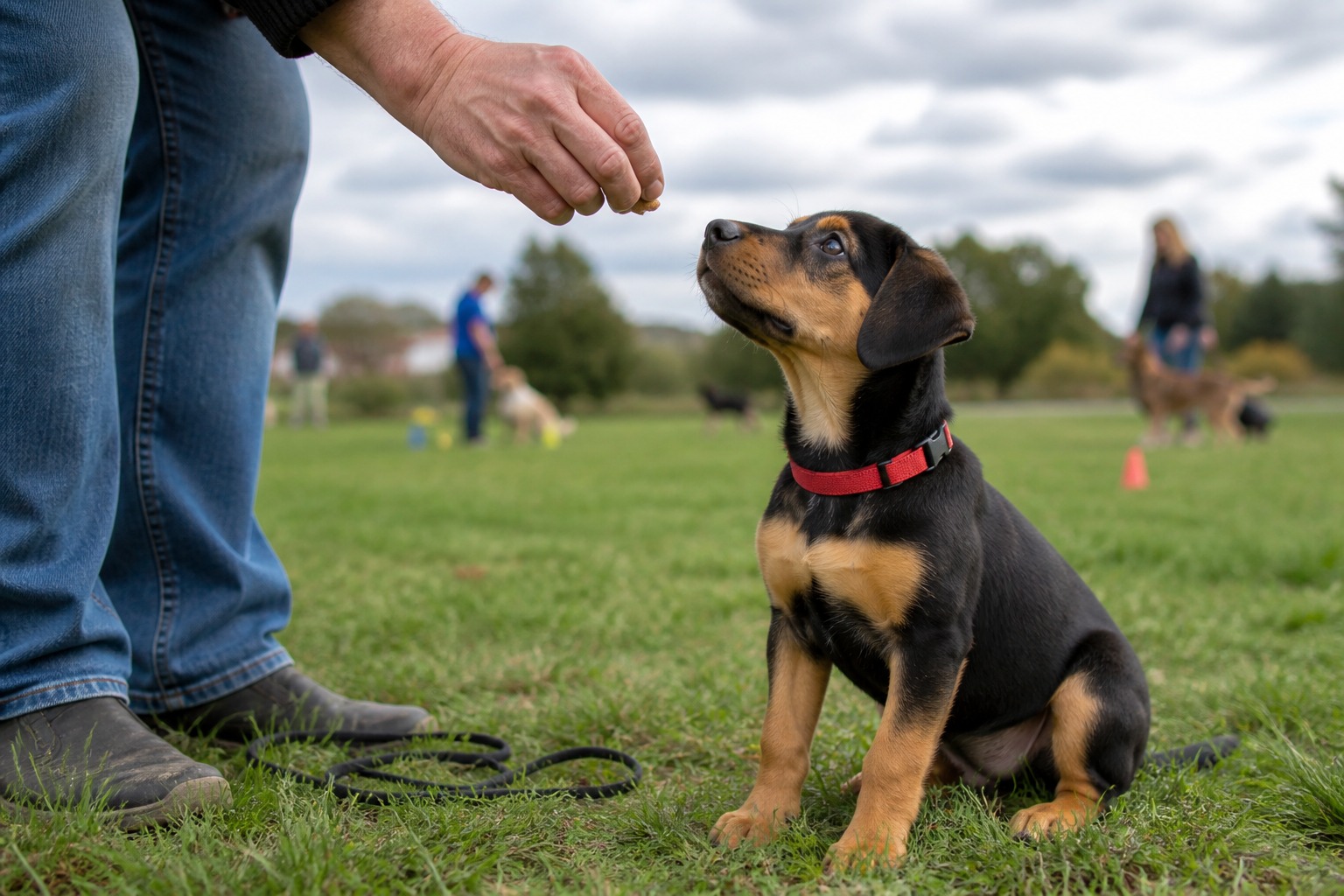
Almost everyone knows one fact about dog training: you give the dog a treat when it does the right thing. It is true, as far as it goes. But that single fact, held on its own, is exactly what produces the most common complaint I hear from owners: “He’ll only sit if he can see the treat in my hand.”
That dog is not stubborn. That dog was taught, very effectively, that two things have to be true before sitting is worth it, the cue and a visible snack. Take away either one and the deal is off. The good news is that this is a fixable mechanics problem, not a character flaw, and the fix is the part of reward-based training that almost no one gets told about. It is not about using more treats, and it is not about using fewer. It is about making them unpredictable.
Why predictability is the enemy
Think about why people compulsively check their phones. It is not because a notification is guaranteed every time. It is precisely because one isn’t. The maybe is what hooks us. A reward that arrives on a reliable schedule gets boring fast; a reward that might arrive, on a pattern you can’t predict, keeps you checking.
Dogs run on the same wiring. When a treat follows every single correct sit, forever, the behavior becomes a transaction with a fixed price, and your dog will happily decline to pay when the till is empty. But when the reward becomes a pleasant surprise rather than a certainty, the behavior stops being a negotiation and starts being a habit. Getting there is a three-stage progression, and skipping straight to “wean off treats” is why so many owners end up frustrated.
Stage one: reward everything (briefly)
When you first introduce a behavior, be generous and consistent. Teaching a puppy to sit? Treat every successful rep. At this stage you are not building reliability, you are simply pairing the verbal cue and the hand gesture with the action so your dog understands what the word means. This is called continuous reinforcement, and it works beautifully, for a few days.
Then it curdles. A puppy who gets a treat for every sit soon stops trying hard, or fast, or at all, because the reward is guaranteed no matter what. Lean on continuous reinforcement too long and you manufacture the exact treat-dependent dog you were trying to avoid. It happens quickly, often within days of teaching something new, which is why the next stage needs to start sooner than most people think.
Stage two: make it a guessing game
Once you are confident your dog genuinely understands the behavior, start rewarding only some of the time, on no discernible pattern. Trainers call this variable-ratio reinforcement, and it is the workhorse of reliable behavior.
Start loose, rewarding roughly one correct rep in three, then gradually stretch the ratio across sessions. The pattern should look random from your dog’s side. If you are running your dog through, say, twenty-five sits, you might reward at the 2nd, 7th, 9th, 15th, 18th, 19th, 20th, 23rd, and 25th, sometimes three in a quick row, sometimes a long dry stretch. That irregularity is the whole point. It keeps your dog attentive and working, because the next rep might be the one that pays.
A few practical notes. Keep sessions short and frequent: two to five minutes, twice a day, beats one long slog. Over those sessions, thin the rewards until your dog is earning a treat for maybe one correct rep in ten. And even once a behavior is a solid habit, do not go completely cold, keep tossing an occasional reward across your dog’s whole life to keep the cue fresh. (One more tip from experience: use soft treats that don’t shatter into crumbs the second they hit your pocket, and check those pockets before laundry day.)
Stage three: pay premium for excellence
There is a final polish worth adding once the first two stages are locked in: start reserving your best rewards for your dog’s best work. Trainers sometimes call this differential reinforcement of excellent behavior, which is a formal way of saying great performance earns a bigger payday.
This shines for something like a reliable recall. Once your dog answers “come” consistently and you have worked through variable-ratio rewards, begin saving the high-value treats, or a bigger handful, for the times your dog comes fast and eagerly. If they amble over after stopping to investigate three smells on the way, no jackpot. Only the sharp, immediate response earns the good stuff. Over time this doesn’t just maintain the behavior, it sharpens it.
“The instinct almost every owner has is to fade treats out entirely, and that’s usually where a solid recall quietly falls apart,” says Dr. Nina Kohl. “You never fully retire the reward. You make it rarer and more surprising, and you save your best currency for your dog’s best efforts. A dog who thinks a jackpot is always possible keeps trying, and trying is what reliability is made of.”
Go at your dog’s pace
None of these stages are rigid rules to march through on a schedule. Some days one approach fits better than another, and if you have pushed the ratio too fast and your dog is losing the thread, it is completely fine to back up a step and rebuild. A dog who needs the training slowed down is not a bad dog. They are just telling you where they are, and good training meets them there.
What newer research adds
The broader science of dog training has moved firmly in one direction since these techniques were first popularized, and it is worth knowing where the field stands. Major veterinary behavior organizations, including the American Veterinary Society of Animal Behavior, now explicitly recommend reward-based methods as the standard of care and caution against aversive tools like shock, choke, and prong collars, citing evidence that punishment-based approaches carry a higher risk of fear, anxiety, and aggression without training any faster.
In other words, the “make good behavior pay” framework in this piece isn’t just one style among many. It is the approach the current evidence supports, both because it works and because it protects the relationship between you and your dog. The unpredictable-reward mechanics are simply how you make that humane approach genuinely reliable.
References
- AVSAB Position Statement on Humane Dog Training. American Veterinary Society of Animal Behavior.
- The Case for Reward-Based Training. American Veterinary Society of Animal Behavior.
- Ziv, G. “The Effects of Using Aversive Training Methods in Dogs, A Review.” Journal of Veterinary Behavior.