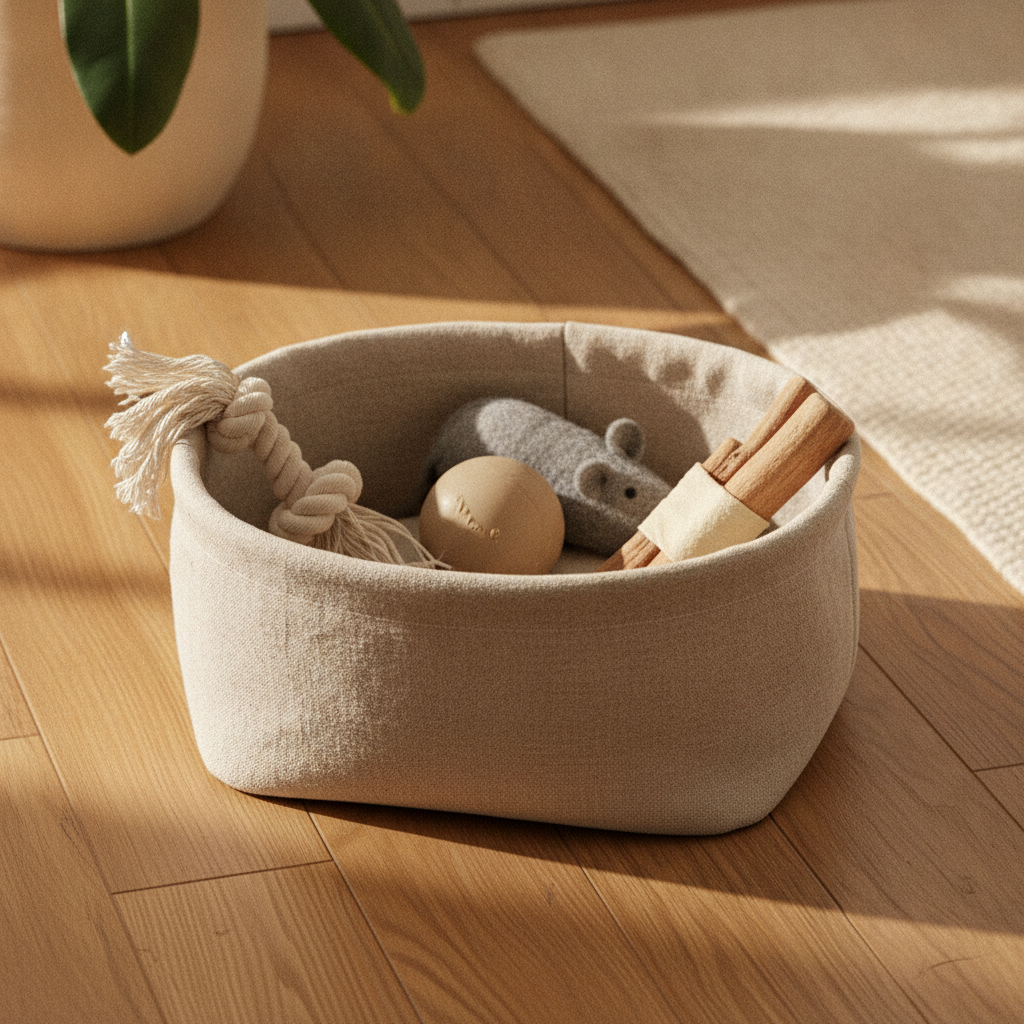
Your pet’s toy collection almost never starts as a problem. It starts as one squeaky duck. Then a rope tug, a few tennis balls, a crinkle mouse, a birthday plush, and somehow it has colonized a corner of the living room, half the toys chewed into unrecognizable states and none of them, you’ll notice, actually being played with.
Here’s the part that surprises people: the pile isn’t a sign of an enriched pet. It’s often the reason your pet looks bored. When everything is available all the time, nothing feels new, the genuine favorites get lost in the heap, and the whole mess just becomes clutter you step over. Fewer, better-managed toys almost always means more real play. To get there, I borrowed the bones of the KonMari method from two certified consultants who happen to be devoted pet parents, Michele Vig of Neat Little Nest (dog mom to Piper, a Cavapoo) and professional organizer Jenny Albertini (owner of Huck, an English Bulldog), and added the one move they leave out. Six moves, start to finish.
1. Dump it all in one place
The first real step is deceptively simple: gather every single toy into one spot, like with like. Vig’s point is that you can’t judge a collection you can’t see. Piled together, the volume becomes obvious, and so does the fact that you own six near-identical tennis balls and your dog only ever fetches one.
Then ask the KonMari question, adapted for a household with a tail in it: does this toy spark joy, for your pet first, and for you too? Albertini’s framing is that pets have favorites just like people do, and your job is to notice them. Her bulldog Huck loves tennis balls, so rather than keep six rolling into every corner of the house, she keeps a single easy-to-grab one by the door. One beloved, used toy beats five ignored ones.
2. Let a small container set the limit
Once you’ve thinned the herd, the right storage does the rest of the work for you. Pick a container that’s modestly sized on purpose, so it functions as a built-in ceiling: when the bin overflows, that’s your signal to let something go, not to buy a bigger bin.
Albertini favors open, lightweight, soft-sided bins with low edges. Low sides mean a dog or cat can often nose out their own toys, and cleanup becomes a ten-second job of tossing strays back in at the end of the day. And reuse a bin you already own before buying one. The whole reason you’re doing this is to end up with less stuff at home, not more, and whatever you already have probably suits your space fine.
3. Give the collection one home
Put the packed bin somewhere your pet can easily reach it, and ideally fold it into a single pet zone alongside your other supplies. Vig’s observation is that most people scatter leashes, food, medicine, and toys across the whole house, which is exactly why nobody can ever find anything. Cluster it all near where feeding happens, often the kitchen, and everyone, including a pet sitter or a kid helping with care, always knows where things live.
That zone can mix open, grab-and-go containers for toys and leashes with sealed, airtight tubs that keep smelly food and treats fresh. It’s also the natural home for a small “backlog bin” holding new toys you haven’t rotated in yet, or the supervision-only items like horns and rawhide you don’t want left out.
4. Rotate, don’t hoard
This is the move the tidy-up guides skip, and it’s the one that turns decluttering into actual enrichment.
A curated collection doesn’t mean your pet only ever sees five toys for the rest of their life. It means only a few are out at any given time. Keep the rest in that backlog bin, and every week or two, swap what’s available. To your pet, a toy that’s been out of sight for two weeks reads as brand new all over again. Novelty is most of what makes a toy interesting, and animals habituate fast, which is why the newest arrival gets loved for a day and then abandoned. Rotation hacks that instinct: the same small set of toys stays exciting because your pet keeps rediscovering it. You buy less, they play more, and the pile never rebuilds.
People assume a bored dog needs another toy, when what they usually need is the toy they already own to disappear for a week and come back. Rotation is the cheapest enrichment trick there is, and it’s the difference between a collection that gets used and one that just gets stored.
5. Offload the rejects the right way
Don’t sweep the cut toys into a black bag and call it done. Before anything hits the trash, ask what can be reused. A barely-touched toy your pet rejected in a minute is exactly what a local shelter or secondhand store might want, and some food pantries accept lightly used pet toys and food too. Give everything a wash first so it arrives looking close to new.
Soft toys that have been genuinely loved to pieces don’t have to be landfill either. Many areas have textile recyclers that will take them, or you can repurpose the stuffing into a DIY project like a pillow if you’re the crafty type. The goal is to close the loop, not just relocate the mess.
6. Going forward, buy less and buy better
The best part of a reset is the momentum it gives you to stop the cycle from restarting. Vow to be genuinely picky: only bring home toys you’re confident your pet will love and use hard, not the impulse-buy squeaker that’ll be shredded by Friday.
As Albertini puts it, a home reset is a good moment to change your buying patterns, for you and your pet both. It cuts waste, it saves you from forever chasing stray squeakers and drifts of fluff, and it frees you up for the only part of this that your pet actually cares about: playing with you.
References
- The KonMari Method, Marie Kondo
- Michele Vig, Neat Little Nest
- Jenny Albertini, Declutter DC
- How to recycle textiles and worn fabric items, U.S. EPA
Common questions
Does having more toys make my pet happier?
Not usually. Past a small handful, extra toys tend to get ignored, and the favorites get buried in the pile. A tighter, rotated collection keeps novelty high and makes it far easier for your pet to actually find and use the toys they love.
How do I know which toys to get rid of?
Gather every toy in one place so you can see the whole collection, then keep the ones that genuinely spark joy for your pet (and for you, since you're the one living with them). Watch what your pet reaches for. The tennis ball they ignore for the one they always carry is your answer.
What should I do with the toys I remove?
Don't just bag them for the trash. Wash lightly used toys and offer them to a local shelter, secondhand store, or food pantry. Worn soft toys can go to a textile recycler, or become stuffing for a DIY project. Only truly unsalvageable items should hit the bin.