


A Kitten Landed in Your Lap and Can't Eat on Its Own. Here's the Playbook.
Bottle-feeding an orphaned kitten is a math problem, a temperature problem, and a round-the-clock job. A vet-backed guide to doing it right, from formula ratios to the cotton-ball trick nobody warns you about.

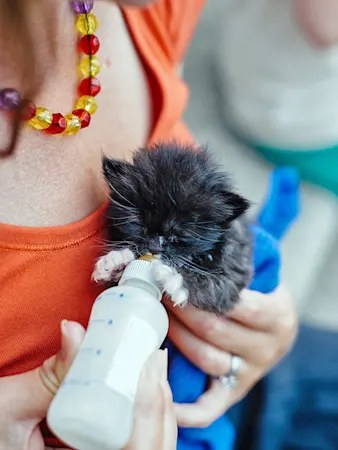
A kitten too young to eat on its own is one of the few animals whose survival genuinely depends on you getting the details right. Not roughly right. Right. The good news is that bottle-feeding is not complicated once you understand what you’re actually doing, which is standing in for the mother cat during the most fragile stretch of a kitten’s life. The bad news is that “standing in for the mother cat” means feeding a schedule that ignores your sleep, keeping a body the size of a lemon warm, and doing a job her tongue used to do.
This guide walks the whole process, but the single idea to hold onto is this: for a neonatal kitten, feeding is a measured, calculated task, not a “top them up when they cry” one. The mother’s milk delivered a precise amount on a precise rhythm. Your bottle has to do the same, because both overfeeding and underfeeding can hurt a kitten this small, and the margin between the two is narrow. Everything below is built around getting the numbers, the temperature, and the position correct.
First rule: a kitten belongs with its mother whenever that’s possible
Before you commit to weeks of round-the-clock care, make sure the kitten actually needs it. A nursing mother, even a stray one, gives a kitten a far better shot than any human with a bottle. If you find kittens with a mom present and she’s caring for them, the kindest move is usually to leave the litter with her and support the family from a distance, waiting until the little ones have reached roughly eight weeks before separating them. Well-meaning “rescues” of kittens whose mother has just stepped away to hunt are one of the most common mistakes in kitten season.
Sometimes, though, there’s no mother in the picture, or she can’t or won’t care for the litter. That’s when you step in, and the more prepared you are before the kitten is hungry, the calmer the whole thing goes.
Get the supplies before the hunger sets in
Orphaned kittens tend to arrive at the worst possible moment, so if you can stock up in advance, do. If you can’t, don’t panic, but move quickly. Your core kit:
Kitten milk replacer, which is the non-negotiable centerpiece. Small bottles with kitten-sized nipples. A safe nesting box with a reliable heat source. Soft bedding. A gram scale, because ounces are too coarse for an animal this small. And cotton balls, which you’ll understand shortly.
A note on the bottles and nipples, because people improvise here and it backfires. Kitten mouths and stomachs are tiny, so you want equipment built for them. Skip large bottles, both because the formula only stays safe for a short window, so you’ll waste it, and because a big bottle is awkward for a small kitten and encourages gulping air. The nipple hole matters more than it sounds: turned upside down, a properly sized nipple lets one drop fall at a time. Too big a hole floods the kitten and risks aspiration. Too small, and nothing comes out. A too-tight hole can be opened up a little using a clean needle.
The mistake I see most with first-time bottle-feeders isn’t the formula, it’s the flow rate. A nipple hole that’s a hair too wide sends milk into the lungs before the kitten can swallow, and aspiration pneumonia in a two-week-old is a fight you don’t want. Do the upside-down drop test on every new nipple, every time.
Formula: match the species, and never the raw stuff
Kittens need kitten milk replacer, full stop, because it’s formulated to mirror the sugar, protein, and fat balance of queen’s milk. Every species’ milk is different, so cow’s milk, human formula, or a splash of whatever’s in the fridge is not a substitute and can cause serious digestive upset. Most pet stores and vet clinics carry milk replacer, and in a genuine overnight pinch, a 24-hour emergency clinic can often provide enough to get you to morning.
You’ll find homemade formula recipes online. Treat them with real skepticism. Most were never tested for safety or nutritional balance, none are meant for the long haul, and any recipe calling for raw egg or unpasteurized milk should be discarded outright, since those carry pathogens a kitten’s immature immune system can’t handle.
Mix exactly as the package directs, and warm it gently to room temperature or a touch above by sitting the bottle in warm water. Never microwave, and never serve it hot. Pay attention to the label’s window for how long prepared formula stays safe, and don’t push past it. Spoiled formula is a fast route to a sick kitten.
The feeding itself: position is everything
Here’s where human instinct betrays you. We feed babies tilted back, cradled. You must not do that with a kitten. Kittens nurse lying on their bellies with their paws down, and feeding them on their backs invites choking and aspiration, milk going into the lungs instead of the stomach.
So: kitten on its stomach, on a towel or in your palm. Gently lift its head just enough to introduce the nipple, angle the nipple downward, and tip the bottle only enough to fill the tip. Let the kitten set the pace with its own suckling reflex. Never squeeze the bottle to hurry things along — that forces milk faster than the kitten can manage. A healthy kitten will latch and suck on its own. One that won’t latch, feels cold, or seems limp needs a vet, not more coaxing, and a cold kitten must be warmed before you attempt to feed at all.
The numbers you actually need
This is the part people skip and shouldn’t. Underfeeding starves a kitten that’s already behind; overfeeding risks aspiration and diarrhea, and a young kitten with diarrhea dehydrates alarmingly fast. Consistency protects against both.
The working formula, drawn from Maddie’s Fund’s bottle-feeding guidance, is about 25 mL of formula per 100 grams of body weight per day. Weigh the kitten in grams, run the math, then divide the daily total across the day’s feedings.
A worked example: a kitten weighing 170 grams needs roughly 42.5 mL per day (170 ÷ 100 = 1.7, times 25 = 42.5). Split across seven or eight feedings in 24 hours, that’s about 5 mL per feeding. That per-feeding amount matters because a neonatal kitten’s stomach only holds about 4 mL per 100 grams of body weight — exceed that and you’re overfilling a stomach the size of a marble.
Frequency tracks age and weight. Newborns a few days old eat every two to three hours, day and night, which is seven to nine feedings across 24 hours. Older kittens can go three to four hours between meals. As weight climbs, the intervals stretch.
And weigh daily. A well-fed kitten gains weight every single day, so a scale is your early-warning system. Log the weight (same time each day, before a feed), how much the kitten took, and when it peed and pooped. That record is gold for your vet if anything looks off.
The part nobody warns you about: you have to make them go
After each feeding, you have to do what the mother’s tongue would do — stimulate the kitten to pee and poop. Very young kittens can’t eliminate on their own; the queen licks their hind end to trigger it. Your stand-in is a warm, damp cotton ball, dabbed gently around the genitals and rear until the kitten goes. Skip this and the kitten can’t empty its bladder or bowels, which becomes a medical emergency.
Once it’s done, clean off any mess with warm water and dry the kitten thoroughly before returning it to the nest, because wet fur pulls body heat away fast, and heat is something a neonatal kitten can’t spare. Burp the kitten first with a gentle back rub, then settle it back into its warm box. This is also a natural moment to swap out heating elements or freshen the bedding.
When to stop worrying about the bottle
Once a kitten hits the three-to-four-week mark, solid food enters the picture. Introduce a soft, gruel-like mix and let the transition happen gradually. Over a week or two, the kitten takes less from the bottle and eats more on its own until it’s fully weaned, and your sleep schedule slowly returns to you.
What newer guidance adds
Two things are worth knowing beyond the basics. First, neonatal care specialists increasingly stress that warmth comes before food, every time. A chilled kitten can’t digest, and feeding a cold kitten can do harm rather than help; the current advice is to bring a kitten’s body temperature up to normal before offering the bottle, using a heat source the kitten can crawl away from so it doesn’t overheat.
Second, kitten-season programs now lean hard on the daily weight log as the single best tool a foster has. A kitten that fails to gain, or loses weight, over a 24-hour stretch is flagging a problem early, often before other symptoms show. If the scale stalls, that’s your cue to call the vet rather than wait, and it’s a far more reliable signal than eyeballing whether a kitten “seems fine.”
Neither of these replaces a vet’s eyes on a struggling kitten. A kitten that won’t suckle, feels cold, has diarrhea, or isn’t gaining weight should be seen promptly. Bottle-feeding is rewarding and, honestly, ridiculously cute, but it’s also fragile work, and knowing when the job is bigger than a bottle is part of doing it well.
References
Common questions
How often do you bottle-feed a newborn kitten?
A newborn just a few days old eats every two to three hours, around the clock, which works out to seven to nine feedings in 24 hours. Older kittens can stretch to three or four hours between meals. Feeding frequency drops as weight goes up.
When can a kitten stop bottle-feeding?
Weaning usually begins at three to four weeks, when you can offer a soft gruel. Over the next week or two the kitten takes less from the bottle and eats more on its own until it's fully weaned.
Dr. Nair is a veterinarian focused on diet and feeding. She covers everyday nutrition, treats, and the many "can they eat this?" questions owners ask, grounding each answer in what is actually safe and sensible for dogs and cats.
Meet our experts ↗Keep reading
 First DaysYour Kitten's Scale Is the Best Early-Warning System You Have. Here's How to Read It.Dr. Amara Solis · 6 min
 First DaysYour Kitten's First Year Is a Series of Doors That CloseDr. Lena Park · 8 min
 First DaysThere's No 'Best' Kitten Dewormer. Why the Schedule Beats the BrandDr. Mara Chen · 7 min
 First DaysEight Weeks Is a Shelter Deadline, Not a Kitten's Biology. The Data Says 14.Dr. Priya Nair · 9 min
 First DaysA Kitten's Body Keeps a Calendar. Here's How to Read It.Dr. Priya Nair · 5 min
 First DaysOrphaned Kittens Can't Poop on Their Own. Miss This and They Crash Fast.Dr. Priya Nair · 8 min