


A Kitten's Body Keeps a Calendar. Here's How to Read It.
Found a kitten and have no idea how old it is? You don't have to guess. Kittens hit developmental milestones in a fixed order, eyes, ears, teeth, then behavior, and reading that sequence dates them within a week, which decides how you care for them.


You spot a tiny kitten, maybe you planned to adopt one, maybe one appeared on your doorstep and adopted you, and the first question is impossible to answer by looking: how old is this thing? It feels like a guess. It isn’t.
A kitten’s age isn’t a number you estimate from vibes. It’s a story their body tells in a fixed, reliable order. Eyes and ears open on schedule. Teeth erupt in sequence. Coordination and independence arrive in predictable steps. Learn to read that sequence and you can pin a kitten’s age down to within about a week, far more accurately than by weight alone. And getting it right matters, because nearly everything about a kitten’s care follows directly from how old they are: what goes in the bowl and how much of it, how many hours they sleep, how independent they can be, the kind of mischief they’re capable of, and the veterinary care they need.
So how do the professionals do it? Vets read a combination of physical features and behavior. The physical clues are the teeth, the eyes, and the ears; the behavioral ones are things like whether a kitten is still crawling or has graduated to walking. Here’s the calendar their body is keeping.
The milestones to watch
Experts anchor a kitten’s age to a handful of developmental markers:
- Tooth eruption
- Eyes and ears opening
- Eye color and vision
- Coordinated walking
- Peeing and pooping without help
Each one shows up in a dependable window, which is what makes the whole thing readable.
The kitten age timeline
Kittens grow fast, hitting milestone after milestone in the first few weeks, so a small change can mean a big jump in age. Here’s what to look for as they grow.
Newborn. Born essentially defenseless: eyes and ears closed, no teeth yet. The stub of the umbilical cord is still visible but should be gone within about three days. Movement is limited to shimmying toward mom to nurse.
One to two weeks. The eyes open, but they look blue and hazy and the vision is unfocused. The ears unfold and the ear canals open. Kittens crawl with more purpose, if still a bit clumsily, and they’re wholly dependent on mom for food, warmth, and stimulation to eliminate.
Three to four weeks. They graduate from crawling to walking, and from needing help to pee and poop to doing it on their own. The first baby teeth appear, starting with the incisors and canines.
Four to six weeks. The eyes move from that cloudy gray-blue to whatever shade the kitten’s genes had planned. Baby premolars come in. This is when weaning off nursing and onto more solid food can begin.
Eight weeks. A full set of baby teeth is in, and yes, those little teeth are sharp. Kittens should be fully weaned and eating a food formulated for growth.
Twelve weeks. Playful and adventurous now. They’ve generally figured out the litter box and started grooming themselves, adult teeth begin coming in, and teething behavior can show up.
Four to twelve months. Most owners never spot a single baby tooth falling out, but a full set of adult teeth comes in over this stretch. Cats hit sexual maturity around six months, so a female may go through her first heat cycle, and most cats finish growing by about one year.
Kitten weight by age
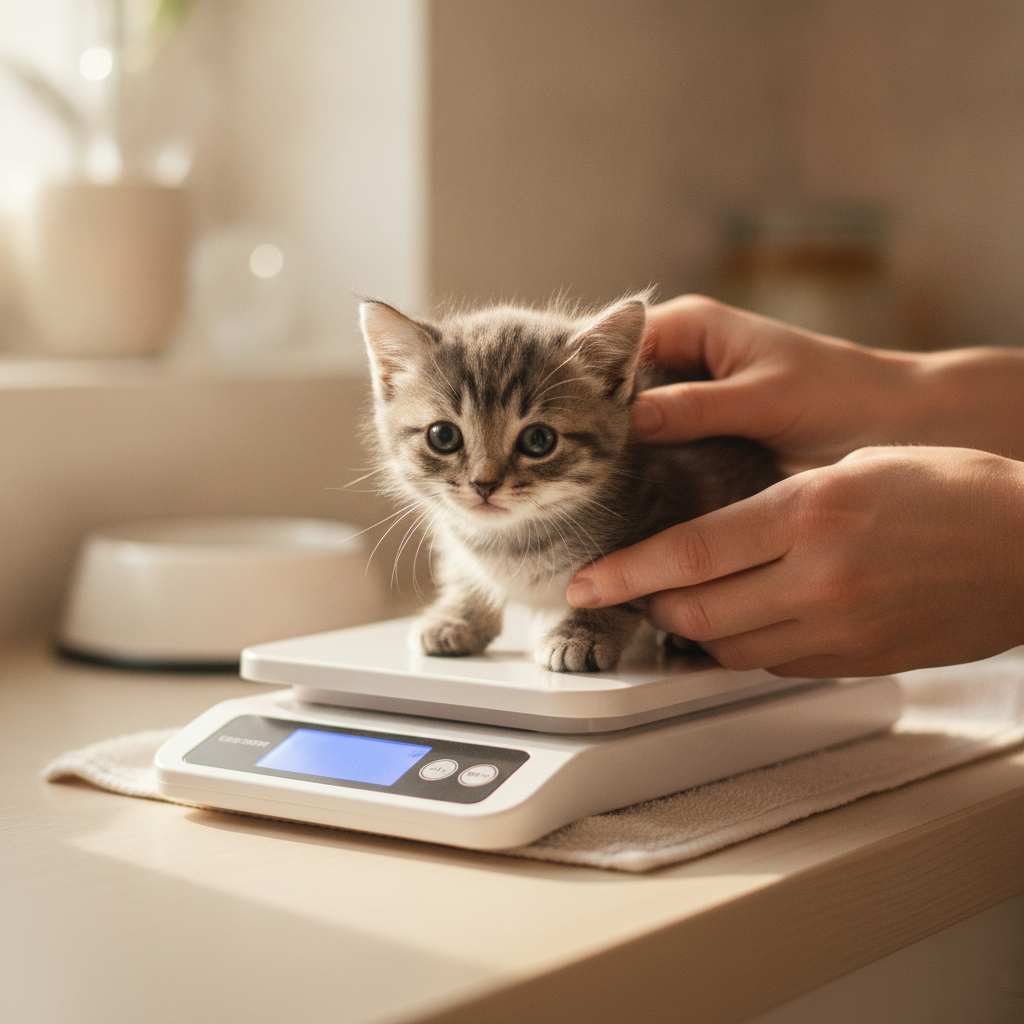
Weight is a helpful cross-check, but treat it as the backup, not the headline, because it’s less reliable than the developmental milestones. A kitten’s weight can be thrown off by breed, litter size, nutrition, and the overall health of the litter and the mother. With that caveat, here’s a rough guide:
- Birth: about 100 grams on average.
- One to two weeks: gaining roughly 10 to 15 grams a day, passing 200 grams within the first two weeks.
- Four weeks: 460 to 550 grams.
- Six weeks: 600 to 700 grams.
- Eight weeks: 800 to 1,000 grams.
- Twelve weeks: 1,300 to 1,400 grams.
- Four to twelve months: four to ten pounds.
When weight is a red flag
Kitten growth should be quick, especially in the first several months, so if a kitten is losing weight, that’s a problem, full stop. Get a kitten checked by a vet if they’re losing weight, not steadily gaining, or gaining too slowly. Poor weight gain can point to a congenital issue or simply not enough nutrition, and a vet can check for obvious abnormalities and may suggest bottle-feeding to help an underweight kitten catch up.
What newer guidance adds
Two things are worth knowing beyond the timeline. First, if you have to pick one method, trust the milestone sequence over the scale: shelters and vets lean on developmental markers precisely because weight is so easily skewed by litter and nutrition, while eyes, ears, and teeth follow the body’s own clock. Second, pinning down a kitten’s age isn’t just trivia, it drives a real decision. Many veterinary and shelter groups now recommend spaying or neutering cats by around five months of age, before that first heat and before accidental litters become possible. Knowing whether the kitten in your arms is eight weeks or four months tells you how soon that appointment needs to be on the calendar.
Whether you planned for this kitten or not, reading their age off their own body turns an anxious guess into a plan, so you can feed, protect, and care for them exactly the way their stage requires.
References
- Little, S. “Feline Pediatrics: How to Treat the Small and the Sick.” Proceedings, and related feline pediatric literature.
- “Birth Weight in the Feline Species: Description and Factors of Variation in a Large Population of Purebred Kittens.” Preventive Veterinary Medicine / peer-reviewed feline literature.
- ASPCA. “Kitten Progression: At-a-Glance.” aspca.org.
- American Association of Feline Practitioners. “Feline Life Stage Guidelines.” catvets.com.
Common questions
When do kittens outgrow the chewing phase?
Not all of them do. Chewing can signal boredom, stress, or a health issue, so give kittens plenty of enrichment and check with a vet if the chewing seems excessive or off.
At what age is a kitten no longer a kitten?
Around one year. By then most growth is finished and nutritional needs shift to adult food, though a one-year-old cat is often still very much a kitten at heart.
Dr. Nair is a veterinarian focused on diet and feeding. She covers everyday nutrition, treats, and the many "can they eat this?" questions owners ask, grounding each answer in what is actually safe and sensible for dogs and cats.
Meet our experts ↗Keep reading
 Health & WellnessA Kitten Sneeze Is Cute Once. Here's the Line It Shouldn't Cross.Dr. Mara Chen · 8 min
 First DaysYour Kitten's First Year Is a Series of Doors That CloseDr. Lena Park · 8 min
 First DaysA Kitten Landed in Your Lap and Can't Eat on Its Own. Here's the Playbook.Dr. Priya Nair · 10 min
 First DaysOrphaned Kittens Can't Poop on Their Own. Miss This and They Crash Fast.Dr. Priya Nair · 8 min
 First DaysEight Weeks Is a Shelter Deadline, Not a Kitten's Biology. The Data Says 14.Dr. Priya Nair · 9 min
 First DaysYour Kitten's Scale Is the Best Early-Warning System You Have. Here's How to Read It.Dr. Amara Solis · 6 min