Most litter box shopping is displacement activity.
Somebody has a cat peeing on the rug, and instead of fixing the thing that is causing it, they buy a nicer box. Then a bigger box. Then a hooded one, then a robot. The rug situation continues.
I want to be blunt about this, because I see the consequences in an exam room: in a multi-cat household, the box is close to the last variable that matters. Four things sit above it, and if you get those right, almost any decent box will do. If you get them wrong, no box on earth will bail you out.
So we will do those four first, and then, once they are handled, the boxes, ordered by the specific failure each one is good at solving.
Before you buy anything
1. Rule out the vet problem. First. Always.
A cat urinating outside the box is a medical event until proven otherwise. Urinary tract disease, crystals, cystitis, kidney disease, diabetes, hyperthyroidism, and arthritis all show up first as house-soiling, and arthritis in particular is massively under-diagnosed in cats who “suddenly got lazy about the box.”
And one hard line: a male cat straining in the box and producing nothing is a blocked cat, and a blocked cat can die within a day. That is an emergency room visit, not a Monday appointment.
Do not buy a box to solve this. Buy a vet visit.
2. Count: one per cat, plus one
The standard is n+1. Two cats, three boxes. Three cats, four boxes.
The reason is not hygiene, it is politics. Cats are territorial about resources, and one cat can control another’s access to a box without ever laying a paw on them: sitting in the hallway, occupying the doorway, lying on the route. The extra box exists so that there is always an option that is not being guarded.
If your home genuinely cannot fit n+1, get at least one per cat and prioritize the next item, which matters more anyway.
3. Distribution beats count
This is the one almost everybody gets wrong.
Three boxes lined up against the same wall are, to a cat, one box. A single resource, in a single location, that a single cat can dominate.
Boxes need to be in different rooms, on different levels, with different approaches and different escape routes. The goal is that no cat can ever be cornered on the way to relieve itself. If you take one thing from this article, take this one, because it is free.
4. Size: bigger than you think, by a lot
The working rule is that a box should be about one and a half times the length of your cat, measured nose to the base of the tail.
Measure your cat. Then measure your box. Most people find the box is too small, because most commercial boxes are sized for the shelf, not the animal. A cat that cannot turn around and dig comfortably will start using the edge, then the floor beside it.
When in doubt: buy the largest option available. In a multi-cat house, always.
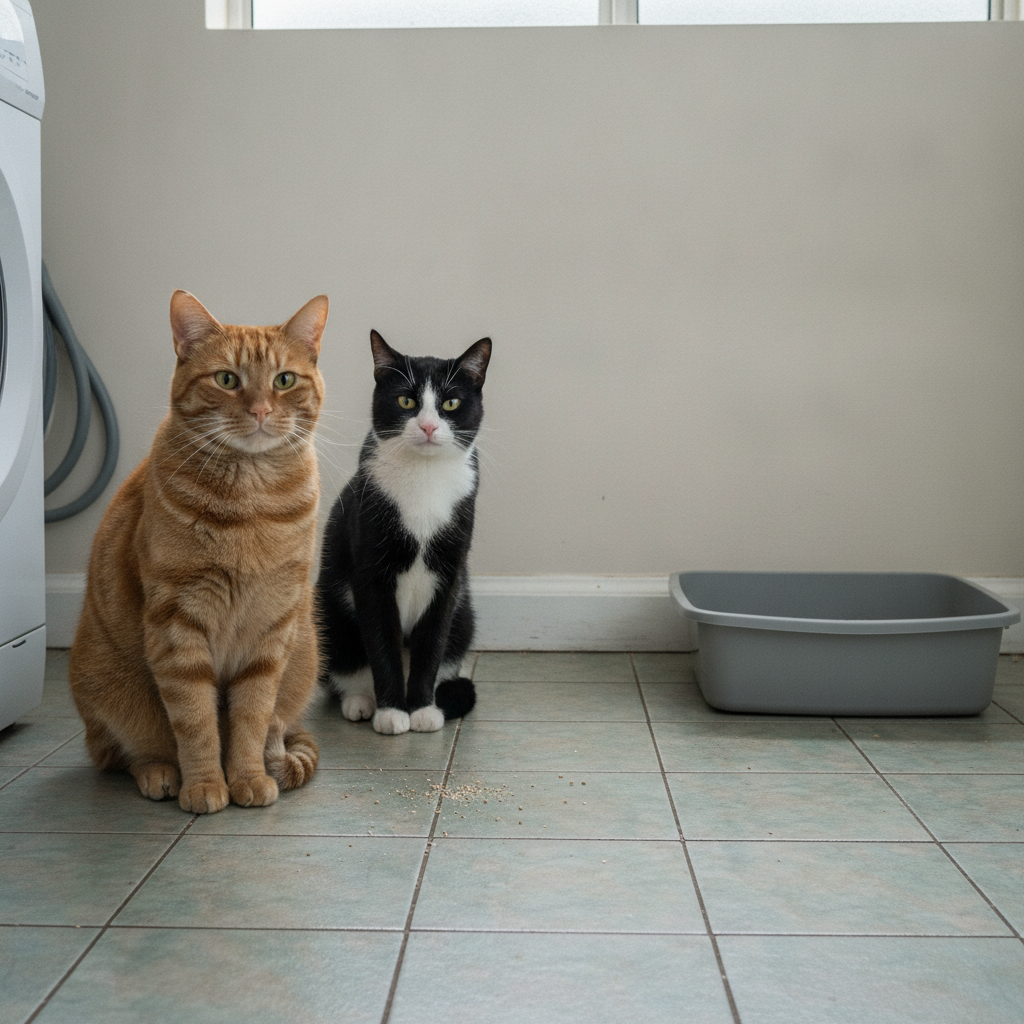
“I ask two questions before I ask anything about the box. How many boxes, and where are they. Ninety percent of the time the answer is ‘two, in the laundry room,’ and there are three cats. That’s the entire problem, and it costs nothing to fix.” — Dr. Lena Park
Then: cleaning
Scoop daily, at minimum, per box. Full litter change and wash on a regular cycle. A box that is clean by your standards is frequently filthy by a cat’s, and their standards are the only ones that count.
The eight boxes, by the problem they solve
Now, and only now, the hardware. These are not ranked by quality. They are ranked by how often the failure they fix is the failure you actually have, which is a completely different order and a much more useful one.
If your cat is old, arthritic, or stiff → KittyGoHere Senior Cat Litter Box
This goes first because it is the most under-bought box on the list and it solves the most frequently misdiagnosed problem in the entire category.
When an older cat starts missing the box and is otherwise healthy, the reason is very often devastatingly simple: getting in hurts. Sides here are 5 inches with a 3-inch entry point, so there is no jump at all, and it is still big enough for multi-cat use at 24 x 20 inches.
If you have a cat over about ten who has “developed an attitude” about the litter box, buy this before you buy anything else, and before you buy a behaviorist.
Where it falls down: low sides mean more spray and more tracking. That is the trade. It is worth it.
If you need three boxes and cannot spend three fortunes → IRIS USA XX-Large Cat Litter Box
The n+1 rule only helps you if you can afford to obey it, and this is the box that makes obedience cheap. At around twenty dollars, buy three, put them in three different rooms, and you have done more for your cats than any single purchase on this page.
It is enormous (30 x 20 x 14 inches), holds up to 18 pounds of litter, and has a three-sided shield that contains spray without enclosing the cat. The shield lifts off, so it converts into a plain open pan or slides into a litter cabinet. Front entry is 6.5 inches.
Where it falls down: an open top will never contain tracking the way a lid will, and 6.5 inches is still a step for a creaky cat.
If your house smells and you have run out of ideas → iPrimio XL Stainless Steel Litter Box
Here is the thing nobody tells you: plastic is porous. Two years of claws and it is covered in micro-scratches, the scratches hold urine, and you are now scrubbing a box that smells no matter what you do. That is not your cleaning. That is the material.
Steel does not do this. It shrugs off odor, stains, and rust, it will not scratch the way plastic does, and it actually comes clean. A buy-once box at 23.5 x 15.5 x 6 inches, with an open-top shield and a scoop.
Around $61 to $80.
Where it falls down: heavy and awkward to dump. Some cats dislike the noise of claws on metal, so it is not universally accepted.
If the smell is coming from several cats at once → Nature’s Miracle Hooded Corner Multi-Cat Litter Box
Odor in a multi-cat house arrives from several directions simultaneously, and this box goes after it on three fronts: a large hood, a charcoal filter good for about three months, and Ionpure antimicrobial protection built into the plastic to suppress the bacteria doing the actual smelling. It resists mold and mildew, its nonstick surface stops litter caking, and the corner geometry claws back floor space in a small apartment.
Where it falls down, and read this twice: a hood is the feature cats like least, and it is the one most likely to backfire in a multi-cat home, because it creates a chamber with one exit that another cat can park outside of. If there is any tension at all between your cats, do not buy a hooded box. Buy the steel one.
If your carpet is turning grey → Modkat XL Litter Box
Top entry is the most effective anti-tracking design that exists, and this is the good one. The XL can be reconfigured for top entry or front entry, which is a genuinely useful hedge if you do not yet know whether your cats will tolerate a lid. Full-height base against leaks, a scoop, and two liners, one per configuration, each lasting up to three months.
Where it falls down: the price is steep, and top entry is the single worst design for any cat with a mobility limitation. If there is a senior in the house, this box cannot be one of your n+1.
If you live with a cat who digs like she’s being paid → PetSafe Multi-Cat Litter Box
For the household with a serious excavator. It is huge (30.75 x 20.75 x 8 inches), with a deep litter bed and high sides to keep the spoil in, a large metal scoop, and, unusually, a built-in compartment with a small rubber-sealed waste bin, so scooping does not require a trip across the house.
That last feature is not a gimmick. Scooping compliance is the whole ballgame, and the friction of walking to the bin is exactly the friction that makes people skip a day.
Around $80.
Where it falls down: high sides everywhere and no lowered entry, so it is a poor choice for a senior. It is also a large object in a room.
If you just want the sensible default → Frisco High Sided Cat Litter Box
The box most people should own if none of the above is their specific problem. High sides and a high back to stop the digging-and-spraying issue, with a cut-down front so the cat walks in rather than vaults in. Roomy at 24 x 18 x 10 inches, BPA-free recyclable plastic, cleans with soap and water.
Where it falls down: even the lowered front is too high for a genuinely arthritic cat. Over about twelve years old, go back to the KittyGoHere.
If nobody in the house will scoop → Litter-Robot 4 Supply Bundle
I want to be even-handed here, because this is a seven-hundred-dollar litter box and the internet is very loud about it in both directions.
The honest case for it: scooping compliance is the number one determinant of whether a cat keeps using a box, and every human being on earth eventually skips a day. A machine does not skip a day. It separates waste into a sealed drawer after every use, and it does not get tired. The bundle includes three OdorTrap refills, ten waste drawer liners, thirty cleaning wipes, and two carbon filters. It is rated for up to four cats, and its app tracks litter level, usage, and, usefully, each cat’s weight, which is a genuine early-warning system for illness.
Where it falls down: the price. It requires clumping litter, full stop. It is not suitable for more than four cats, or for any cat under three pounds. And some cats will simply refuse to walk into a machine.
A rule if you buy one: it does not count as your whole n+1. Keep at least one ordinary box in a different room. Machines break, and a cat with nowhere else to go will use your bed.
The one-line version
Three cheap boxes in three different rooms will outperform one expensive box in the laundry room, every time, in every household, without exception. Buy the fancy box after you have done that, not instead of it.
What’s new since this was written
The most useful shift in the last few years is not a product, it is a diagnostic one: weight-tracking litter boxes have turned a piece of furniture into a monitoring device. A cat that is losing weight, or a cat whose visits to the box suddenly triple in frequency, is telling you something weeks before you would otherwise notice, and hyperthyroidism, diabetes, and early kidney disease all announce themselves that way. If you were on the fence about an automatic box on cost grounds, that is the argument that has actually gotten stronger.
The other change is in the litter itself. Low-dust, plant-based, and tofu litters have matured to the point where they clump properly, which used to be their fatal flaw, and they are now genuine options rather than compromises. The box you buy will outlast several changes of litter. Test the litter on one box before you convert all of them.
References
- Cornell Feline Health Center. Feline Behavior Problems: House Soiling. vet.cornell.edu
- American Association of Feline Practitioners & International Society of Feline Medicine. Feline Environmental Needs Guidelines. catvets.com
- Guy, N.C., Hopson, M., & Vanderstichel, R. “Litterbox size preference in domestic cats.” Journal of Veterinary Behavior, 2014. sciencedirect.com
- Grigg, E.K., Pick, L., & Nibblett, B. “Litter box preference in domestic cats: covered versus uncovered.” Journal of Feline Medicine and Surgery, 2013. journals.sagepub.com