


A Kitten Can Eat Wet Food at Four Weeks. That Doesn't Mean They Can Leave.
Solid food and weaning are two different milestones, and the pet world routinely collapses them into one. The confusion has a measurable cost, and it shows up years later as an aggressive cat.

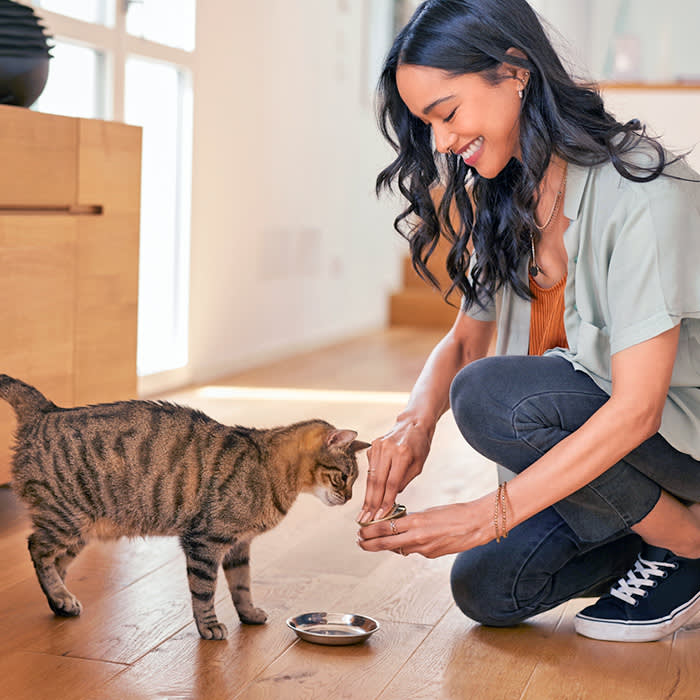
Search the question and you will get a number: kittens can start eating wet food at about four weeks. That number is correct. It is also, on its own, one of the more quietly damaging facts in cat care, because of what people hear when they hear it.
What they hear is: the kitten no longer needs its mother.
Those are two entirely different milestones, and collapsing them is the single most consequential mistake made about kitten feeding. Starting solids is a skill. A kitten at four weeks is learning to lap, chew, and swallow something that is not milk. Weaning is a separation, the gradual end of nursing, and of everything nursing comes bundled with: warmth, grooming, immune factors, and several more weeks of learning how to be a cat around other cats.
The first begins around four weeks. The second should not finish before eight, and the evidence increasingly suggests it should not finish there either.
Get that distinction and everything else about kitten feeding falls into place.
Part one: the skill
When the mouth is ready
Solid food usually enters the picture around four weeks, and the physical cue is in the mouth. Kitten teeth erupt between three and four weeks, and a full set is in by six weeks. (Adult teeth start showing up around eleven weeks, with the full adult set typically in by six months.) Those first needle teeth are the hardware announcing itself.
A kitten at four weeks has never eaten from a bowl and has never chewed. Their entire feeding experience to date has been suckling. So the first attempts at “food” are, from the kitten’s side, an attempt to suckle a puddle.
That is why the first solid food is not solid at all. It is a gruel: a tablespoon or two of canned kitten food mixed with warm water or kitten formula, thinned to nearly liquid, served in a dish shallow enough that the kitten cannot fall into it. They will fall into it anyway. Expect mush facials and full-body dips. This is not a failure state, it is the curriculum.
Then you thin it less, week by week, as they get the hang of lapping. By six to eight weeks, most kittens have made the switch to solid food and are nursing very little.
What you are watching
One number, throughout: weight.
Kittens gain roughly one pound per month up to about ten weeks, which makes for an easy check. A one-month-old should be around a pound; a ten-week-old around two and a half. After ten weeks growth gets more variable and the rule of thumb loses precision, but it is a good tool exactly when you need it most.
If a kitten’s weight gain slows or stalls during the transition to solids, the transition is running ahead of the kitten. That is not a reason to push harder. It is a reason to keep nursing or bottle-feeding going at full frequency and talk to a vet. Some kittens need more feedings, or more milk, for longer, even while they are enthusiastically wearing their dinner.
Watch also for vomiting or diarrhea, and, in a multi-kitten litter, for the quiet one who is not getting to the dish. If the bigger kittens are body-checking a smaller one away from the food, feed them separately. Access is not the same as availability.
Part two: the separation, and why it is the bigger deal
Here is where the two milestones get dangerous.
Nursing is not just calories. Newborn kittens obtain critical immune factors through their mother’s milk that protect them while their own immune systems are still immature. And the weeks spent alongside mother and littermates are where a kitten learns bite inhibition, social signaling, and how to tolerate the presence of other cats. None of that arrives in a can.
The ideal is a slow taper: solids introduced around four weeks, nursing gradually decreasing, complete weaning around six to eight weeks. Sudden, early separations are stressful and are associated with both physical and behavioral problems.
And “behavioral problems” is not a soft phrase here. It is measured.
The number that should change how you think about eight weeks
A study of 5,726 pet cats across 40 breeds, published in Scientific Reports by a University of Helsinki group, examined weaning age against adult behavior.
Weaning before eight weeks of age was associated with an increased risk of aggression and of stereotypic behavior, specifically wool-sucking, the compulsive chewing and suckling of fabric that plagues some adult cats.
Cats weaned later were less likely to show aggression or wool-sucking. And the group with the lowest probability of aggression, shyness, and abnormal behavior were the cats weaned latest of all, at 16 weeks or beyond. The authors’ recommendation was blunt: the conventional 12-week benchmark should be pushed later, to at least 14 weeks.
The honest caveats: it is a large survey, it is retrospective, and owner-reported data carries real bias. Nobody is claiming a randomized trial. But the direction is consistent, the sample is enormous, and the mechanism, more weeks of maternal and littermate learning, is not exotic.
The practical translation for anyone acquiring a kitten: the fact that a kitten can eat is not evidence that a kitten is ready to go home. A breeder or rescue moving kittens at six weeks because “they’re eating on their own now” is using the wrong milestone.
Orphaned or bottle-fed kittens are a separate case with no good options: they still need kitten-specific formula as their primary nutrition until they can genuinely eat solids, and they should be encouraged onto solids around the same age, with bottle-feeding tapering as they eat well. But they are paying a real developmental cost that no formula fixes, which is precisely why fostering them alongside littermates matters so much.
Parents ask me when the kitten can come home, and I always answer with a different question: is the kitten still learning from other cats? The stomach is ready long before the brain is.
Part three: why wet food, specifically
Given that a kitten is learning to eat, wet food carries three real advantages, and one of them is a long-term insurance policy.
Moisture. Wet food is mostly water, and cats are famously poor drinkers. That matters less at twelve weeks and enormously at twelve years, when urinary disease, kidney disease, or a weight-loss plan may make water intake a clinical goal. A cat who already eats and enjoys wet food is a cat you can move onto an all-wet diet without a fight.
Texture and flavor variety. Pate, chunks in gravy, shredded, stews, different proteins. This is the window where preferences form, and a kitten exposed to a wide range now is far more likely to accept a diet change later. That is not a lifestyle nicety. It is the difference between a cat who eats their prescription renal diet and a cat who refuses it, at the exact moment the diet is the treatment.
Nutrient density. Foods labeled for kittens, or for “growth and reproductive stages,” are required to be complete and balanced for growth, which means high-calorie and nutrient-dense by design. That is deliberate: a kitten has a tiny stomach and cannot eat a large volume at a sitting, so the food has to do more per bite.
The flip side of that density is the thing people forget. The same food that is right for a kitten is far too calorie-dense for an adult cat, who can eat a bigger meal and has lower metabolic demands. Kitten food fed indefinitely is a weight problem waiting to happen.
Choosing the food
Age labeling is the one non-negotiable. Look for “kitten,” or “for growth and reproductive stages,” or “all life stages.” Do not feed adult or senior formulas to a growing kitten; they are not calorie- or nutrient-dense enough to meet the demand.
On “quality,” be a little skeptical of your own instincts. An obligate carnivore does not want what you want. Ingredients we recoil from, organ meats, meat by-products, often supply nutrients that closely match what a cat would get eating actual prey. Meanwhile, marketing that leads with blueberries and sweet potato is talking to you, not to your cat, and those ingredients are contributing very little to the nutrient profile. Complete and balanced is the standard that matters. Treats and meal toppers are not balanced and must not replace the main diet.
Can size is a real decision, not a trivial one. The standard wet-food can comes in two sizes, roughly three ounces and roughly five. One small kitten will not finish the larger one, and opened wet food must be refrigerated or it spoils. Small cans mean less waste and fresher food for a single kitten. Multiple kittens flip the math, and larger cans get cheaper and more convenient.
Portions, and when to stop
For a young, growing kitten, portion control is essentially not a concern. Use the guidance on the can as a starting point, and if your kitten eats more than that, feed more. They need to eat every few hours, and if you are out of the house for stretches, leaving dry food available is a reasonable safeguard, since it does not spoil at room temperature and ensures nobody goes too long without a meal.
That permission has a hard expiry date.
The rapid growth phase typically ends around one year, though some large breeds keep going closer to 18 months. At that point, the metabolic demand drops, and everything reverses:
- Switch to an adult formula. Kitten food past full growth is a straight line to weight gain.
- Start measuring. Consistent mealtimes, a measured portion based on size, age, and the label’s guidance.
- Stop free-feeding. Adult cats do not self-regulate. Leave food out and they graze all day, and indoor adults are already less active than they should be.
- Build in exercise. Daily play sessions, food puzzles, interactive toys. Not optional.
Breed notes worth knowing
Two exceptions to the one-year rule.
Large breeds keep growing. Maine Coons, Siberians, and Savannahs commonly keep developing past the average Domestic Shorthair, and the recommendation for these cats is to stay on kitten food closer to 18 months.
Flat-faced breeds may need wet food permanently. Persians and Exotic Shorthairs frequently have trouble chewing, thanks to shortened faces and misaligned teeth, and often do better on a wet diet for life. If you have one, the wet food introduction is not a phase, it is the plan.
What’s new since this was written
The clearest change is where the field puts the emphasis. Ten years ago the kitten-feeding conversation was almost entirely about nutrients: calories, protein, taurine, calcium-phosphorus ratios. That problem is largely solved for anyone buying a complete-and-balanced food labeled for growth.
What has moved to the center is timing and behavior, and the Helsinki weaning data is the anchor. The finding that weaning before eight weeks raises adult aggression risk, and that later weaning keeps lowering it, reframes the whole subject: the kitten’s first food is not just a nutrition event, it is a developmental one, and rushing it costs something you cannot buy back with a better can.
There is a second, quieter update in the same direction. Early texture and flavor exposure is now understood as a legitimate preventive-medicine intervention rather than a nice-to-have. Feline food neophobia is a real clinical problem: a cat who will only eat one thing is a cat who may refuse the therapeutic diet that would extend their life. The four-to-twelve-week window is where that gets decided. So put a stupid variety of textures in front of your kitten while they are still young enough to think everything is a game. You are not spoiling them. You are buying an option on their eleventh year.
References
- Ahola, M. K., Vapalahti, K., & Lohi, H. (2017). Early weaning increases aggression and stereotypic behaviour in cats. Scientific Reports.
- Hoskins, J. D. Tooth Eruption and Exfoliation in Dogs and Cats. dvm360.
- U.S. Food and Drug Administration. “Complete and Balanced” Pet Food.
- Association of American Feed Control Officials. Selecting the Right Pet Food.
- Cornell Feline Health Center. Feeding Your Cat.
Common questions
Does eating solid food mean a kitten is weaned?
No. Eating solids is one milestone. Weaning is the gradual end of nursing, which should not be complete before eight weeks and, on current evidence, is better later still.
Is wet food better than dry for kittens?
Both can be complete and balanced. Wet food carries much more moisture, which matters in a species that drinks poorly, and it gives you an early chance to build texture tolerance. Most kittens do best on both.
How much should a kitten weigh?
Roughly one pound per month of age up to about ten weeks, so a one-month-old kitten is around a pound, and a ten-week-old is around two and a half. Consistent gain matters more than any single number.
Not a substitute for your vet. Our guidance is educational. For urgent symptoms, contact a vet or emergency clinic right away. Editorial standards
Dr. Solis is a board-certified veterinary dermatologist with over twelve years of clinical experience. She advises on skin conditions, allergies, and grooming practices that affect coat and skin health. All dermatology and allergy content at The Pet Times is reviewed by her team before publication.
Meet our experts ↗Keep reading
 FoodYour Kitten Isn't Starving. Weigh Them Every Week.Dr. Priya Nair · 7 min
 FoodWhen a Kitten Can Eat Dry Food, and the Tradeoff Nobody MentionsDr. Amara Solis · 8 min
 First DaysThe Kitten Feeding Rule Flips at 16 WeeksDr. Priya Nair · 8 min
 First DaysA Kitten's Body Keeps a Calendar. Here's How to Read It.Dr. Priya Nair · 5 min
 First DaysGive Your New Cat Less House. They'll Settle Faster.Jordan Ellis · 7 min
 TrainingThe Cat Your Kitten Becomes Is Mostly Decided by Week SevenDr. Nina Kohl · 7 min