Here is the thing nobody says out loud about losing a pet: the culture gives you about a week.
There is a sympathy card, maybe. A colleague says they are sorry. And then, quite quickly, an unspoken clock starts, and after a certain point continuing to visibly grieve a cat begins to feel like an embarrassment. It was a dog. You know it, and everyone around you knows it, and so the grief goes somewhere private and stays there, unresolved and unritualized, for years.
There is an alternative. It has existed for centuries, it is practiced by millions of people every autumn, and if you did not grow up with it, nobody has ever told you it is available to you.
It is an ofrenda. And you can build one for your dog.
What an ofrenda actually is
Ofrenda is Spanish for “offering.” During Día de Muertos, families build altars to welcome their dead back for a visit, and the practice long predates the Spanish arrival, running back through the Olmecs, Toltecs, Mixtecs, Zapotecs, Maya, and Aztecs.
Its emotional logic runs opposite to the one most Americans inherit. In a lot of traditions, the anniversary of a death is heavy going: bowed heads, low voices. Día de Muertos is a party. The dead are invited back. They are given their favorite food. You tell stories about the ridiculous things they did. The premise is not that you have lost them and must accept it. The premise is that the relationship continues, and once a year there is a door.
Pets have always been on the invitation list. Mexico’s relationship with its dogs is ancient, and it is worth knowing why. The Xoloitzcuintle, the hairless breed native to the country, has long been associated with loyalty and healing, and in Aztec belief was a guide for souls crossing to the underworld. The Chihuahua, once treated as sacred, was bred by the Aztecs into the small dog we know now.
Dogs, in other words, were never a lesser category of the beloved dead. They were the ones who showed you the way across.
The LA Zoo built one, and it started with a Yorkie
The Los Angeles Zoo runs an annual Beloved Pets Ofrenda, in partnership with the Plaza de la Raza cultural center, where visitors are invited to contribute photographs, drawings, and mementos of pets who have died. Art supplies are on hand for people who arrive unprepared and find they cannot leave without making something.
It began, as most good things do, with one person’s grief. In June 2019, Coral Barreiro, now manager of community programs at the zoo, lost her Yorkie, Vegas. She set up a small ofrenda for him in her office.
She asked coworkers to add their own pets, and the response outgrew the desk almost immediately: the little altar kept having to be enlarged and rearranged to hold what people kept bringing.
Zoo leadership asked her to do it at scale for the public. She partnered with Plaza de la Raza, whom she describes as the experts in creating ofrendas, and the program has since become one of the zoo’s most successful community offerings. It won the Association of Zoos and Aquariums’ Innovation in Education Award.
Barreiro’s account of why it works is worth sitting with, because it contains an argument about who this is for.
Losing a pet, in her experience, is one of the few griefs that crosses every background without translation. And in a city that is home to more Mexicans than any place outside Mexico itself, she sees the altar doing two jobs at once: it puts a cherished tradition somewhere its own community can see it honored, and the sight of Angelenos of every background pinning up photographs beside one another lands as something like appreciation, and something like acceptance.
And the connection to a zoo’s actual mission is less of a stretch than it sounds. The zoo is in the business of growing empathy for wild animals, as Barreiro frames it, and her conviction is that the capacity gets built at home first, on the practice animals: the furred, the scaled, the feathered ones asleep on the couch.
The finished thing is less like a shrine than an installation: fresh flowers and pet treats, horse reins and collars, photographs in elaborately decorated frames, drawings by children.
The crying is predictable enough, Barreiro notes, that tissues are now part of the altar’s standing equipment.
How to build one at home
Community ofrendas are wonderful and most people do not live near one. The practice was always domestic anyway. Styles vary enormously across Mexico, and families make their own.
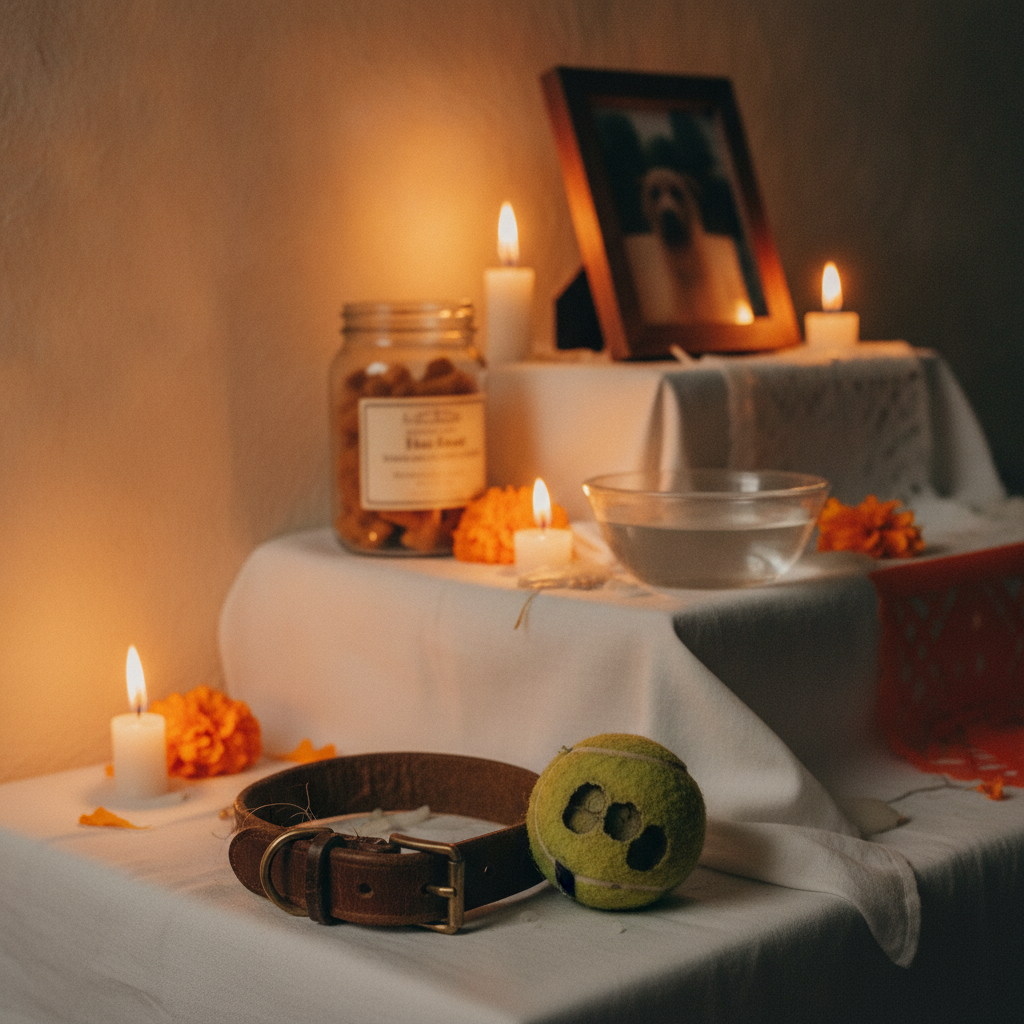
Build it in tiers. Traditionally at least three, representing heaven, earth, and the other world. Stacked boxes or books under a cloth are entirely sufficient. The levels are the bones of the thing.
Include the four elements. Water, in a bowl, for the journey. Fire, as a candle. Earth, usually represented by food. Wind, as something light that moves, most often papel picado, cut tissue paper.
Put their face at the center. A photograph. If you have no photograph, a drawing. This is the part that does the calling.
Add what was unmistakably theirs. The collar. The bald tennis ball. The bag of treats they were not supposed to have. The leash. Specific objects, not generic ones. It is the specificity that makes the altar recognizable as theirs rather than as an altar for pets in general.
Marigolds, if you can get them. Cempasúchil, the bright orange marigold, is said to guide spirits home by scent and color. Any bright fresh flower will do if marigolds are out of reach where you live.
Give it days, not a day. Build it in the last days of October, leave it through the first days of November, and let it sit in a part of the house people pass through.
Then, and this is the part that is not on any instruction list: let people look at it. Let your children look at it. An ofrenda gives a child something to do with a feeling they do not have words for yet, which is more than “she went to live on a farm” has ever done for anybody.
Why this works when a sympathy card does not
Modern grief around pets has a structural problem: it is real, it is often severe, and it is disenfranchised. It is grief the culture does not fully authorize, so it goes unexpressed, and unexpressed grief does not resolve. It just gets quieter.
An ofrenda solves that with three things that cost nothing.
A date. Grief without a container leaks into every day. Grief with an annual appointment has somewhere to go.
A task. You are not sitting with a feeling. You are cutting paper, arranging photographs, finding the collar, buying marigolds. This is why the LA Zoo keeps art supplies on hand. Doing something with your hands is one of the oldest technologies we have for surviving a feeling.
Permission to keep them. The most quietly radical part. The ofrenda is not built on the premise that you must let go and move on. It is built on the premise that they are still yours, and that once a year you set a place for them.
Grief does not get finished. It gets carried, and you get better at carrying it. What an ofrenda offers is not a finish line but an annual appointment, a night set aside to remember the sheer good luck of having had them at all.
And you do not need to be Mexican to be allowed to do this, any more than you need to be Irish to sit up with a body or Jewish to say a name aloud on an anniversary. What you need is a photograph, a candle, some water, and a willingness to say the thing our culture keeps declining to say.
That it was not just a dog.
References
- Doka, K.J. Disenfranchised Grief: Recognizing Hidden Sorrow. Lexington Books.
- Smithsonian Latino Center. Day of the Dead: The Ofrenda.
- National Museum of the American Indian. Día de los Muertos.
- American Kennel Club. Xoloitzcuintli.
- Association of Zoos and Aquariums. Annual Awards.