Most advice about nature and mental health stalls on the same problem: knowing that the outdoors is good for you does not get you out the door. Your pet solves that. A dog who needs a walk is a standing appointment with the outside world, and the research on what that world does to your body is strong enough that it is worth treating those outings as more than a chore to clear.
The catch is that speed cancels the benefit. Marching a loop while your mind grinds on your inbox is exercise, and exercise is great, but it is not the nervous-system reset nature can offer. That reset needs slowness and attention, and those are precisely the things your pet is happy to help you practice. Here are six ways to get it.
1. Walk with no finish line
Pick a direction, not a destination. When you stop treating the walk as ground to cover and start treating it as space to move through, small ordinary moments have room to land. You do not need a summit or a scenic overlook. A stand of trees at the end of your block will do if you let yourself actually be in it. Your dog already lives this way. Follow their lead for once.
2. Let the sniffing happen
The single easiest way to slow a walk down is to stop dragging your dog off every smell. Sniffing is how dogs read the world, and a walk built around their nose instead of your pace forces you into their tempo, which is slower than yours and better for you. Give them a long line and a few unhurried minutes to investigate. You will be surprised how much your own shoulders drop while you wait.
3. Breathe on purpose in front of something big
Researchers who study awe have found that slow, controlled breathing helps anchor you in the present and can even stretch your subjective sense of time, so a few minutes feel more spacious. You do not need a mountain, though a wide view helps. Standing where you can see some sky or water, try a long, even breath, in for a slow count and out for a slightly longer one, repeated a handful of times while you simply look. Your dog will happily sit beside you while you do it.
4. Carry one question out and back
Before you leave, pick one thing you are stuck on, a decision, a worry, a knot you cannot untie at your desk. Do not chew on it while you walk. Just carry it. When you get home, spend two minutes writing down whatever surfaced along the way. Walking and unstructured attention have a way of shaking loose ideas that force never produces, and a pet who needs the outing guarantees you take it.
5. Walk the same path through the seasons
Return to one route again and again across the year and watch it change: bare then green, muddy then frozen, quiet then loud with birds. The point is not the scenery. It is that the trail becomes a mirror. The place is different each visit, and so are you, and noticing the gap between this walk and the last one is a gentle way to see how you have moved through whatever you are carrying. Grief programs use exactly this rhythm, walking mourners along the same ground through the year. You do not have to be grieving for it to work.
6. Get off the obvious path
Most people experience a fraction of a park or a preserve because they never leave the paved loop by the parking lot. The good stuff, the quiet, the wildlife, the feeling of being genuinely alone with your own thoughts, tends to start a little past where the crowd turns around. You do not need backcountry skills. You need to take the smaller trail, go a bit farther than usual, and let the noise thin out. Keep your pet leashed where the rules require it, and mind the terrain, but do wander.
What newer research adds
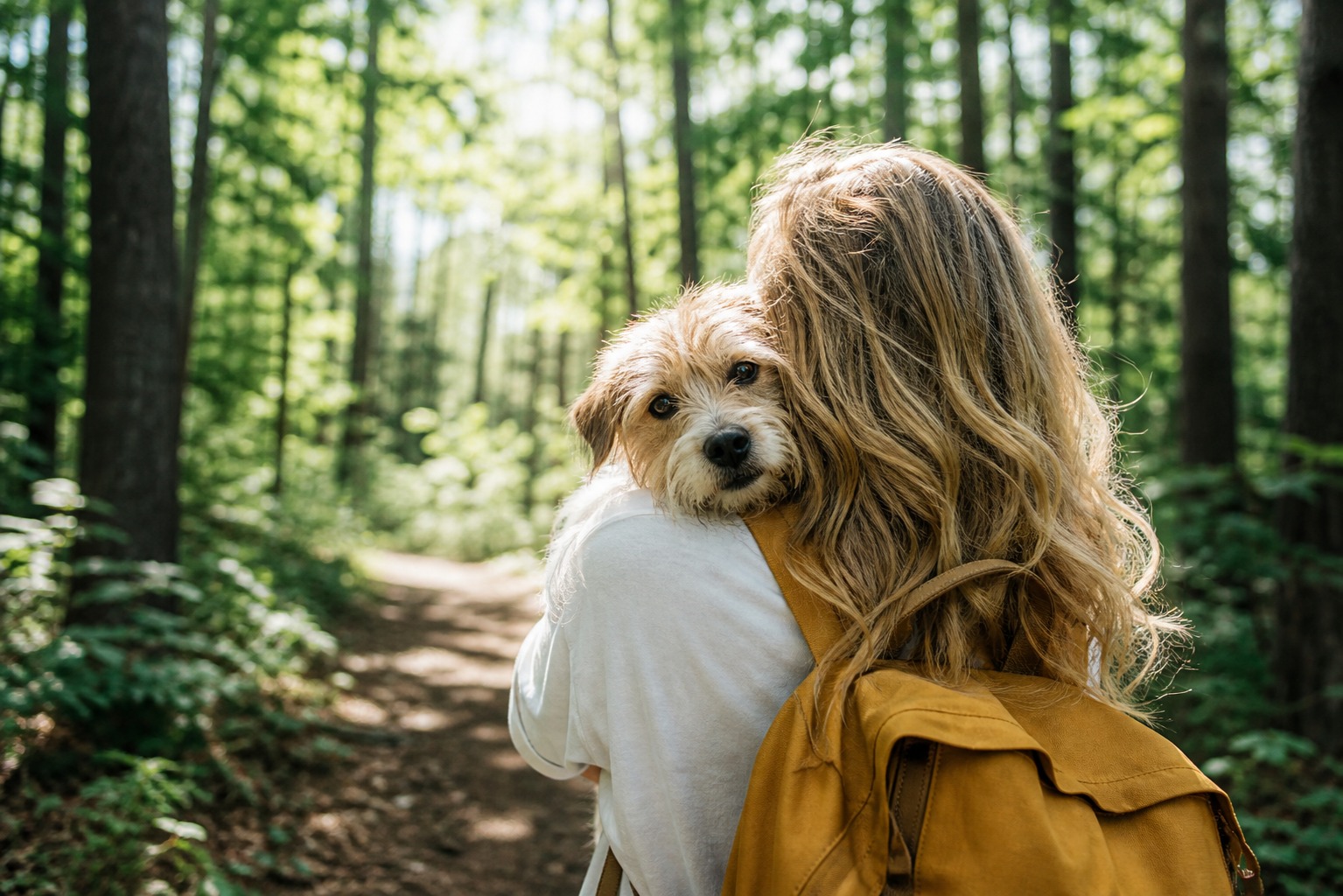
If you want a single number to justify all of this, the Japanese practice of shinrin-yoku, or forest bathing, has one. It is not hiking and it is not exercise. It is slow, attentive time among trees, and it has been studied hard. A meta-analysis of the research found that people’s cortisol, the main stress hormone, was consistently lower after time in a forest compared with time in an urban setting, with measurable drops after as little as twenty minutes. Other work has linked forest time to lower blood pressure, a calmer heart rate, and even a temporary boost in the immune system’s natural killer cells.
The practical version is undramatic. Twenty unhurried minutes among trees, phone away, attention loose, does something real to your body, and you do not have to earn it with sweat. A dog who needs to get out, or a cat who will happily supervise from a catio or a harness in the yard, is the nudge that turns “I should” into “we’re going.” That is the quiet gift of sharing your life with an animal: they will not let you skip the thing that is good for you.
References
- Antonelli, M., et al. (2019). Effects of Forest Bathing (Shinrin-yoku) on Levels of Cortisol as a Stress Biomarker: A Systematic Review and Meta-analysis. International Journal of Biometeorology. https://link.springer.com/article/10.1007/s00484-019-01717-x
- Rudd, M., Vohs, K. D., & Aaker, J. (2012). Awe Expands People’s Perception of Time. Psychological Science. https://journals.sagepub.com/doi/10.1177/0956797612438731
- Kaplan, S. (1995). The Restorative Benefits of Nature: Toward an Integrative Framework (Attention Restoration Theory). Journal of Environmental Psychology. https://www.sciencedirect.com/science/article/abs/pii/0272494495900012