Start with the number, because it reframes everything else on this page.
Researchers with the Dog Aging Project assessed the nutritional completeness of 1,726 homemade diets that owners were actually feeding their dogs, and found that only about 6 percent met essential nutritional requirements. An earlier University of California, Davis analysis of 200 published homemade recipes found that 95 percent produced food deficient in at least one essential nutrient, and more than 83 percent had multiple deficiencies.
Of those 200 recipes, only four had been written by board-certified veterinary nutritionists. All four of those were fine.
Sit with that for a second, because it tells you exactly where the risk lives. It is not in the cooking. It is not in the ingredients. People who cook for their dogs are, as a group, buying better food than the kibble aisle sells. The failure is happening at the level of the recipe, before anyone turns on a stove.
Which means the useful version of this article is not “here is how to cook for your dog.” It is: here is the specific way homemade diets go wrong, here is a starter recipe, and here is the thing you must add to it or the whole exercise backfires.
What “incomplete” actually costs your dog
The deficiencies that show up in these analyses are not random. The recurring ones are calcium, choline, vitamin D, zinc, and vitamin E, and the reason is structural: those are the nutrients that whole human foods, in the combinations people naturally cook, simply do not supply in the ratios a dog needs.
The consequences are not immediate, which is the trap. A dog eating a home-cooked diet that is short on calcium or vitamin D looks great for months. The bowl is clean, the coat is shiny, the poop is good. Deficiency in these nutrients is associated with immune dysfunction, fat accumulation in the liver, and musculoskeletal problems, and those arrive on a timeline of months to years, long after you have concluded that the diet is working.
This is the central asymmetry of home cooking. Commercial food fails loudly, in recalls. Homemade food fails quietly, in a dog who seems fine.
“Nobody comes into my exam room because their home-cooked diet is failing. They come in for something else, and we find it,” says Dr. Amara Solis. “The dog looked wonderful the entire time. That is exactly what a slow nutrient deficiency looks like from the outside, and it is why ‘my dog is thriving’ is not evidence that a recipe is balanced.”
So why do it at all?
Because the upside is real, and the research above does not say otherwise.
Home cooking gives you total control over the ingredients, which is genuinely valuable if your dog has food allergies or dietary sensitivities. You choose the freshest, highest-quality ingredients. You know exactly what is in the bowl. And you can use homemade food as an addition to a commercial food your dog already likes, for variety, though you should talk to their vet before you do.
The pitch is sound. It is the execution that has a 94 percent failure rate. So let us fix the execution.
The balance target, in plain numbers
A nutritionally complete homemade recipe needs to hit rough proportions, and these are the ones to build against:
- Protein: at least 10 percent. Chicken, turkey, fish, or a lean cut of beef.
- Carbohydrate: up to 50 percent. Rice, pasta, potatoes. These pull double duty as a fiber source.
- Fiber: 2.5 to 4.5 percent. Vegetables carry this. Peas, green beans, and carrots are the usual workhorses.
- Fat: around 5.5 percent.
- Vitamin and mineral supplementation.
Read that last line again, because it is the one people skip, and it is the one the research is pointing at. A recipe of chicken, rice, and vegetables is not a diet. It is a base. Without the supplement, you have built the 94 percent version.
Before you start, talk to your vet. They likely have recipes to recommend, they can tell you your dog’s ideal weight, and they can refer you to a board-certified veterinary nutritionist, which is the single highest-value move available here. Remember: every one of the professionally formulated recipes in the UC Davis analysis passed. That is not a coincidence, and consulting one is not overkill.
The slow-cooker method, properly
Long, low heat does something useful to vegetables: it softens the tough ones, kale and parsnips and sweet peas among them, into something a dog will actually eat. And the slow cooker earns its place on scale alone. Run two seven-cup cookers and you come out with roughly nine pounds of finished food, which is what makes this a Sunday habit instead of a nightly chore.
The technique is fussier than it looks.
Sizing. A six- or seven-quart cooker is the sweet spot. Load it to roughly two-thirds full, and never below the halfway mark. Too full and it will not heat through; too empty and it scorches.
Heat. Think of an hour on high as buying you two to two and a half hours on low.
Lids. Leave it alone. Every time you lift the lid to peek, you are giving back 20 to 30 minutes of cooking time.
Prep. Trim the fat off your meat and strip the skin from poultry. Anything ground should be browned and drained before it ever reaches the pot. Defrost everything first, because frozen food does not belong in a slow cooker. And cut to a consistent size, or half your dinner will be mush and the other half raw.
Layering. Build it from the bottom up by density. Sweet potatoes, potatoes, carrots, and the heavy roots (parsnips, turnips, rutabagas) go down first, meat next, and the softer vegetables and fruit ride on top.
Grains. They are thirsty. Cooked alongside everything else, they will pull water out of the pot and you will be topping it up partway through, brown rice especially. The lighter-cooking grains and legumes (oats, millet, whole wheat couscous, barley, bulgur, quinoa, lentils, split peas) do better added at roughly the three-quarter mark, or cooked on their own and folded in at the end. If you do cook them apart, use the leftover broth from the pot as the cooking liquid. It is full of what leached out of the meat, and it would otherwise go down the drain.
Texture. Nobody wants to hand a dog a whole braised chicken thigh. Once it has cooled, tip the batch into a large bowl and break it down: a potato masher works, so does a spatula or the back of a wooden spoon. A grinder or food processor is faster if you have one.
Rotation. Do not run the same recipe for a year. Cycle the protein (chicken and turkey one month, beef and pork the next) and move the vegetables, fruits, and carbohydrates around too. That is not just enrichment. Rotating ingredients is how you dilute the blind spot of any single recipe, which is exactly the failure the studies keep catching.
Storage. Let it cool fully, then portion into freezer-safe containers. What is left in the fridge is good for three to four days. Thaw frozen portions overnight in the fridge, never on the counter.
The one number nobody accounts for: shrinkage
Here is a technical detail that quietly wrecks calorie math.
Meat is mostly water, and it shrinks as it cooks. Cook a pound of chicken and you end up with substantially less meat than a pound in the finished product, which means fewer calories and fewer nutrients than your recipe thinks it has. The USDA publishes retention and yield data for exactly this.
Calculate on the after-cooking weight, not the raw weight. If you want to shift the protein-to-carb ratio, simply add more meat, or cook extra separately and stir it in at mealtime.
Vet-approved slow-cooker starter recipe
This is adapted from a starter recipe by veterinarian Greg Martinez. On a dry-matter basis it lands at roughly 50 percent protein and about 10 percent fat, which makes it leaner and more protein-forward than most of what circulates online.
Use it as a starting point and nothing more. Every dog has specific medical and dietary needs, and this recipe should be reviewed against yours with your vet.
Ingredients
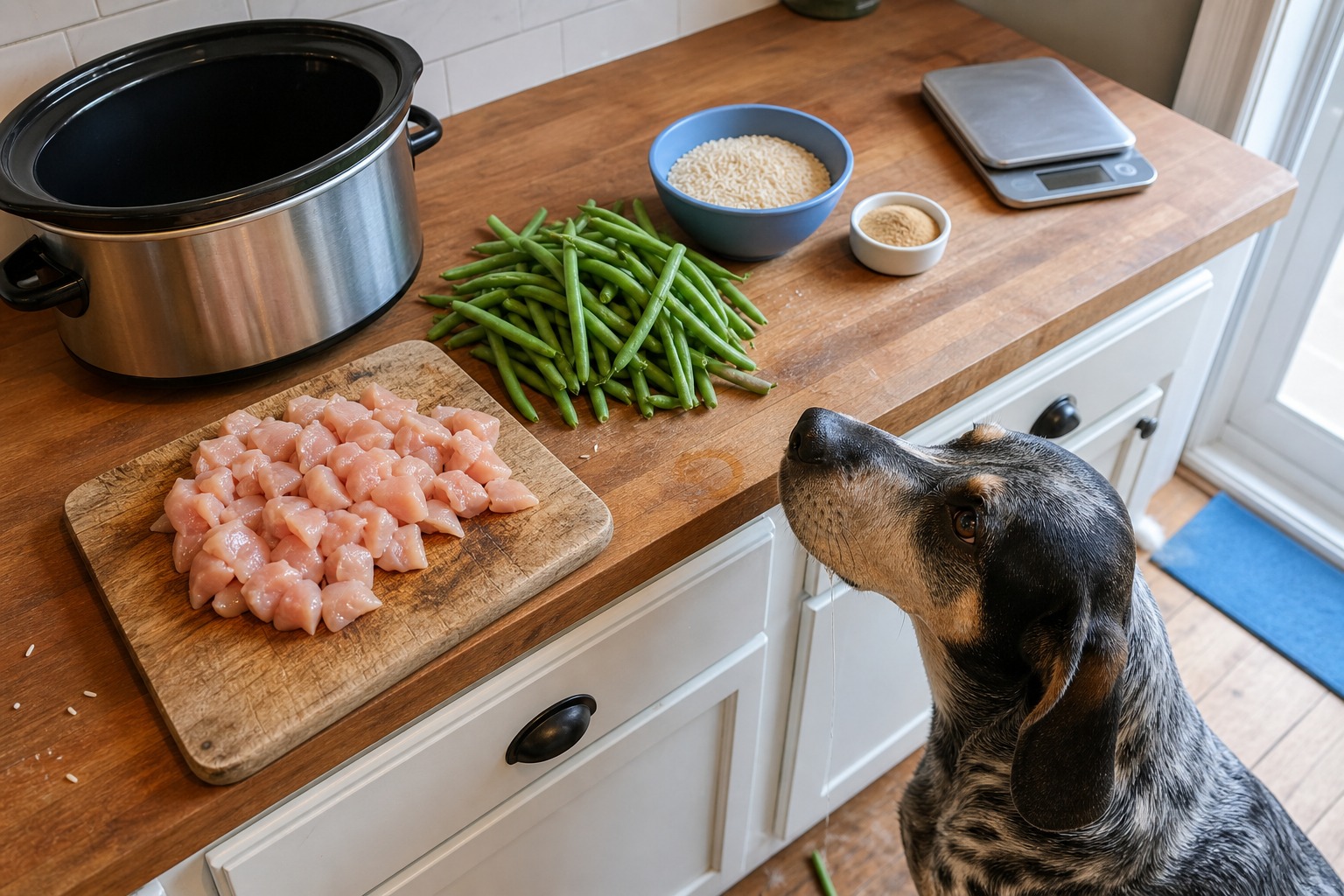
- ¾ to 1 pound cubed, skinless, boneless chicken breast or thighs, or lean beef, turkey, or fish
- 1 to 3 ounces of chicken liver, hearts, gizzards, or another animal liver
- 1 or 2 whole eggs (a source of healthy fat)
- 8 ounces of uncooked white or brown rice
- 16 ounces green beans
- Bone meal, 1 teaspoon (about 1,500 mg) per pound of meat, if this meal accounts for more than 10 percent of your dog’s daily diet
- Water
Directions
- Drop the meat, the organ meat, and the eggs into the cooker together.
- Follow with the rice, the green beans, and the bone meal.
- Pour in water until everything sits below the waterline. It does not have to be fully drowned. Give it a stir.*
- Lid on, low heat, four to eight hours. It is ready when the chicken shreds apart under a fork.
- Stir again, then add water or pour some off depending on whether you want a drier or a wetter stew.
- Cool it completely before anyone eats it or it goes in the fridge.
*The longer it runs, the more water it wants. A 14-hour cook with chicken and bones needs noticeably more than a four-hour one.
What it yields
Depending on the fat content of the meat and the amount of green beans and rice, this mixture approximately produces:
- Quantity: 7 to 8 cups (60 oz.)
- Moisture: 70 percent
- Protein: 10 to 15 percent
- Fat: 5 to 7 percent
- Carbohydrates: 5 to 7 percent
Note the organ meat and the bone meal. They are not garnish. The liver, hearts, and gizzards are carrying micronutrients that muscle meat does not, and the bone meal is the calcium. Leave those out and you have built a very nice chicken-and-rice dish that is a poor long-term diet, which is precisely the mistake the studies keep finding.
How much to feed, actually
There are several formulas for estimating a dog’s daily calorie need, and they will not all give you the same answer. Use one anyway, then correct it against reality. The workflow:
- Estimate the daily energy requirement (DER) in kilocalories from your dog’s age, breed, and activity level.
- Split that total across however many meals you serve, which for most people is two.
- Take the treats out of it. Snacks are calories, and you may have to hunt down a manufacturer’s nutrition panel to find out how many.
Step one is where people guess worst, because “active” is a word everyone applies generously to their own dog. Dr. Christine Zink, a veterinarian and leading expert on canine sports medicine, has published thumbnail definitions that are usefully deflating. Roughly:
| Zink’s activity tier | What it actually looks like |
|---|---|
| Inactive | Little more than a wander around the yard |
| Moderately active | A solid 15 to 30 minutes of continuous exercise daily |
| Active | Two real walks a day, around 45 minutes each |
| Highly active | Several hours of exercise, every day |
Most dogs people describe as “very active” land in row two.
And do not over-trust the arithmetic regardless. Dogs are individuals, and no formula outranks the animal standing in front of you. The real test of a feeding plan is the scale. Weigh your dog, watch the trend, and adjust the portion, not the theory.
The risks worth naming out loud
Raw diets carry an added burden of disease risk, salmonella among them. This recipe is cooked for a reason.
Transitions should be gradual: mix the new food with the old and increase the proportion slowly. Watch for adverse reactions, which may be food allergies. The common canine food allergens are wheat, eggs, chicken, and beef, all of which are candidates in a homemade rotation.
Ongoing monitoring. Keep a record of changes in your dog’s weight and body condition. Stay in touch with your vet about how the change is going, and call immediately if you see vomiting or diarrhea.
What newer research adds
The evidence base on this has sharpened considerably, and it points in one direction.
The Dog Aging Project analysis, published in the American Journal of Veterinary Research, is the largest look yet at what people are really feeding: 1,726 homemade diets, assessed on ingredients and preparation as reported by the owners themselves. Roughly 6 percent were nutritionally complete. Not 6 percent were bad. Six percent were adequate.
That result lines up with the earlier UC Davis work on published recipes, and together they make a claim that is worth taking seriously: the internet’s stock of homemade dog food recipes is, in aggregate, unsafe as a sole diet. Not because the recipes are careless, but because balancing a canine diet from whole foods is a genuinely hard technical problem that looks like an easy cooking problem.
None of that means stop cooking. It means stop free-styling. The single intervention that reliably fixes the failure rate is a board-certified veterinary nutritionist, either to formulate a diet for your dog or to review the one you want to use, and then following it exactly as prescribed rather than swapping ingredients on the fly. Substituting sweet potato for rice because you ran out is exactly how a formulated diet stops being one.
Cooking for your dog is a lovely thing to do. Just do the boring part too.
References
- Dog Aging Project. “Nutritional adequacy of home-prepared diets fed to companion dogs.” American Journal of Veterinary Research. https://avmajournals.avma.org/view/journals/ajvr/ajvr.overview.xml
- Stockman, J., Fascetti, A. J., Kass, P. H., & Larsen, J. A. “Evaluation of recipes of home-prepared maintenance diets for dogs.” Journal of the American Veterinary Medical Association, 2013. https://www.ucdavis.edu/news/homemade-dog-food-recipes-can-be-risky-business-study-finds
- American College of Veterinary Nutrition. “Find a board-certified veterinary nutritionist.” https://acvn.org/directory/
- U.S. Department of Agriculture, Agricultural Research Service. “USDA Table of Cooking Yields for Meat and Poultry.” https://www.ars.usda.gov/northeast-area/beltsville-md-bhnrc/beltsville-human-nutrition-research-center/methods-and-application-of-food-composition-laboratory/mafcl-site-pages/yields/
- U.S. Food and Drug Administration. “Get the Facts! Raw Pet Food Diets Can Be Dangerous to You and Your Pet.” https://www.fda.gov/animal-veterinary/animal-health-literacy/get-facts-raw-pet-food-diets-can-be-dangerous-you-and-your-pet
- WSAVA Global Nutrition Committee. “Guidelines on Selecting Pet Foods.” https://wsava.org/global-guidelines/global-nutrition-guidelines/