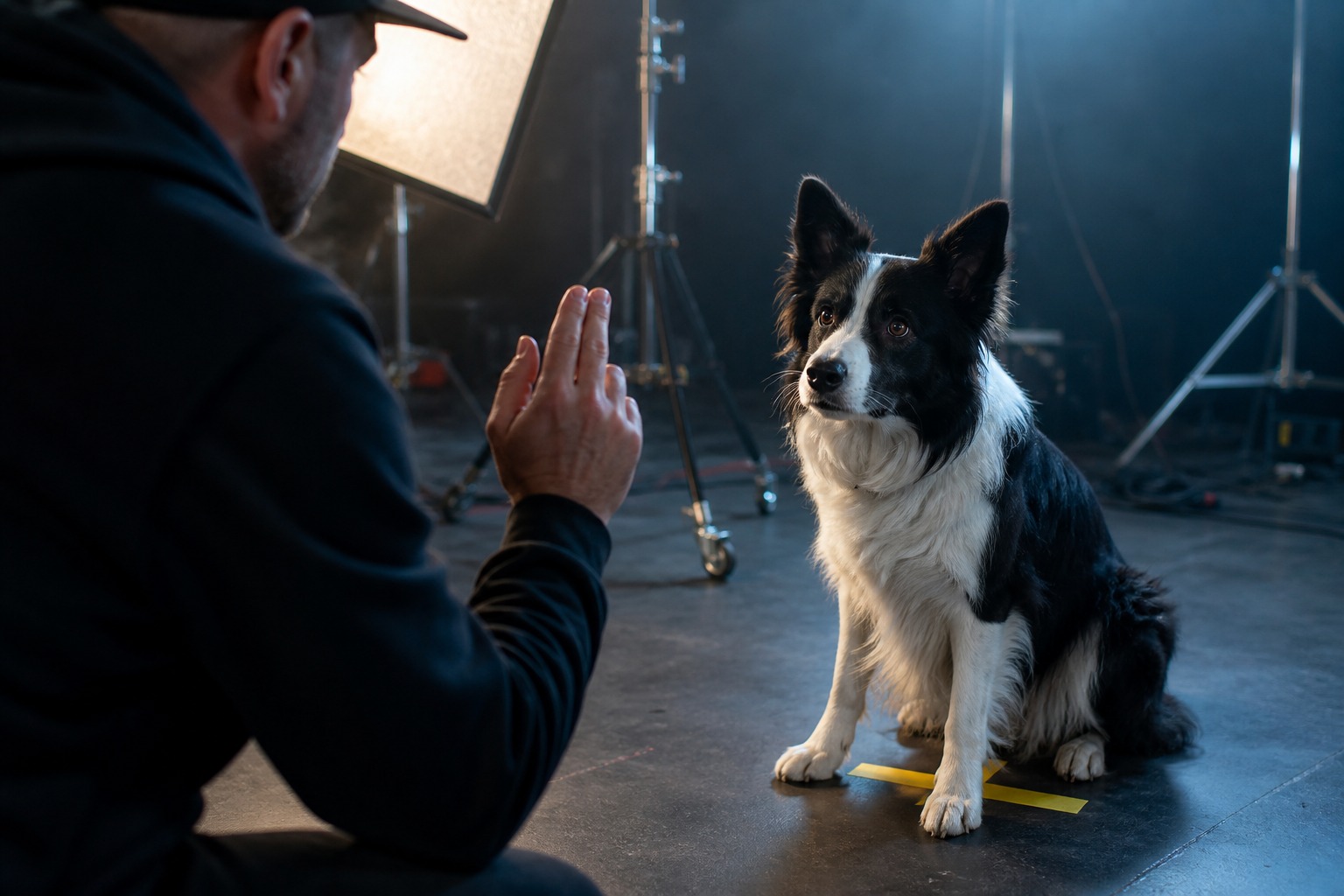
When an animal quietly steals a film, audiences credit the animal. The dog was so expressive. The cat had such presence. What they are really watching is the work of a trainer, usually crouched just out of frame, who spent weeks or months turning an ordinary pet into a performer. It is one of the most demanding and least visible jobs in the business, and the people who do it will happily argue that the old showbiz warning against working with children and animals gets the animals completely wrong.
Teaching a dog to act, not just to obey
Anyone can teach a dog to sit on a mark. The hard part is emotion on demand. Trainer Steve Berens spent four months preparing Gus, a young Goldendoodle who had never worked on camera before, for a central role in the Apple TV+ series Lessons in Chemistry, playing a soulful dog named Six-Thirty who adopts Brie Larson’s chemist. The character had to read as perceptive and desperate to be loved, which meant Berens had to coach Gus not only to hit marks and knock over a trash can on cue but to deliver a specific, longing look at a specific moment. Trainers generally agree that kind of emotional cue is harder to nail than choreographed action, and Berens would know: he also trained the Jack Russell that leaps to Jim Carrey’s rescue in The Mask and readied a German shepherd to co-star with Will Smith in I Am Legend.
One day it’s Meryl Streep, the next it’s a pony party
The range of the work is part of what makes it strange. Veteran trainer Mark Harden’s credits run from an “annoying” monkey perched on Geoffrey Rush’s shoulder in Pirates of the Caribbean to a swarm of 600 rats sharing scenes in the 2003 horror film Willard, and once included wrangling swans and peacocks for a 1989 gala. Many trainers keep working ranches and menageries, animals cast into everything from features and commercials to birthday parties and charity events, so a week can swing from a prestige set to a kid’s backyard.
Tamara Brock, who began working with horses at 13 and runs the New Mexico operation Novel Animals, has trained the tigers in Life of Pi, the camels and kangaroos in Saving Mr. Banks, wolves for a thriller, and a golden retriever on the series Pushing Daisies. Her guiding rule is to stop projecting human feelings onto animals and instead work with each species’ own instincts and social wiring. We read faces; they don’t learn that way.
The job is mostly managing chaos
On a set, every idle minute burns money, and animals add unpredictability that equipment and actors do not. A low-flying camera drone can spook a horse; a missed mark can leave an animal with no idea what to do next. The trainer’s real job is to make the unpredictable reliable.
Brock’s most demanding project may be the brutal climactic fight in Once Upon a Time… in Hollywood, in which a pit bull named Brandy takes apart a trio of intruders. She actually trained three dogs for the single role: an affectionate “hero,” a playful one, and a highly skilled dog for the attack choreography, plus a separate specialist for the defense work. One of them, Sayuri, had to be relaxed enough that Brad Pitt could take a bone from her mouth without a flicker of tension, which made Brock responsible for protecting one of Hollywood’s more valuable assets. The team rehearsed the sequence, in which the dog knocks a revolver from an actor’s hand and lunges without hurting anyone, for three weeks. When the director floated swapping in a puppet at the last minute, Brock’s dog was so ready that she talked him back to the original plan.
Why a good animal is worth the trouble
Directors sometimes assume animals will only cost them time. Brock, who also worked on Django Unchained, makes the opposite case: a well-used animal adds atmosphere and emotional texture to a scene the way lighting or a score does, often without the audience consciously noticing. Trainers occasionally slip their own pets into the frame, too. Kim Krafsky slipped her own cats, Towne and Merle, into Can You Ever Forgive Me?, and Molly Shannon, shooting the comedy Year of the Dog, gravitated to one particular Chesapeake Bay Retriever that turned out to be Harden’s own family dog.
The guardrails that keep it humane
As budgets and safety standards have climbed, so has the profession’s rigor. On most productions involving animals, a monitor from a welfare group like American Humane stays on set to ensure nothing is mistreated, and trainers themselves can hold membership in a local Teamsters union, giving them industry protections of their own. The stakes of getting it wrong are not abstract: the HBO series Luck was canceled in 2012 after three horses died, a case still cited as the reason oversight tightened. Krafsky has said her hardest problem on the crime drama The Drop was the opposite kind of trouble, keeping cast and crew from constantly borrowing the puppies, one of which Tom Hardy reportedly kept spiriting off to his hotel.
What’s new since this was written
The clearest recent proof of how far a trained animal can carry a film is Messi, the French Border Collie who played Snoop in the 2023 courtroom drama Anatomy of a Fall. His performance was singled out at Cannes with the festival’s Palm Dog award, and he went on to appear at the Oscars nominees luncheon and the 96th Academy Awards ceremony in early 2024, a level of attention for a canine actor that would have been unthinkable a decade ago.
The welfare framework has kept evolving alongside the fame. American Humane’s on-set certification program, the source of the familiar “No Animals Were Harmed” end-credits line, remains the industry’s main safeguard, and productions increasingly treat that oversight as a baseline expectation rather than an optional courtesy. The animals are getting their due, and so, slowly, are the people off-camera who taught them how to do it.
References
- ‘Anatomy of a Fall’ Border Collie Messi Wins Palm Dog — The Hollywood Reporter
- Messi (dog) — filmography and awards
- No Animals Were Harmed program — American Humane