The advice people give lonely people is almost always “get a pet,” and it is, for a lot of them, terrible advice.
Not because the underlying idea is wrong. It is not. But the person most likely to be seriously lonely is also frequently the person least able to take on a decade-plus commitment to a living animal: they may be broke, or renting somewhere that says no, or ill, or old, or working the kind of hours that would make a dog miserable. Handing that person a puppy is not a solution. It is a second problem wearing a friendly face.
Which is a shame, because the benefit is real, and almost none of it requires you to own anything.
First, the scale of the thing
Loneliness is not a mood. It is a mortality risk, and it is one that public health bodies have finally started treating as such.
In 2023, the US Surgeon General issued an advisory titled “Our Epidemic of Loneliness and Isolation,” which put the health cost of social disconnection at roughly the level of smoking 15 cigarettes a day. About one in two American adults, he noted, reported experiencing loneliness in recent years, and that was measured before the pandemic tore through everyone’s remaining social scaffolding.
Then, in June 2025, the World Health Organization’s Commission on Social Connection published the global version, and the numbers are worse than most people would guess. One in six people worldwide is affected by loneliness. Social isolation and loneliness are linked to an estimated 871,000 deaths a year, which works out to about 100 people an hour. The report places social disconnection alongside air pollution, tobacco, and alcohol as a public health risk, and it is not being rhetorical.
And the group with the highest reported loneliness is not who you would expect. It is not the very old. It is teenagers and young adults, with 13- to 17-year-olds reporting the highest rates of all, at 21 percent.
What animals actually do about it
The Human Animal Bond Research Institute’s work is the most cited here, and the findings are consistent: people who spend time with animals report less loneliness and less stress, get more physical exercise, and have stronger social ties. Two numbers from HABRI’s survey work are worth holding onto. Loneliness dropped for 80 percent of the pet owners asked. And 54 percent credited the animal with putting them in contact with other human beings.
Look closely at that second number, because it is the one people skip past. More than half the reported benefit was not “the animal is company.” It was “the animal got me talking to humans.”
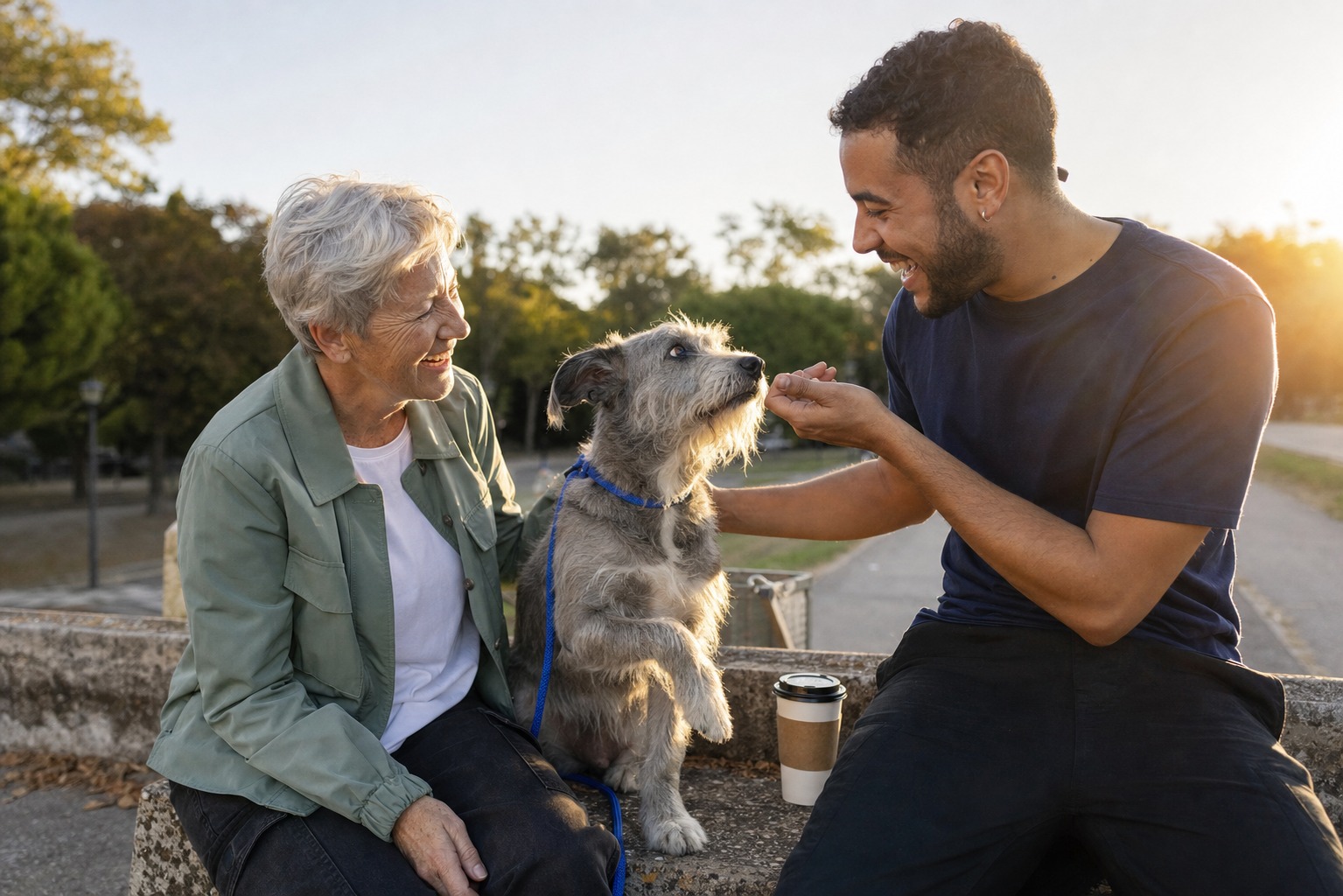
That reframes the whole question. If a big share of what a pet does is act as a social bridge, then you do not necessarily need to own the animal. You need access to one, in a place where other people also are.
Seven ways to get the animal, and the humans
Sorted, roughly, from lowest commitment to highest.
1. Volunteer at a shelter
The lowest-friction entry point there is. Shelters need people for dog walking, cat socializing, cleaning, laundry, and administrative work, and most will take you for a regular shift or on a come-when-you-can basis. You get hours of animal contact, and you get it standing next to other people who chose to spend a Saturday doing the same thing, which is about as easy as adult friendship gets. Wear closed-toe shoes and clothes you do not care about.
2. Visit a cat café
A very cheap dose of the thing. Cat cafés have proliferated well beyond their Japanese origin, and the US now has more than 125 of them, many partnered with rescues so the cats are adoptable. An hour, a coffee, and however much attention the residents feel like granting you.
3. Go to the dog park, with or without a dog
If you already have a dog, this is the most reliably social hour of your week. Dog parks are one of the last places in American public life where it is entirely normal to open a conversation with a stranger, because the conversation topic is standing right there. Look for parks that require proof of vaccination, keep an eye on your own dog, and skip it in extreme heat or cold.
4. Take a class
Puppy socialization classes, basic obedience, agility, scent work. You get a trainer, a room full of people at exactly your stage, and a shared, slightly ridiculous project. If you have just brought home a puppy and are quietly drowning in the regret people call the puppy blues, a puppy class is the single best place to discover that everyone else in the room feels the same and nobody says so out loud.
5. Foster
This is the big one, and it is the one most under-used. Shelters are chronically short of foster homes, and fostering does three things at once: it gets an animal out of a kennel, it gives you weeks or months of full-on animal companionship, and it lets you find out whether you actually want to own a pet without committing to fifteen years of it.
There is even direct evidence for the loneliness effect specifically. Fostering programs aimed at older adults have reported both drops in loneliness and, notably, a very high rate of fosters who end up adopting the animal outright, which tells you something about how well the trial period works.
6. Walk someone else’s dog
The least formal option and the most overlooked. Neighbors who are elderly, ill, working long shifts, or newly disabled frequently have a dog who is not getting enough walks and an owner who is too proud to ask. Offering is a real favor, it is a standing appointment, and it produces a relationship with the human as well as the dog.
7. Adopt, if and only if the shape of your life fits
Not last because it is worst. Last because it is the biggest, and because the honest question is not “am I lonely” but “can I care for this animal well for its whole life.” If the answer is yes, then adopt, and know the evidence is on your side. Compared with people who have no animals, owners hit national exercise targets more often, carry a lower risk of heart disease, and score better on measures of social connection.
If the answer is no, or not yet, the first six options are not consolation prizes. They deliver most of the same thing.
The catch worth naming
An animal is not a substitute for people, and the research does not claim it is. What the data actually supports is subtler and more useful: animals lower the barrier to human contact. They give you a reason to leave the house, a reason to be somewhere at a fixed time, and a subject to talk about with a stranger, which is precisely the machinery that a lonely life is missing.
The WHO report is blunt that loneliness is a structural problem, and it will not be solved one Labrador at a time. But the day-to-day version of the problem, the one where you have not spoken to anyone since Thursday, is often solved by a standing Saturday shift at a shelter full of dogs and the people who show up for them.
The shelters are overflowing. They would love to see you.
References
- Office of the U.S. Surgeon General. “Our Epidemic of Loneliness and Isolation: The U.S. Surgeon General’s Advisory on the Healing Effects of Social Connection and Community.” U.S. Department of Health and Human Services, 2023. hhs.gov
- World Health Organization. “Social connection linked to improved health and reduced risk of early death.” Report of the WHO Commission on Social Connection, 30 June 2025. who.int
- Human Animal Bond Research Institute. “The Health Benefits of Companion Animals.” HABRI. habri.org
- Holt-Lunstad, Julianne, et al. “Loneliness and Social Isolation as Risk Factors for Mortality: A Meta-Analytic Review.” Perspectives on Psychological Science, vol. 10, no. 2, 2015, pp. 227-237. journals.sagepub.com