There is a specific kind of modern self-care ritual, the diffuser humming in the corner, eucalyptus mist drifting over the couch, your nervous system supposedly resetting without you having to move. It’s lovely. It’s also, if you share your home with a cat, potentially a slow-motion poisoning, and the reason comes down to a single fact of feline biology that most diffuser packaging will never mention.
The core issue is this: your cat is not a small human, and its liver proves it. Cats lack an important liver enzyme that people and even dogs have, and without it their bodies struggle to break down a range of compounds, essential oils very much included. What washes harmlessly through your system can accumulate in your cat’s, and the results range from vomiting and labored breathing all the way to liver failure. The Pet Poison Helpline notes that a higher concentration of oil translates directly into higher risk. So before you write this off as fussy overcaution, understand that the biology is not on your cat’s side.
The oils that are actually dangerous
Not every oil is equally risky, but the list of ones flagged as hazardous to cats is longer than most people expect. The Pet Poison Helpline names cinnamon, citrus (d-limonene), clove, eucalyptus, pennyroyal, peppermint, pine, sweet birch, tea tree, wintergreen, and ylang ylang as hazardous to cats.
Dog owners aren’t fully off the hook, either. Poison-control resources and veterinary hospitals cite a shorter but overlapping set as dangerous or simply bad for dogs, including pennyroyal, pine, tea tree, wintergreen, cinnamon, citrus, peppermint, sweet birch, and ylang ylang. If you have both species under one roof, treat the stricter, cat-focused list as the rule for the whole household.
The diffuser type is the plot twist
Here’s the detail that changes how you should think about this: how the oil gets into the air matters enormously, and the modern, popular kind is the worse kind.
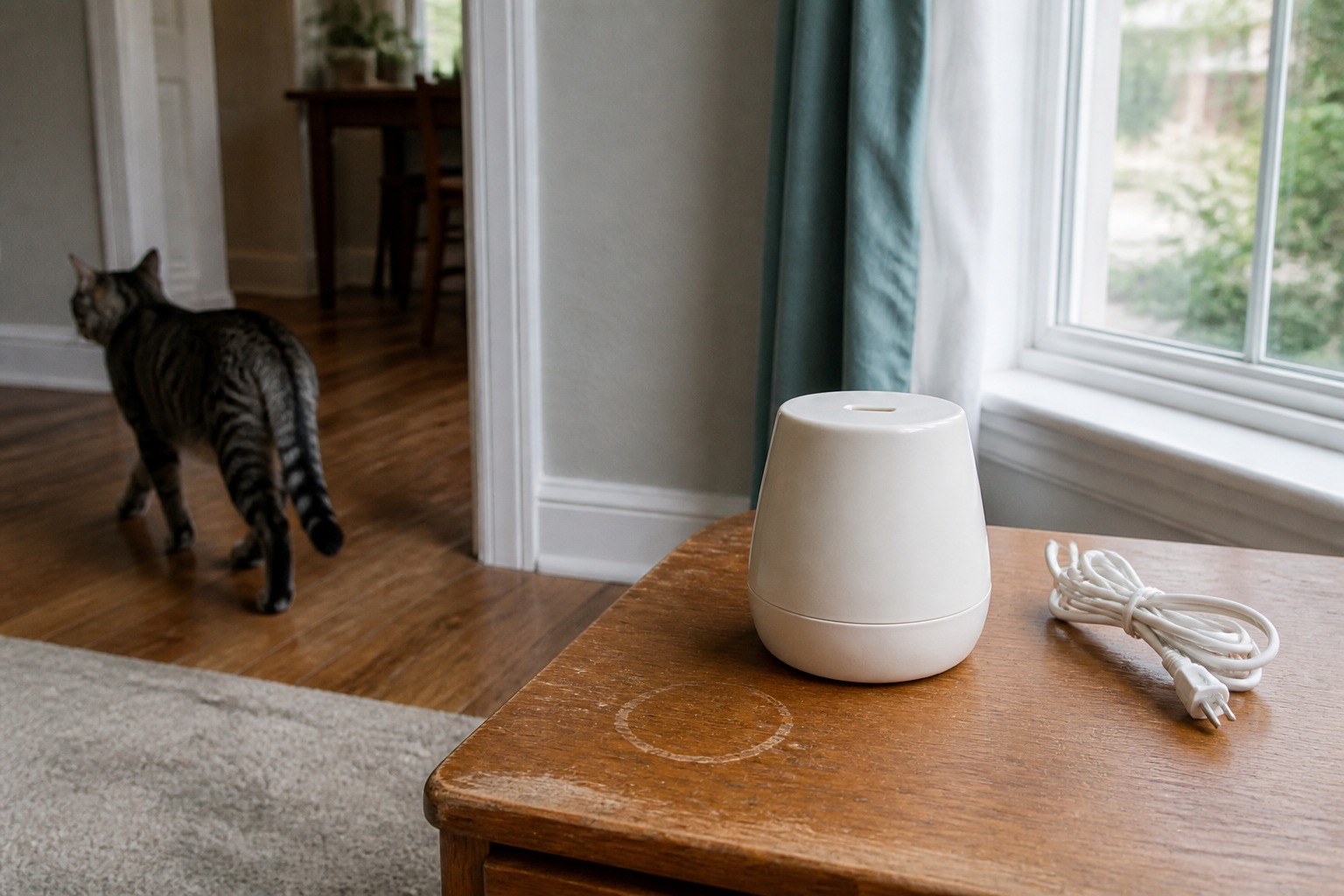
The riskier category is the active diffuser, the plug-in units that spritz a fine, nice-smelling mist. Nebulizing and ultrasonic diffusers fling tiny droplets of both water and oil into the air. Those droplets can land on a cat’s fur, where the cat then either absorbs the oil through its skin or, more commonly, ingests it while grooming, which for a fastidious self-cleaner is more or less guaranteed. With an active diffuser, the oil can hit a cat three ways at once: inhaled, groomed off the coat, or absorbed through the skin.
The older passive diffusers, reed diffusers or heated plug-ins, are safer but not risk-free. Danger can still come through inhalation or ingestion, and there’s the added hazard of a curious cat deciding the reeds look chewable. Watch for troubled breathing, panting, or wheezing, watery eyes or nose, or vomiting, and if any of that shows up, get your cat to fresh air immediately and to a vet if it doesn’t resolve quickly.
The full symptom picture with active diffusers can include drooling, vomiting, tremors, wobbliness or ataxia, trouble breathing, a low heart rate, and even liver failure, with small cats, kittens, and cats that have pre-existing conditions at elevated risk. These aren’t mild reactions; some are life-threatening.
“The thing owners underestimate is grooming,” says Dr. Amara Solis. “People picture a cat having to lick a bottle of oil to get sick, but an ultrasonic diffuser quietly coats the fur in a fine film, and then the cat does what cats do, it cleans itself, and swallows the dose. By the time you notice drooling or a wobbly walk, the oil’s already been ingested. With a cat in the house, an active diffuser is a risk that isn’t worth the vibe.”
Please don’t use essential oils for fleas and ticks
One especially common trap deserves its own warning. Search how to handle fleas and ticks naturally and you’ll find endless recommendations for essential oils, often the very ones on the danger list, eucalyptus, mint, tea tree, citrus. There may be some early lab research suggesting a few of these compounds can repel certain insects, but those studies almost always test repellent efficacy in a dish, not safety on an actual pet.
Sometimes these DIY lists specifically target dog owners and pick oils that are “less dangerous” for dogs. Even then, tread carefully, and in a multi-pet home, don’t use them at all, because your cat may decide to groom your dog and pick up a mouthful of something toxic. For parasite control, talk to your vet: the major flea and tick medications are rigorously tested and certified by the FDA or EPA before they ever hit shelves, which is exactly the safety data the homemade oil approach lacks.
What to use instead
The good news is you don’t have to choose between a nice-smelling home and a safe cat. Passive diffusers are, overall, meaningfully safer than active ones; you lose the face-full-of-mist experience but dramatically cut the danger to your animals, particularly when you choose oils that sit nowhere near the hazard list and keep the diffuser out of paw’s reach. The same logic applies to scented candles, keep watching for any adverse reaction, and know that while some candles are marketed as pet-friendly, that’s a claim worth scrutinizing.
And honestly, the lowest-tech option might be the best one: bake something. Cookies, bread, whatever. Your house smells incredible, your cat stays safe, and you end up with cookies. It’s hard to argue with the math.
What’s new since this was written
Poison-control data suggests the problem is growing, not shrinking, as diffusers become household staples. The ASPCA Animal Poison Control Center has reported that calls involving essential oil exposure in pets rose meaningfully in recent years, with cats making up the majority of those cases, an unsurprising split given feline biology and grooming habits. Veterinary toxicologists continue to emphasize the same core points: cats can’t metabolize the phenols and terpenes in many oils, active diffusers pose the greatest risk because of airborne droplets settling on fur, and skin exposure alone has produced serious signs like unsteady walking, muscle weakness, and even loss of consciousness. If you take one thing from the latest guidance, make it this: with cats in the home, the safest essential-oil diffuser is the one you don’t run. Keep the Pet Poison Helpline (855-764-7661) and ASPCA Animal Poison Control (888-426-4435) numbers handy just in case.