


Your 80-Pound Dog Knows He's Not a Lapdog. He's Choosing You Anyway
That giant dog flattening you on the couch isn't confused about his size. New research shows dogs carry a real sense of their own body, and they use it to make decisions. Sitting on you is one of them.

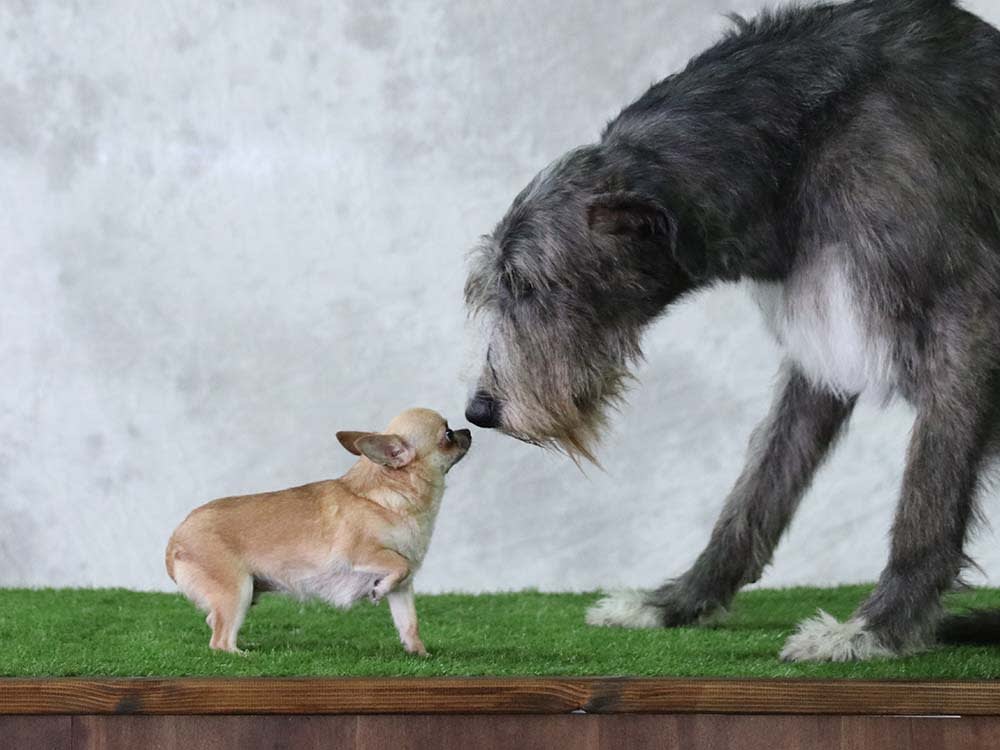
You know the scene. An eighty-pound dog surveys the room, considers the several perfectly good dog beds available, and instead folds himself onto your lap like a teacup breed, driving the air out of your lungs. It’s tempting to read this as adorable cluelessness, a dog who simply hasn’t noticed he’s enormous. The research says otherwise. Your dog almost certainly knows how big he is. He’s just decided it doesn’t matter, because being on you is the point.
That reframing turns a running joke into something more interesting. The question “do dogs know how big they are?” has quietly picked up real experimental answers over the past few years, and they lean toward yes. Which means the giant lapdog isn’t a comedy of errors. It’s a choice, made by an animal who understands his own dimensions and prioritizes closeness over comfort, yours or his.
People assume the big dog on your lap is confused, and it’s the opposite. Body awareness and social motivation are two different systems. One tells a dog how much room he takes up. The other tells him where he wants to be. When those disagree, closeness usually wins, and that’s not a mistake, it’s a preference.
The evidence that dogs know their size
For a long time this was guesswork. Then researchers started designing clever tasks, and the picture sharpened.
In a 2021 study, scientists tested whether dogs treat their own body as a physical obstacle, a hallmark of body awareness. Dogs stood on a small mat and were asked to pick up an object and bring it to their owner. When the object was attached to the mat, so that the dog’s own weight was pinning down the thing they needed to lift, dogs stepped off the mat sooner and more often than when the object sat loose on the ground. In other words, they recognized that their body was the thing in the way, and adjusted. It was some of the first convincing evidence that dogs grasp the consequences of their own physical presence.
A 2023 study out of Eötvös Loránd University in Hungary pushed further, into body-size awareness specifically. Nearly 70 family dogs faced a transparent fence with a treat behind it and two ways to reach it: a long detour around, or a short cut straight through a doorway that was small, large, or closed depending on the trial. Dogs sized up the doorway. When it was big enough, they took the shortcut without hesitation. When it looked too small for their body, they gave up on it and took the long way around instead. They were, in effect, measuring themselves against the gap, flexibly, in a situation they’d never encountered before. Follow-up work has since found this body-size awareness in mixed-breed dogs too, suggesting it’s a broad canine trait rather than a quirk of certain lineages.
The honest counterargument
Good science leaves room for doubt, and there’s a reasonable alternative reading. Dogs spend their whole lives moving through and between things, so maybe these experiments show something a little simpler: that dogs have learned, from endless experience, what they can and can’t squeeze through. A dog might hesitate at a small opening not because he’s consulting an internal body-map but because a lifetime of bonking into doorframes taught him that certain gaps don’t work out.
The results fit both explanations, and they don’t cleanly rule the second one out. What’s clear either way is that dogs behave as though they understand their size, whether that understanding comes from an abstract self-representation or from hard-won practical experience. For the purposes of the dog on your lap, the distinction hardly matters. Either he knows he’s big, or he’s learned he’s big. He’s still choosing you.
Body awareness can be trained
Here’s the useful part: whatever a dog starts with, body awareness improves with practice, and trainers build it deliberately. Dogs who compete in agility go through exercises designed to sharpen exactly this sense, walking backward, weaving through a handler’s legs, crawling forward and back, and placing front or back paws on a platform.
A favorite drill is walking over a ladder laid flat on the ground. Dogs who’ve practiced it are far less likely to clip the rungs, especially with their back paws, than dogs meeting the task for the first time. Trainers often joke that dogs need to be taught where their back feet are, and there’s truth in it: rear-end awareness is genuinely learnable. Many believe a dog who’s developed it is also less likely to plant a paw on your bare foot, which, if you share your home with a large and affectionate animal, may be the most practical payoff of all.
What newer research adds
The last few years have quietly transformed this topic from cocktail-party speculation into a small, real body of cognition research. The 2023 detour study gave us the first solid evidence of flexible body-size awareness in dogs, and newer work extending it to mixed-breed dogs suggests the ability isn’t limited to any particular type of dog. Researchers now frame self-representation in dogs as modular, meaning a dog can show body awareness on these physical tasks even though dogs famously flunk the mirror self-recognition test, a reminder that “self-awareness” isn’t one thing you either have or don’t. For owners, the update is simple and a little charming: the science increasingly says your dog knows his own size. The lap-sitting is on him.
References
- Dale, Rachel, et al. “Dogs (Canis familiaris) Recognize Their Own Body as a Physical Obstacle.” Scientific Reports, vol. 11, 2021, https://www.ncbi.nlm.nih.gov/pmc/articles/PMC7893002/.
- Rivas-Blanco, Daniela, et al. “Body Size Awareness Matters When Dogs Decide Whether to Detour an Obstacle or Opt for a Shortcut.” Scientific Reports, vol. 13, 2023, https://doi.org/10.1038/s41598-023-45241-w.
- Pongrácz, Péter, et al. “Body Awareness Does Not Need a Pedigree: Mixed-Breed Dogs Rely More on Self-Representation Than Social Learning in a Spatial Task.” Animals, 2025, https://www.ncbi.nlm.nih.gov/pmc/articles/PMC11816050/.
Common questions
Do dogs know how big they are?
Recent studies say yes, at least in a practical sense. Dogs act on an internal sense of their own body size when they decide whether they'll fit through a gap, and they treat their own body as an object that can get in the way. It's not human-style self-reflection, but it is real body awareness.
If my dog knows his size, why does he sit on me like a lapdog?
Because closeness beats comfort in his math. Body awareness tells him he's big; it doesn't tell him to care. Leaning and lying on you is contact-seeking and security, so a dog who fully knows his size may still choose your lap on purpose.
Can I improve my dog's body awareness?
Yes. Agility-style exercises like walking over a flat ladder, backing up, weaving through your legs, and placing paws on a low platform all sharpen a dog's coordination and sense of where their body, especially their back paws, actually is.
Dr. Chen is a small-animal veterinarian who leads health and safety coverage at The Pet Times. She writes and reviews the bulk of our illness, condition, and safety content, translating clinical guidance into clear, practical advice owners can act on at home.
Meet our experts ↗Keep reading
 TrainingYour Dog's Behavior Problem Probably Isn't Your FaultDr. Nina Kohl · 6 min
 TrainingYour Two Dogs Used to Be Best Friends. Here's Why That Cracked, and Why It Won't Just Pass.Dr. Mara Chen · 6 min
 LivingYour Dog Doesn't Care About Your Square Footage. It Cares About You.Marcus Webb · 9 min
 TrainingYour Dog Isn't Antisocial. They're an Introvert.Dr. Nina Kohl · 6 min
 TrainingYour Dog Knows You're Coming Home. It's Smelling Time Pass.Dr. Mara Chen · 5 min
 TrainingThat Embarrassing Baby Voice? Your Dog Is Begging You to Keep Doing It.Dr. Amara Solis · 5 min