
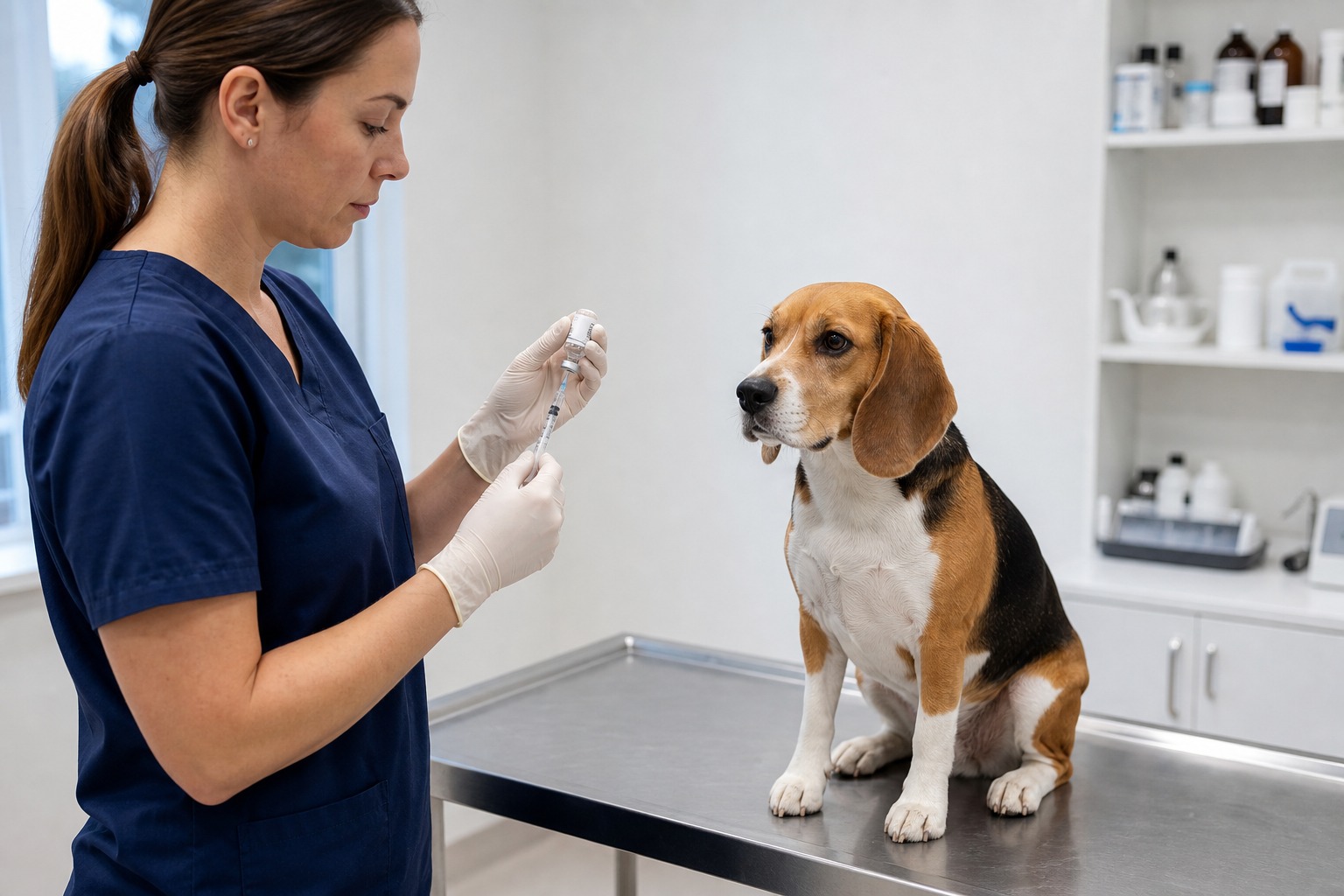
For years, the vaccine schedule ran on autopilot: the reminder postcard arrived, and your dog got another round of shots, whether or not their immune system actually needed them. That reflex is worth questioning. Vaccines are genuinely important, but there is now a simple blood test that lets you and your vet make the call based on your individual dog’s immunity rather than the calendar. It is called a titer test, and for the core viral diseases it can spare a well-protected dog from shots they don’t need.
This is not an anti-vaccine argument. It is the opposite: it is about vaccinating precisely, giving the shots that protect and skipping the ones that would only add risk without adding immunity. Here is what a titer test measures, what it can and can’t do, and which dogs stand to gain the most.
What a titer test actually measures
A “titer” is a way of measuring the level of antibodies in a blood sample for a specific disease. Your vet draws a small amount of blood and runs it through the test. Results are usually expressed as a ratio. A high titer means your dog has enough antibodies to fend off that particular disease and is considered immune. For most dogs that immunity comes from a previous vaccine, though a dog can also develop it after surviving the disease itself. Either way, a strong titer means your dog is protected right now.
A low titer is a flag, not a verdict. Your dog may still have some residual protection, but a low result is the cue for you and your vet to talk about revaccinating.
The practical breakthrough of the last couple of decades is that this no longer requires a specialty lab. In-clinic kits, among them VacciCheck (made by Biogal Laboratories) and TiterCHEK (from Synbiotics), let an ordinary veterinary practice run a titer during a normal visit. Because the kits are cheap, reliable, and processable right in the clinic, many vets now weave titer testing into routine preventive care, using the results to shape a vaccine plan for the individual dog that keeps protection up while sparing unneeded boosters.
“The goal was never to vaccinate less for its own sake. It’s to vaccinate exactly as much as a given dog needs,” says Dr. Ravi Mehta. “A titer lets me look at real evidence of a dog’s immunity instead of guessing from a date on a chart.”
What it costs
Titer pricing varies, much like vaccine pricing does. The in-clinic VacciCheck, which screens for three diseases (parvovirus, distemper, and adenovirus, the virus behind canine hepatitis), typically runs between $45 and $80, slightly above what most vaccines cost. Send-out laboratory titers can climb higher, occasionally to around $200 apiece, so it is worth asking your clinic which method they use before you assume a price.
Which diseases titers can check, and which they can’t
Four diseases can be checked reliably by titer: rabies, distemper, parvovirus, and adenovirus. But availability is not the whole story, and two important limits shape how titers get used.
First, the core viral three are where titers shine. The American Animal Hospital Association considers a titer an appropriate way to confirm immunity to parvovirus, distemper, and adenovirus. Titers are not recommended for leptospirosis, Bordetella, or Lyme disease, because those vaccines only provide short-term protection, so a titer wouldn’t tell you anything useful about ongoing coverage. There are vaccines for other illnesses, such as canine influenza, but accurate titers for them aren’t currently available.
Second, rabies is a legal category all its own. Rabies vaccines do give long-term protection, and rabies titers are actually a very accurate measure of immunity. But no U.S. state accepts a titer result in place of a rabies vaccination record, because rabies vaccination is mandated by law. Practically, that means you should keep your dog on the standard rabies schedule (usually every three years) regardless of what a titer would show. If your dog ever bites someone, they will still face quarantine based on vaccine history, not titer results. The one place a rabies titer earns its keep is travel: specific rabies titer tests are used to qualify a dog for shortened quarantine when moving to rabies-free regions such as Hawaii, Japan, New Zealand, and Great Britain.
How long a titer “lasts”
Most veterinarians recommend repeating a titer for a given disease every one to three years, even though many vaccines protect for three years or longer. In fact, some studies have found that a large majority of dogs, over 90 percent in certain research, still carry protective antibody levels from a vaccine for seven to nine years. That is a striking gap between how long immunity often lasts and how often dogs have historically been revaccinated. The practical rule: if you can’t titer for one of your dog’s diseases in a given year for any reason, don’t agonize over it, just take your dog in for the booster.
The real risks
Like any test, titers aren’t perfect. Occasionally a titer returns a false positive or a false negative. A false result can lead a pet parent to vaccinate when it wasn’t needed, or, more concerning, to skip a vaccine their dog genuinely needed. There is also a behavioral risk that has nothing to do with the test itself: some owners use titers as a reason to stop vaccinating and then quietly stop titering too. That is the dangerous combination. Titering in place of automatic boosters is reasonable. Abandoning both leaves a dog unprotected against serious, preventable diseases.
Who benefits most from titer testing
For a lot of dogs, a titer is a nice-to-have. For certain dogs, it is genuinely valuable. Consider it especially useful in these situations:
The dog with a vaccine reaction history. If your dog has reacted badly to a vaccine before, a titer can confirm they are still protected without another dose. The immunocompromised dog. Dogs on immune-suppressing medication or managing chronic disease benefit from vaccinating only when truly necessary. The newly adopted dog with unknown history. When you have no records, a titer tells you where your dog actually stands. The puppy finishing its shot series. A titer can confirm that a young dog responded to its initial vaccines and is fully protected. If a pup didn’t respond, it may mean the vaccine was compromised, the mother’s immunity was still interfering, or the dog is a genuine non-responder, all worth knowing. The senior dog. For older dogs who were effectively vaccinated as puppies, revaccinating can be unnecessary and, given aging immune systems and chronic conditions, sometimes riskier. A titer helps you skip what isn’t needed.
Titers are also gaining ground in animal shelters, though with a very different aim. There, they help staff sort low-risk animals from high-risk ones during an outbreak: a shelter dog whose titer against the circulating disease runs high is at low risk, can be housed apart from vulnerable animals, and may be considered adoptable. Maddie’s Fund has published useful guidance on using titers this way to fight shelter outbreaks.
Is a titer right for your dog?
If your dog is a previously vaccinated adult, a titer is a solid way to confirm ongoing immunity to parvovirus, distemper, and adenovirus before automatically boostering. It is also a smart move for a newly adopted dog of unknown background, for puppies finishing their series, and for seniors and immunocompromised dogs where every unnecessary shot is worth avoiding. Vaccinating protects your dog and the wider community of dogs around them. Titer testing simply removes the guesswork about whether this year’s shot is one your dog actually needs.
What newer research adds
The most recent AAHA canine vaccination guidance still does not fold routine titer testing into its general recommendations, but it does lay out clearly how vets can interpret a dog’s serologic (antibody) status as a marker of immune protection, which is exactly what makes evidence-based, individualized vaccine plans possible. In other words, the science supports using titers thoughtfully, even if “titer everything” is not the official default.
The other shift is access. In-clinic titer kits are now common enough that many general practices can run one during an ordinary appointment, which has moved titering from a niche request into a realistic option for everyday pet parents. If it interests you, it is a reasonable thing to raise at your dog’s next wellness visit.
This article covers vaccination decisions, which are medical. Use it to have a better conversation with your veterinarian, not to replace their advice for your individual dog.
References
- American Animal Hospital Association. “2022 AAHA Canine Vaccination Guidelines.” aaha.org
- American Animal Hospital Association. “2022 AAHA Canine Vaccination Guidelines,” Journal of the American Animal Hospital Association 58(5). jaaha.kglmeridian.com
- Maddie’s Fund. “Using Antibody Titer Testing to Manage Disease Outbreaks in Shelters.” maddiesfund.org
- Bergmann, M. et al. “Antibody Response to Canine Parvovirus Vaccination in Dogs.” Viruses. ncbi.nlm.nih.gov