Search “remove dog tartar at home” and you’ll find a confident parade of fixes: coconut oil, apple cider vinegar, carrots, special gels. Here’s the thing nobody selling those fixes says plainly: once tartar has formed, none of them will take it off. Tartar is plaque that has mineralized into something close to cement, and the only thing that removes it completely is a professional cleaning.
That sounds discouraging. It’s actually liberating, because it tells you exactly where your effort matters. Plaque takes roughly 24 to 72 hours to harden into tartar. Inside that window, you have all the power: plaque is a soft film that brushing wipes away. Outside it, the job belongs to your vet. This article is about doing your half well and knowing when to hand off the other half.
The 72-hour chemistry, briefly
Plaque is a sticky film of bacteria that forms on teeth constantly, in dogs exactly as in people. Combine it with the minerals in your dog’s saliva and it calcifies into tartar, that hard yellow-brown crust, within about one to three days. Brushing removes plaque easily. It cannot remove tartar at all.
Left alone, tartar causes real trouble: gingivitis with red, swollen gums; foul breath from bacteria producing smelly compounds; gum recession that exposes tender tooth roots; pain that makes eating a chore; and infection as tartar creeps below the gumline, where it can seed abscesses. From there, mouth bacteria can spread to the heart, kidneys, and liver. Dental disease is whole-body disease.
Some dogs build tartar faster than others. The accelerants include infrequent brushing, soft food that requires no chewing, high-carbohydrate diets that feed oral bacteria, saliva that’s naturally rich in minerals, crowded or misaligned teeth, softer enamel, older age, dry mouth from medications, underlying conditions like diabetes or immune disorders, and simply skipping professional cleanings for years.
Your half: winning the plaque war
Everything below works on plaque, the soft stuff, before the 72 hours run out. That’s not a consolation prize. Done consistently, this is what determines whether your dog needs a cleaning every year or can go several years between them.
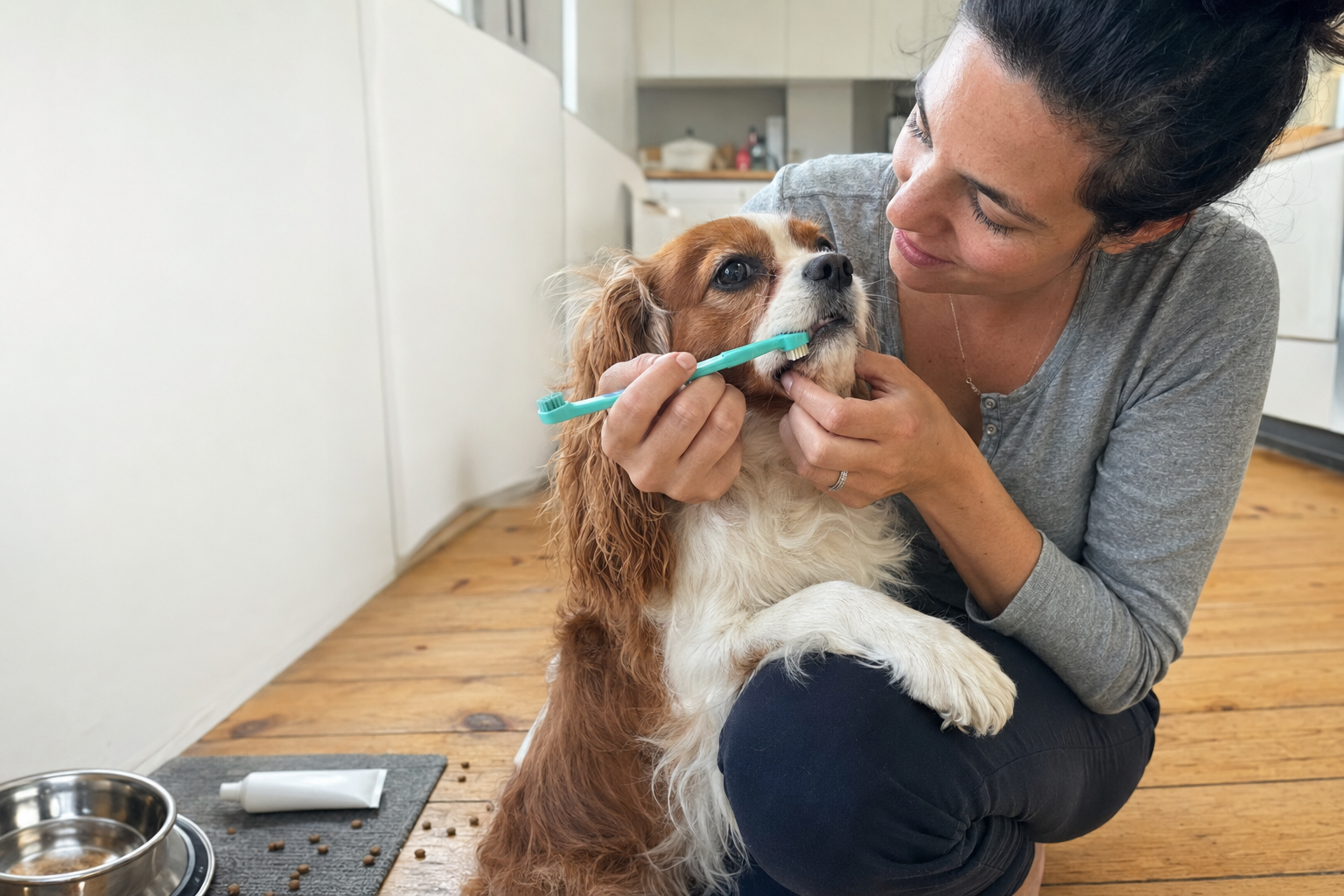
Brushing is the whole ballgame. Nothing else you do at home comes close. Use a dog toothbrush or finger brush and a toothpaste made for dogs, never human toothpaste: its fluoride load is wrong for dogs, and some formulas contain xylitol, a sweetener that’s poisonous to them. Lift the lips, brush in small circles, and give the gumline most of your attention. Daily is the goal, but even two or three sessions a week helps.
Sprays and gels back up the brush. Choose products made for dogs, and check the label for the VOHC seal from the Veterinary Oral Health Council, which means the product actually proved it slows plaque or tartar. Useful ingredients to recognize on labels: enzymes like glucose oxidase and lactoperoxidase that target oral bacteria, chlorhexidine gluconate (a potent veterinary antiseptic), mild abrasives like baking soda, soothing aloe vera, natural antimicrobials like neem oil and grapefruit seed extract, thyme leaf oil’s antiseptic properties, and breath-freshening peppermint or spearmint oils. Ask your vet before using anything with essential oils.
The kitchen-cabinet tier. Some low-tech options can chip in, especially right after a professional cleaning when you’re starting from clean teeth: brushing with baking soda, coconut oil rubbed on teeth and gums with a finger, apple cider vinegar diluted 1:10 in water (added to the bowl or dabbed on with a cotton ball), crunchy vegetables like carrots, fresh parsley or mint mixed into food for breath, enzyme or aloe water additives, dog-specific oral probiotics, and natural dental chews and chew toys. Treat these as helpers, not heroes. If the tartar is already thick, they will not rescue the situation.
Chewing counts. Dogs who chew appropriate toys and dental chews mechanically scrape plaque off as they go. A dog on soft food who never chews anything is running the plaque race with no help.
The vet’s half: everything below the gumline
There comes a point for every dog, however good your brushing, when a professional cleaning is due. Watch for: persistent bad breath, visible tartar, red, swollen, or bleeding gums, drooling or trouble eating, loose, broken, or missing teeth, pawing at the mouth, facial or jaw swelling, repeatedly dropping food or toys, stained teeth, receding gums or exposed roots, irritability or flinching when the mouth is touched, and pus, discharge, or obvious abscesses. Any of those means it’s vet time.
Here’s what actually happens in the dental suite, since most owners never see it:
- Pre-anesthetic workup. A full exam and blood tests confirm your dog can safely have general anesthesia.
- Scaling under anesthesia. An ultrasonic scaler plus hand instruments remove tartar above and, crucially, below the gumline. That subgingival zone is where periodontal disease lives, and it can’t be reached on an awake dog.
- Polishing and protection. Teeth are polished smooth so plaque has a harder time re-adhering. Some vets follow with fluoride or a sealant. If anything looks off, dental X-rays check the roots and jawbone, and extractions or other treatments happen in the same session.
- Home again the same day. Depending on findings, your dog may go home with antibiotics or pain medication and a home-care plan. Dogs with multiple extractions get pain management; most others bounce back immediately.
“Owners sometimes ask me to just scrape the visible tartar off without anesthesia. But the crust you can see is the least dangerous part. The disease that costs dogs their teeth is happening under the gums, where I can’t safely work on a patient who’s awake,” says Dr. Mara Chen.
A warning about “anesthesia-free” cleanings
You may see groomers or storefront services offering anesthesia-free dental cleanings. The American Veterinary Dental College has formally opposed dental scaling without anesthesia since 2004, and the American Animal Hospital Association’s dental guidelines call it inappropriate. The reasons are practical: an awake dog can move into a sharp instrument, debris can be inhaled into the lungs without a protected airway, and the procedure only polishes the visible crown, leaving the disease under the gumline untouched while making the mouth look deceptively clean. It’s cosmetic, not medical.
And don’t play dentist yourself
Buying a dental scaler online and scraping at home is a worse idea still. You can gouge gums and enamel, you can’t reach below the gumline, and one bad experience can make your dog fight every future attempt at mouth care, including yours.
The long game
After a professional cleaning, the plaque clock simply restarts. Daily brushing is the best insurance; the sprays, additives, chews, dental diets, and crunchy vegetables above all buy you margin when brushing doesn’t happen. Keep up routine vet exams either way; your vet will track the teeth and tell you when the next cleaning is due. Some dogs go years between cleanings. Some need one annually. The difference, mostly, is what happens at home in those 72-hour windows.
What newer research adds
A study published in late 2024 in the Journal of Veterinary Dentistry tested dental home-care protocols in dogs that had never had a professional cleaning and found that consistent home care measurably improved oral health even in unscaled mouths. That’s encouraging news if your dog has never seen the dental suite: starting now still helps.
Earlier work in the journal Animals compared brushing tools and found dogs adapted well to both manual and ultrasonic brushes, as well as textile options like microfiber, and oral health improved across the board. The takeaway from both lines of research is the same: the tool matters far less than the habit.
References
- Gawor, Jerzy, et al. “Effectiveness of Dental Homecare Protocols in Unscaled Dogs.” Journal of Veterinary Dentistry, November 2024.
- Olsén, Lena, et al. “Improved Oral Health and Adaptation to Treatment in Dogs Using Manual or Ultrasonic Toothbrush or Textile of Nylon or Microfiber for Active Dental Home Care.” Animals, September 2021.
- 2019 AAHA Dental Care Guidelines for Dogs and Cats. American Animal Hospital Association.
- Do Pets Need Anesthesia for Dental Care? American Animal Hospital Association.