


Your Dog Stealing Your Socks Is a Love Note. Until He Swallows One.
The sock heist is one of the most misread things dogs do. It's rarely defiance and usually a bid for you, but the same habit has a dangerous ending, and knowing the difference tells you when to laugh and when to call the vet.

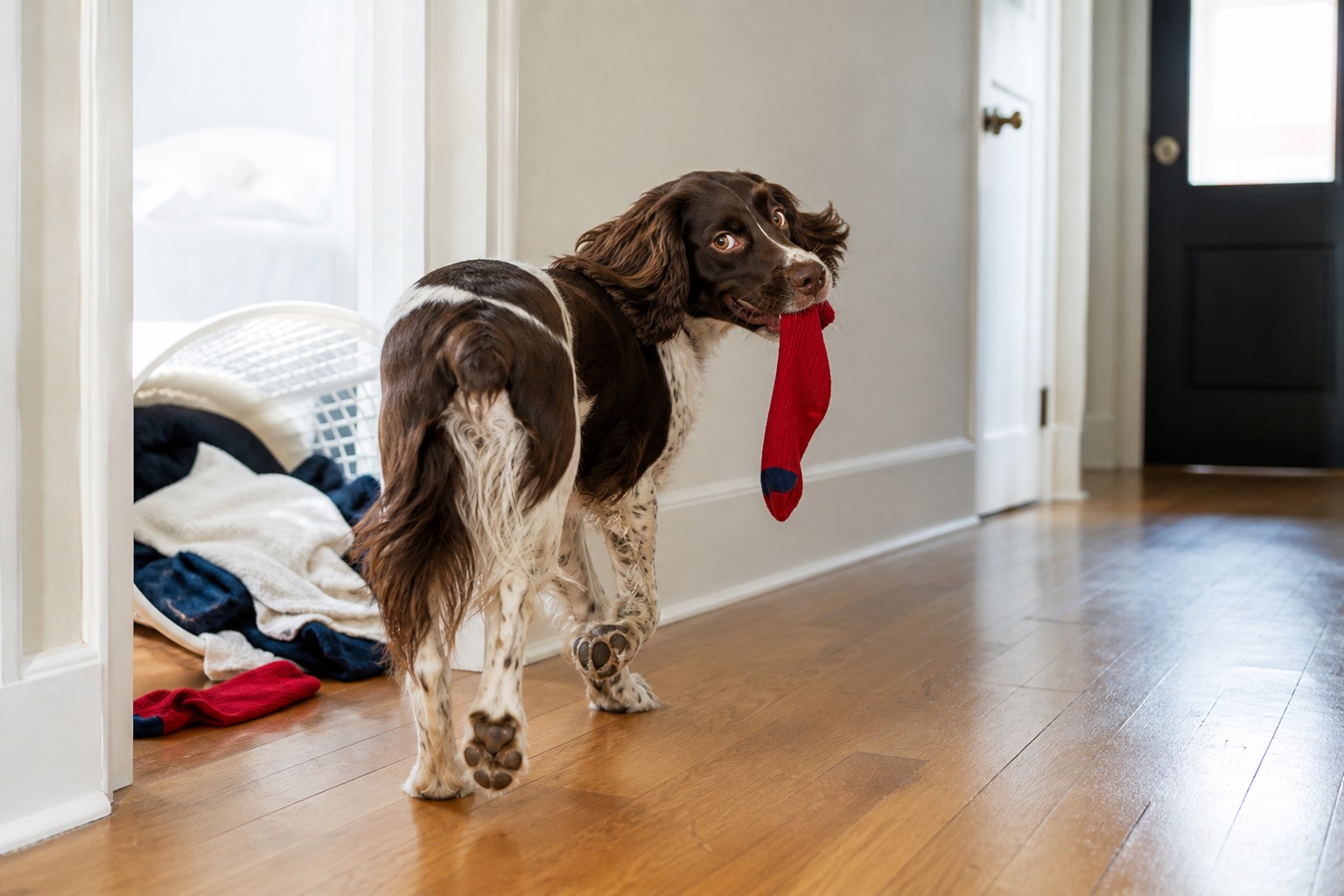
Socks vanish. Some go to the dryer’s black hole, and some go to the four-legged thief padding away with one dangling from their mouth, glancing back to check that you noticed. It’s easy to read the sock heist as your dog being naughty. It almost never is. In most cases, taking your sock is a bid, for your attention, your scent, or a game, and understanding that changes how you respond, because chasing a sock-thief usually rewards exactly the behavior you’re trying to end. But there’s a hard edge to this cute habit that every owner needs to know about: a swallowed sock is a genuine emergency. So this is really two stories, why they do it, and what to do the day it goes wrong.
Why your dog keeps taking socks
A few motivations cover almost every sock thief, and they’re worth telling apart because they point to different fixes.
Attention, above all. The single most common reason dogs steal socks is to get you to engage. The sock is bait. Your dog wants you to stop what you’re doing and focus on them, and even a frustrated “give that back” as you lunge counts as a win. The antidote is prevention plus not paying out: schedule real one-on-one time, exercise, and mental work so your dog’s need for attention is already met, and when you do catch them mid-heist, resist the urge to chase or shout their name and hand over the attention they were fishing for.
It reads as play. To a dog, a sock can look a lot like a toy, similar size, similar texture, similar squish. Tugging it away can accidentally teach them socks are fair game, so instead wait for them to lose interest and quietly move it, or trade up to an actual toy.
Your scent. Dogs experience the world through their nose, and your socks are soaked in your signature smell. Annoying as it is, a dog carrying your sock is often seeking comfort in your scent, a backhanded compliment. Since you can’t scrub yourself out of your laundry, the real fix is access: keep socks in a drawer or hamper your dog can’t reach.
Teething. A young puppy who targets socks may be soothing sore gums, the fabric’s texture is chew-friendly. Put socks and shoes out of reach and stock plenty of safe teething toys and chews.
Boredom. Sometimes a dog just has nothing better going on, and a sock is the most interesting thing in reach. A daily routine full of walks, play, and mental stimulation heads this off.
Separation-related comfort. A dog who misses you may collect a scent-loaded sock as a stand-in while you’re gone, a small self-soothing behavior tied to your absence.
Ancient collecting instinct. Part of it is deep wiring. A dog’s undomesticated ancestors scavenged and hauled objects back to the den like trophies, and your sock may simply be today’s prize.
How to curb the habit
Start with the least glamorous, most effective step: put socks where your dog physically can’t get them, a drawer, a closed hamper, a closet. If they still find a way, layer on training.
Use positive reinforcement, reward the good choice (leaving socks alone, playing with a proper toy) and calmly ignore the naughty one. Teach a reliable “drop it,” and reward your dog every time they release a sock on cue. If you catch them with one, a firm, unexcited redirect to an appropriate toy beats a dramatic chase. Keep a rotating variety of toys available so socks aren’t the most interesting option in the room, and anchor the whole thing with a daily schedule that includes enough physical activity to burn off boredom.
Two more targeted skills help a lot: place training, teaching your dog to settle on a bed and self-soothe there, and “leave it,” teaching them not to pick the sock up in the first place, on cue. Together they give a determined sock-hunter something better to do with the impulse.
When it stops being funny: a swallowed sock
Here’s the part to take dead seriously. Some dogs don’t just carry socks, they swallow them, and that turns a quirk into a medical emergency. If your dog eats a sock, call your vet immediately. If it’s after hours and your vet is closed, call the nearest 24-hour emergency clinic. A swallowed sock can cause an intestinal obstruction, and time is everything: caught early, a vet may be able to induce vomiting and avoid surgery, but a sock that moves into the intestine can require an operation to remove. Beyond the initial call, watch for the warning signs of obstruction, vomiting, abdominal pain, loss of appetite, and get veterinary help if your dog frequently steals and eats socks rather than just carrying them around.
I always tell people the sock-stealing itself is the good news, it usually means your dog wants you, not that they’re being bad. What keeps me up is the swallowing. A sock is soft, so owners assume it’ll pass, and sometimes it does, but I’d much rather get the call while I can still make the dog bring it back up than meet that same sock in surgery three days later. If it went down the hatch, don’t wait and watch. Phone us.
The bottom line
The sock in your dog’s mouth is almost always a request, come play, pay attention to me, I like how you smell, not a rebellion, and the answer is to meet the need, block the access, and reward the better behavior. Just keep the darker possibility in view. The moment a sock is swallowed rather than carried, you stop being amused and start dialing, because that’s the version of this habit that lands dogs on an operating table.
References
- American Animal Hospital Association. “Gastrointestinal Foreign Bodies in Dogs.” aaha.org. Accessed July 2026.
- American Kennel Club. “Why Do Dogs Steal and Guard Objects?” akc.org. Accessed July 2026.
- Hobday, Melissa M., et al. “Linear vs. Non-Linear Gastrointestinal Foreign Bodies in Dogs.” Journal of Small Animal Practice, 2014.
- ASPCA. “Destructive Chewing.” aspca.org. Accessed July 2026.
Dr. Nair is a veterinarian focused on diet and feeding. She covers everyday nutrition, treats, and the many "can they eat this?" questions owners ask, grounding each answer in what is actually safe and sensible for dogs and cats.
Meet our experts ↗Keep reading
 Health & WellnessYour Dog's Squint Isn't a Smile. Count the Eyes.Dr. Mara Chen · 7 min
 TrainingThe Algorithm Rewards Bad Dog Training. Here Are 10 Tells.Dr. Mara Chen · 7 min
 TrainingYour Dog Listens Great at Home and Ignores You Outside. Here's the Fix.Dr. Nina Kohl · 6 min
 TrainingYou Taught Your Dog to Paw at You. Here's How to Untrain It.Dr. Amara Solis · 7 min
 TrainingYour Dog Isn't Giving You a Hard Time. They're Having One.Dr. Nina Kohl · 7 min
 TrainingYour Dog Isn't Being Rude. They're Reading a Stranger's ID.Dr. Nina Kohl · 6 min