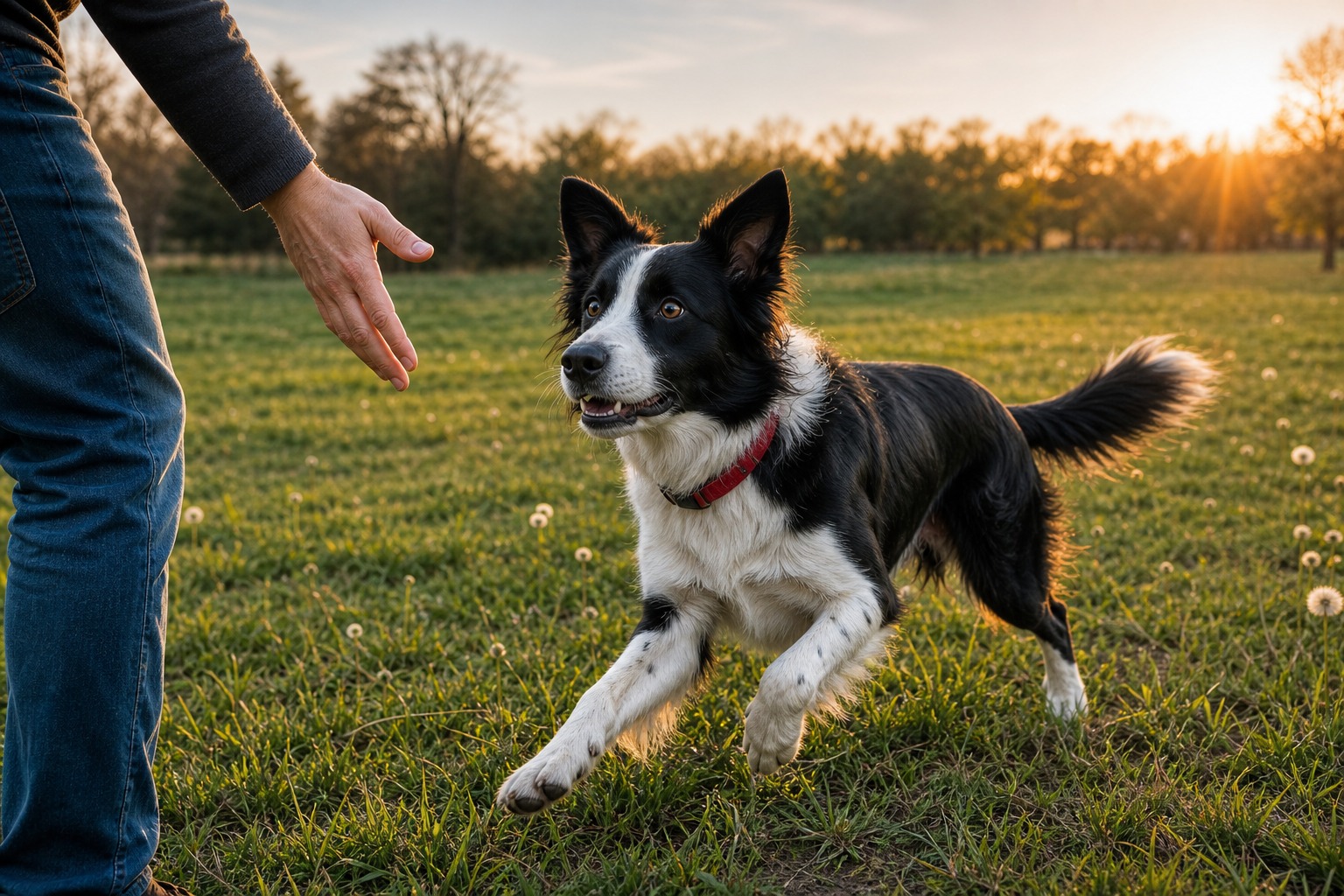
When a dog blows off a cue you know they know, or destroys the couch, or lunges at every passing dog, the story that leaps to mind is that they’re doing it on purpose. They’re stubborn. They’re testing you. They know better. It’s a natural read, and it’s almost always wrong, and holding onto it will quietly sabotage every attempt you make to fix the behavior.
Here’s the more accurate story: a dog who isn’t doing what you asked can’t do it right now. Something is in the way. Maybe they don’t actually understand the cue as well as you assume. Maybe they haven’t practiced it enough to pull it off when it counts. Maybe they’re too scared, too wound up, or too distracted to access it. The dog is not defying you. They’re stuck. Once you make that shift, from “how do I make them obey” to “how do I help them succeed,” the whole enterprise gets easier.
“The word ‘stubborn’ is the single biggest obstacle I see in training,” says Dr. Nina Kohl. “The moment an owner stops asking ‘why won’t he’ and starts asking ‘what’s getting in his way,’ they usually solve the problem in a session or two. The dog was never the issue.”
First, drop the blame, because it’s a dead end
Training is a two-way project. You teach, the dog learns, and when the learning stalls, that’s information, not insubordination. Deciding your dog is being difficult feels satisfying for about a second, and then it strands you, because you can’t train a personality flaw. You can, however, adjust practice, lower the difficulty, or manage the environment. Taking that responsibility isn’t self-flagellation; it’s the only lever you actually control.
Build a deep reinforcement history
Most “won’t listen” problems trace back to a behavior that was never made worth the dog’s while. So make it worth it, relentlessly. If your dog drags their feet on “down,” turn lying down into the price of admission for everything good: ask for it before the walk, before the door opens, before dinner, before the new toy. Each time the behavior earns something the dog wants, it gets a little more automatic, until it holds up in new places and harder moments.
This is where an old myth needs retiring. Dogs are not trying to please us for its own sake. Like every animal, ourselves included, they repeat whatever tends to pay off for them. Positive reinforcement, used generously, is simply the tool that gets your dog’s preferences and your goals pointing in the same direction. It isn’t bribery. It’s the mechanism.
The authorities have converged on this. The American Veterinary Society of Animal Behavior now recommends reward-based methods for all training, including serious behavior problems, and states plainly that there’s no evidence aversive, punishment-based techniques work better in any context. Worse, because fear and anxiety underlie so much problem behavior, punishing a dog tends to deepen the very emotion driving the trouble, sometimes converting a fearful dog into a more dangerous one whose warning signs you’ve trained away.
Engineer success instead of waiting for failure
A core principle of good training: repeatedly put your dog in situations where the behavior you want is likely, then reward it. You can only reinforce what actually happens, so stack the deck.
Take the classic case of a dog who barks and lunges at other dogs on walks. Marching them straight past a dog they’ll certainly react to just rehearses the reaction. The alternative is to arrange easy wins and slowly raise the bar (see the step-by-step above). Start where your dog can stay calm, pay them lavishly for it, and inch the difficulty up only as they’re ready. Their threshold shifts from day to day, so keep nudging it upward in small, gentle increments.
Manage the environment so failure isn’t even an option
Sometimes the smartest training move is preventing the situation entirely while the skill is still shaky. A dog whose recall isn’t bulletproof has no business off-leash in an open field, where every failed “come” teaches them that ignoring you works and might get them hurt. A long line gives freedom without the risk. A dog who mobs guests can wait behind a baby gate with a stuffed food toy until everyone’s settled. Managing the situation isn’t cheating or giving up; it’s removing the chance to practice the wrong thing while you build the right one.
Remember how specific dog learning is
Teaching a behavior on cue is only step one. The harder, longer work is teaching your dog to do it everywhere, under every kind of pressure. “Come” in your quiet backyard and “come” as your dog tears through the neighborhood are, to the dog, nearly different skills. So are “roll over” in a calm living room and “roll over” the instant you enter a chaotic dog park.
Some of the obstacles are subtle. The smell of a neighbor’s grill, a distant rumble of thunder, a stranger watching you show off, even you giving a hand signal while wearing bulky winter gloves, any of these can scramble a dog’s ability to respond to a request that’s usually easy. When you can name the reason a cue isn’t landing, whether it’s fear, distraction, an unclear signal, or plain discomfort, you can meet it: add distance, dial down the difficulty, help them move away from what’s rattling them, or ask for something simpler until you have their attention back.
The mindset is the method
The real shift here happens in your head before it happens in your dog. Trade “stubborn,” “disobedient,” and “ignoring me” for curiosity about what’s actually going on. Well-trained dogs aren’t the ones who’ve been forced into line; they’re the ones whose people got good at setting them up to win. Do that, and your dog earns more freedom, you both have more fun, and the “misbehavior” you were bracing to battle tends to quietly disappear.
References
- American Veterinary Society of Animal Behavior. Position Statement on Humane Dog Training.
- American Veterinary Society of Animal Behavior. Position Statement on the Use of Punishment for Behavior Modification in Animals.