


'Spin' Looks Impressive. It's the Easiest Trick You'll Ever Teach.
The move that gets 'how did you DO that?' reactions is actually the softest possible entry into trick training, and it quietly builds the follow-the-hand skill that harder tricks are made of. Here's the clock-face method, plus how to fade the treat so it's a real cue.
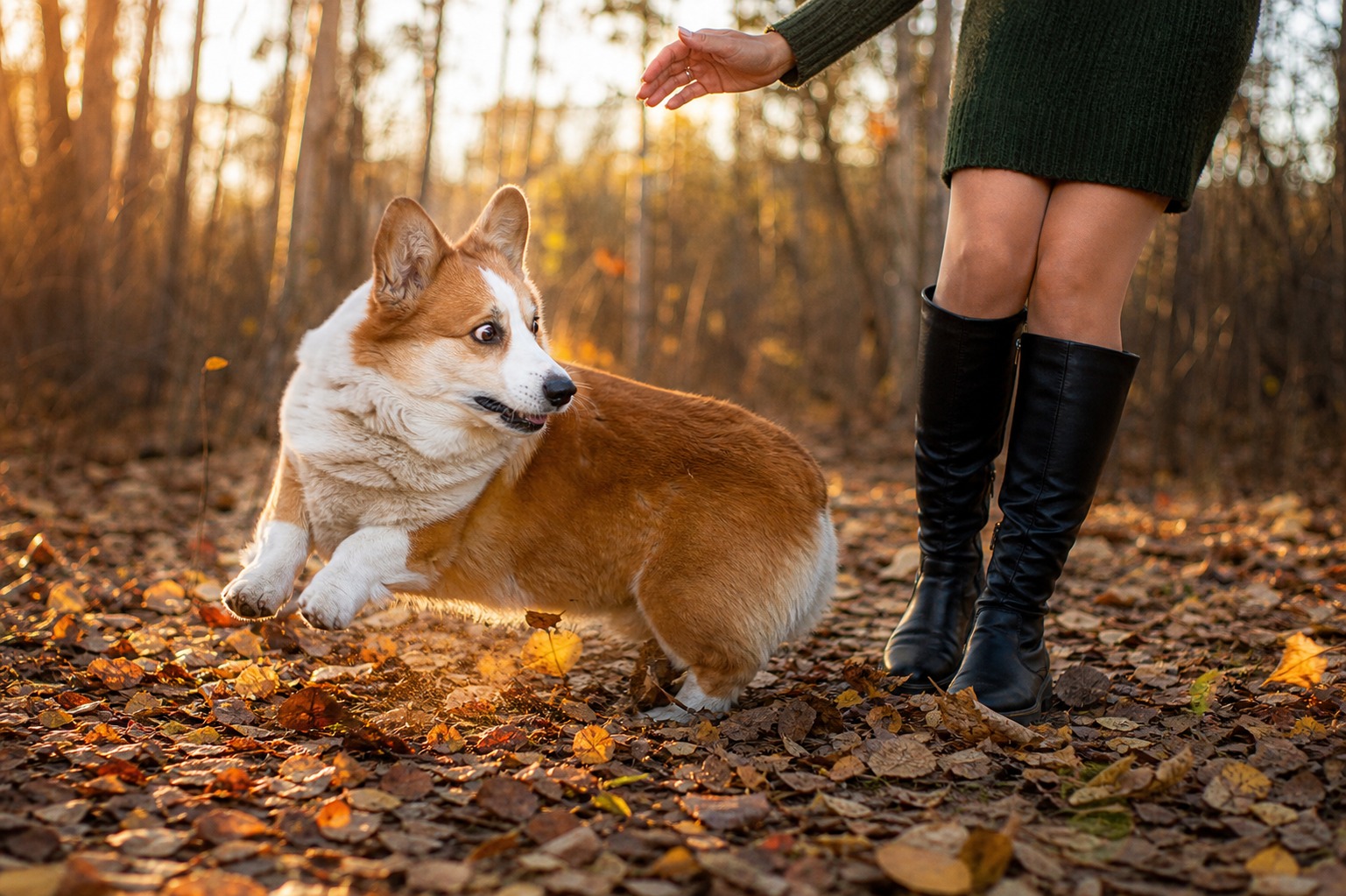
Here’s a small magic trick you can pull at any party: teach your dog to spin. People will react like you’ve spent months at it. You will not tell them it took an afternoon. Spin has the best effort-to-payoff ratio in all of trick training, it looks flashy and takes almost nothing to teach, which makes it the perfect first trick for a dog who’s never learned one.
There’s a sneakier reason to start here, too. Spin is built entirely on one skill: your dog following a treat, or eventually just your hand, through a smooth path in space. That “follow the lure” ability is the raw material for a huge chunk of the trickier stuff you might teach later, from rollover to leg weaves to a proper bow. Teach spin well and you’re not just banking a party trick, you’re installing the engine that runs the fancy tricks.
Keep it a game, not a drill
Before the steps, the one rule that governs all of it: your dog should be having fun. Use food and encouragement to draw the behavior out, never physical steering. If you find yourself trying to nudge your dog around by the collar or shoulders, stop, that’s the fast track to a dog who dreads training. The whole appeal of spin is that it feels like play to the dog, and a dog at play learns quickest.
“Spin is the trick I hand new clients when they’re convinced their dog ‘can’t be trained,’” says Dr. Nina Kohl. “It’s nearly impossible to get wrong, so the dog racks up easy wins and the human finally sees their dog choosing to work with them. That confidence, on both ends of the leash, is worth more than the trick itself.”
The clock-face method
The easiest way to picture the motion is to imagine your dog standing on a clock face, nose pointed at 12.
- Start face to face. Your dog stands on all fours, facing you, somewhere calm and boring, no park, no visitors.
- Lead the nose. Bring a treat right to their nose and move it slowly in one direction, guiding their nose as if it’s drawing a circle around their own body.
- Pay at the quarter-turns. Reward at about 3 o’clock, keep the motion going and reward again at 6, then again at 9. These little checkpoints keep a beginner dog committed to the full loop instead of bailing halfway.
- Close the loop. When they arc back around to 12, reward the finished spin.
A quick read of your dog tells you how much scaffolding they need. A dog who tracks the treat all the way around on the first try may not need those 3-, 6-, and 9-o’clock payments at all, just reward the complete circle. A dog who keeps losing the thread needs you to slow down and shrink the steps so the treat never gets too far ahead of their nose.
Turning motion into a cue
Once your dog is looping reliably, you make it a real trick by attaching a signal and, crucially, fading the food.
Add a cue as the behavior starts to click: a spoken word like “spin” plus a hand signal, a finger rotating in a little circle works well and reads clearly to most dogs. Say the word and give the signal right as they begin the motion, so the two get glued together in their mind.
Then wean off the lure in reverse order. Drop the reward at 6 o’clock first, then at 3, and so on, until you’re only paying for the completed spin. Swap the treat in your leading hand for that empty-hand finger circle, and lure them around a few more times paying only at the end. When it clicks that the empty hand means the same thing the treat used to, you can start giving the signal from farther and farther away, which is when it really starts to look like magic.
Where to go next
Spin is a doorway. The instant your dog can follow your hand in a full circle for a signal, you’ve got the core mechanic behind a long list of showier tricks, teaching the opposite-direction spin (great for a dog’s body symmetry), stringing two spins into a “dance,” or moving on to weaves and bows that reuse the exact same follow-the-hand foundation. Trick training also isn’t just for showing off: the mental work tires a dog out in a satisfying way, sharpens the communication between you, and gives a bored, under-exercised dog a job. Not bad for a move you’ll have taught before dinner.
What newer research adds
Trick training has quietly earned some scientific respect. Research into “do-as-I-do” and reward-based trick work suggests that teaching dogs playful, non-essential skills builds their overall trainability and strengthens the human-dog bond, dogs that regularly learn tricks tend to be more responsive to their people generally. There’s also growing interest in enrichment: cognitive work like learning a new trick appears to leave dogs calmer and more content afterward, similar to a good walk. So the next time someone dismisses spin as a mere party trick, they’re half right. It’s a party trick that happens to make your dog easier to live with.
References
- Fugazza, C., & Miklósi, Á. (2015). “Social learning in dog training: The effectiveness of the Do as I Do method.” Applied Animal Behaviour Science. Link
- American Kennel Club, “Dog Tricks: Teach Your Dog to Spin”
- American Veterinary Society of Animal Behavior, Position Statement on Humane Dog Training
Sasha Ford is a certified cat behaviour consultant who has worked with shelters, catteries, and private clients across the country. They review all feline behaviour content at The Pet Times, with expertise in multi-cat households, indoor enrichment, and stress-related disorders.
Meet our experts ↗Keep reading
 Training8 Ways to Be the Dog Owner Your Building Doesn't Complain AboutMarcus Webb · 8 min
 LivingADHD Doesn't Make You a Bad Dog Parent. Your Reminder App Does.Leila Torres · 8 min
 TrainingYour Dog Doesn't Fail at Restaurants. They Fail in the First 90 Seconds.Dr. Nina Kohl · 7 min
 TrainingBefore You Cut a Hole in Your House, Answer This: What Else Can Fit Through It?Marcus Webb · 8 min
 LivingDon't Teach Your Dog to Swim. Teach Them to Get Out.Dr. Priya Nair · 8 min
 TrainingStop Steering. The Walk Is the One Thing Your Dog Should Get to Decide.Dr. Lena Park · 7 min