Every guide to red eyes in dogs is organized the same way: a long alphabet of causes, from allergies to uveitis, each with its own paragraph. It is a fine way to write a textbook and a useless way to help someone standing in a kitchen at nine at night looking at a dog whose eye has gone red.
Because the person in that kitchen does not need a list. They need to know one thing.
Red is not a diagnosis. Red is a timer. Almost every cause of a red eye produces the same red eye, and what separates them is not what they look like, it is how fast they take something from your dog that does not come back. Some give you a week. Some give you a couple of days. And two of them are measured in hours.
So this is sorted by the clock.
The one rule that outranks everything
Get this one right and the rest is detail.
If the redness came on suddenly, and the eye is painful, cloudy, bulging, or your dog cannot see out of it, that is an emergency right now. Not tomorrow. Not first thing Monday.
The reason is glaucoma. When pressure builds inside the eye, it crushes the retina and the optic nerve, and that damage is permanent. Veterinary ophthalmology is blunt about the timeline: untreated glaucoma can cause irreversible blindness within 24 to 48 hours of the first signs, and even a few hours at genuinely high pressure can take vision for good. Once the optic nerve is gone, it does not come back. There is no later treatment that restores it.
That is the whole reason “wait and see” is such a dangerous default with eyes. With most of your dog’s body, a day of watchful waiting costs you a day. With an eye, it can cost you the eye.
Hours: the ones that take vision
These four need a vet the same day, and if the eye is acutely painful, an emergency vet tonight.
Glaucoma
Pressure inside the eye rises and damages the optic nerve. It can hit one eye or both, and here is a detail worth carrying with you: when it starts in one eye, it very often comes for the other one eventually. Which means a glaucoma diagnosis in the left eye is also a standing instruction to watch the right.
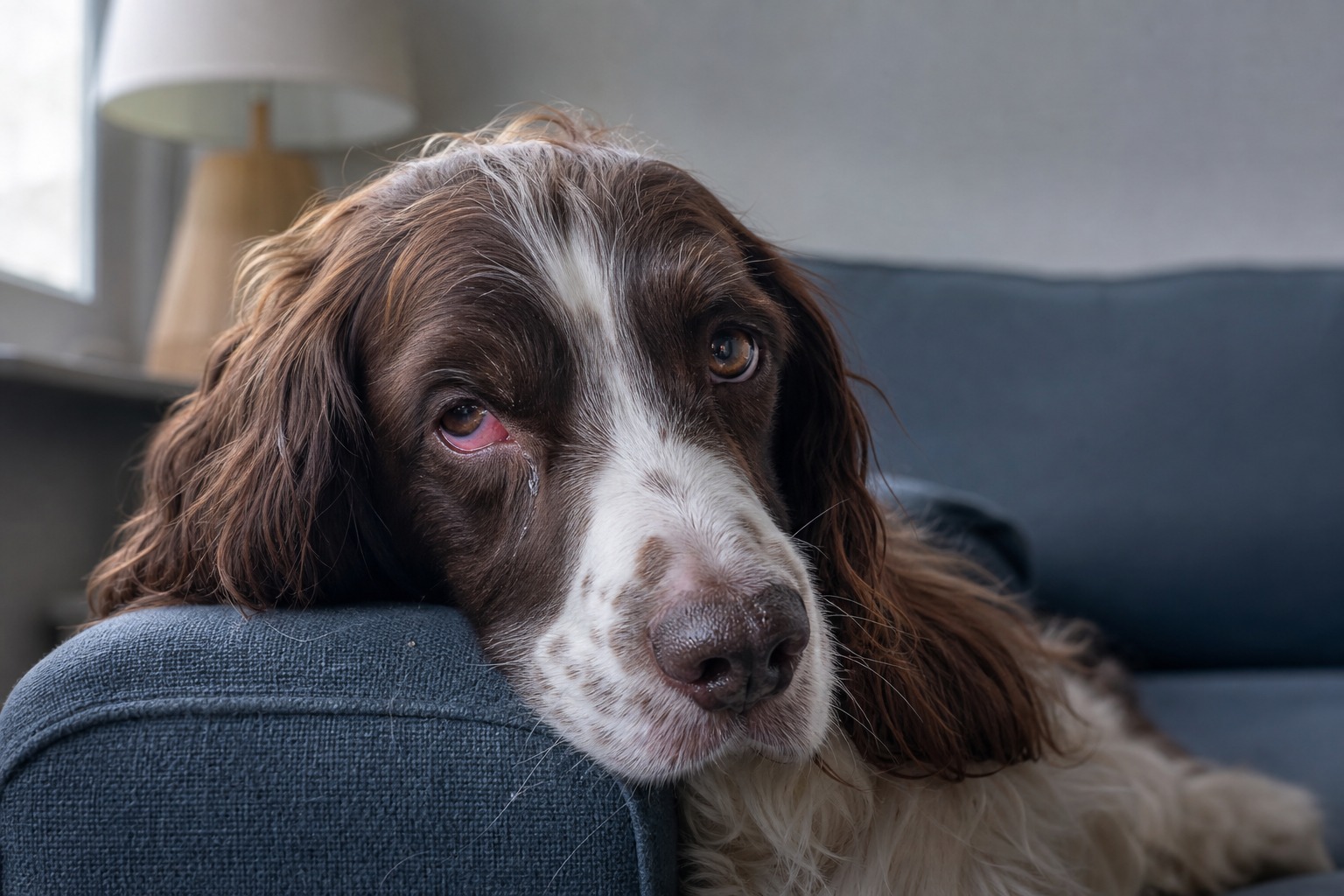
What you see: a red, bloodshot eye, squinting, cloudiness across the cornea, a bulging or swollen eyeball, obvious pain, and vision loss. It is diagnosed with an instrument placed directly on the cornea that measures pressure inside the eye.
It is an emergency requiring immediate treatment. Your vet will use medication to bring the pressure down and control the pain, and surgery is sometimes needed.
Corneal ulcers
The cornea is the clear window at the front of the eye, and an ulcer is a raw, open wound in it. They run the full range from trivial to sight-threatening, and they typically start with dry eye, an injury, or an infection.
What you see: intense squinting and pain, heavy tearing, sensitivity to light, redness, and swelling.
It sits on the hours list because of where an ignored one ends up: infected, blind, or with the globe of the eye actually bursting. The fix is medicated drops, and surgery when it has gone far enough. Once you are treating it, settle in. These wounds are slow to close even when the treatment is working perfectly.
Injury and trauma
Dogs run through brush and tall grass and play rough with other dogs, and eyes are exposed. What you see is sudden redness, swelling and discomfort, and excessive tearing. Treatment runs from drops all the way to surgery depending on severity, and there is no way to grade it from your kitchen. A dog who has taken an eye injury gets seen.
Uveitis
Inflammation of the inner eye, caused by autoimmune disease, trauma, or infection. It is painful, and it can lead to blindness if it goes untreated.
What you see: severe redness, squinting, a cloudy look to the eye, and low pressure inside the eye, which is the mirror image of glaucoma and one of the reasons a vet needs to be the one measuring. Treatment is anti-inflammatory and antibiotic medication.
Days: the ones that need an appointment, not an ambulance
These deserve a vet visit within a day or two. They are not usually sight-threatening in the first 48 hours, but several of them turn into the list above if you ignore them.
Conjunctivitis (pink eye)
The conjunctiva is the fine, transparent skin that wraps the white of the eye and lines the inside of the lids, and when it inflames, you get conjunctivitis. It is among the likeliest explanations for a red eye in a dog, and infection, an allergy, or a plain irritant can all set it off.
What you see: redness and swelling, heavy tearing, and mucus or pus-like discharge. Treatment depends entirely on the cause and may be antibiotic or anti-inflammatory drops or ointment, which is exactly why guessing at home does not work. The same red eye, different bottle.
Eye infections
Bacteria, viruses, and fungi all cause eye infections in dogs. What you see: redness, swelling, squinting or holding the eye closed, and thick yellow, green, or white discharge.
Get on this quickly. Infections can progress to corneal ulcers, which is the moment a days problem becomes an hours problem. Treatment can include antibiotic, antifungal, or antiviral drops, oral medication, and careful eye hygiene.
Foreign bodies
Dust, dirt, grass seeds, and small debris can lodge under an eyelid. What you see: hard blinking or squinting, redness and swelling, and watery discharge. These usually require veterinary removal plus antibiotic drops to head off infection, because the scratch left behind is its own problem.
Blepharitis
Inflammation of the eyelids themselves, rather than the eye. What you see: swollen, crusty eyelids and constant blinking.
Bacterial infection is the most common cause, often following trauma or scratches around the eye, chronic skin infection (pyoderma), or poor hygiene in skin folds, which is why flat-faced breeds get it disproportionately. Those dogs show swollen, red eyelids, pus-like discharge, and crusting or scabbing around the lids. Treatment is warm compresses, medicated drops, and dealing with whatever is underneath.
Bacteria is not the only route in. Blepharitis is also driven by fungal or parasitic infection (yeasts, mites, ticks, and fleas), allergic reactions, constant pawing or rubbing at the eyes, autoimmune disease, hormonal and endocrine disorders, congenital or acquired eyelid abnormalities, tumors or growths on the lid, and plain poor hygiene and environment, meaning heavy exposure to dust, smoke, or pollution, poor grooming in longhaired breeds, and dirt collecting in facial folds in dogs like Bulldogs and Shar-Peis.
Breed matters here. Bulldogs, Pugs, Cocker Spaniels, and Shih Tzus are prone to the eyelid conditions that set blepharitis up. And seborrheic dermatitis, another contributor, runs high in Golden Retrievers, West Highland White Terriers, and Basset Hounds.
Weeks: the slow burners
These are chronic. They will not blind your dog this weekend. They will, quietly, do damage over months if nobody names them.
Dry eye (keratoconjunctivitis sicca, or KCS)
The tear glands stop producing enough tears. What you see: redness, squinting, thick mucus-like discharge, repeated infections, and chronic dryness and irritation.
The thing to understand is why it escalates. Tears are not just comfort, they are the cornea’s protection. Without enough lubrication, the surface of the eye becomes vulnerable to infection and damage, which is how a chronic dry eye quietly becomes an acute corneal ulcer.
It gets started by the immune system attacking the glands, by certain drugs, or by physical damage to the glands themselves. Management runs from artificial tears, to cyclosporine drops, to surgery when it is bad enough.
Allergies
Very common in dogs. Most allergic dogs show it in the skin, but they get red, irritated eyes just as people do.
The categories worth knowing, because they change the plan:
- Environmental allergens: pollen, mold, dust mites, smoke. Many are seasonal, which is genuinely useful diagnostic information. Tell your vet whether the signs are year-round or turn up in certain seasons. That single detail narrows the field.
- Food allergens: certain proteins, grains, or additives. Unlike environmental allergies, these are usually year-round, which is another clue in the same puzzle.
- Chemical irritants: cleaning products, perfumes, air fresheners, shampoo. Keep these off and away from your dog’s face.
Alongside red, watery eyes you may see pawing at the face, sneezing, nasal discharge, skin rashes or hives, and heavy blinking. Treatment can include antihistamines, prescription diets, avoiding the allergen where possible, steroids, and allergy injections.
Entropion
The eyelid rolls inward, so the lashes rub directly against the surface of the eye. It is painful, and the constant irritation causes redness, pain, and ulcers. It is common in Bulldogs and Shar-Peis, and it usually has to be fixed surgically. This is one where “manage it medically forever” is generally the worse deal.
High blood pressure
When a dog is hypertensive, blood vessels inside the eye can rupture, and the eye goes red. Hypertension is usually secondary to something else, most often kidney disease, heart disease, or hyperthyroidism. Treatment means managing the underlying disease and controlling the blood pressure. This is a case where a red eye is not really an eye problem at all, it is the first visible sign of an internal one.
Tumors
Tumors occur in and around the eye, benign or malignant, and cause redness, swelling, and vision changes. On the eyelid or conjunctiva, they are usually obvious. In the iris, you may notice the color changing. Behind the eye, you may see only the effects and never the tumor itself. Treatment depends on type and location: surgery, radiation, or chemotherapy.
How your vet actually tells these apart
You cannot do this at home, and it is worth knowing why, because the tests are simple, fast, and decisive.
- Fluorescein staining. A dye is applied to the surface of the eye. It clings to damaged tissue and makes a corneal ulcer light up. This is how an ulcer gets confirmed or ruled out in about a minute.
- Tonometry. Measures the pressure inside the eye. This is the test that separates glaucoma (high pressure) from uveitis (low pressure), two conditions that can look similar and are treated very differently.
- Schirmer tear test. Measures tear production, and diagnoses dry eye.
- Bloodwork and imaging. Looks for the underlying disease when the eye is a symptom of something systemic, such as thyroid disease, kidney disease, or diabetes.
Some conditions your vet will recognize on sight. The dangerous ones are precisely the ones that require an instrument, which is the whole argument against diagnosing an eye from your sofa.
Treatment, in one place
- Antibiotic or antifungal drops for infection
- Artificial tears for dry eye
- Surgery for entropion, tumors, and severe injuries
- Medication for glaucoma and uveitis
The other symptoms that raise the stakes
Beyond the redness itself, these are the signs that turn a wait into a call:
- Excessive tearing
- Thick or discolored discharge
- Squinting, or sensitivity to light
- Pawing or rubbing at the eyes
- A cloudy or bluish appearance
- Vision loss, or bumping into things
And go straight to an emergency vet for sudden onset redness, severe pain or swelling, or vision loss or behavioral change.
The bottom line
Your dog uses their eyes for nearly everything: eating, playing, exploring, reading your face, reading other dogs, tracking, judging distance. Look at them regularly, so that when something changes, you notice it on day one rather than day four.
When an eye turns red, something is wrong. That much is always true. What varies is the clock, and you cannot reliably read the clock from the outside.
So use the rule. Sudden, painful, cloudy, bulging, or blind means now. Anything else means an appointment, not a wait. And if you genuinely cannot tell which one you are looking at, err toward the vet, because ocular disease can progress fast and the thing you are gambling with is your dog’s sight.
References
- Woerdt, A. van der. “The treatment of acute glaucoma in dogs and cats.” Journal of Veterinary Emergency and Critical Care, vol. 11, no. 3, 2001, pp. 199–204. https://doi.org/10.1111/j.1476-4431.2001.tb00084.x
- Thomasy, S. “Canine conjunctivitis: causes and treatment.” BSAVA Manual of Canine and Feline Ophthalmology, British Small Animal Veterinary Association, 2020. https://doi.org/10.22233/9781910443774.6.1
- American College of Veterinary Ophthalmologists. “Glaucoma.” https://www.acvo.org/common-conditions-1/2018/2/1/glaucoma
- Merck Veterinary Manual. “Glaucoma in Dogs.” https://www.merckvetmanual.com/eye-diseases-and-disorders/glaucoma/glaucoma-in-animals
- University of Missouri Veterinary Health Center. “Glaucoma.” https://vhc.missouri.edu/ophthalmology/glaucoma/