


Your Dog's Nibble Is a Dial, Not a Switch. You're Turning It the Wrong Way.
Nibbling, mouthing, and biting are the same behavior at different pressures. Once you see it as one dial, the popular fix (yelp and pull away) starts looking like exactly the wrong move.

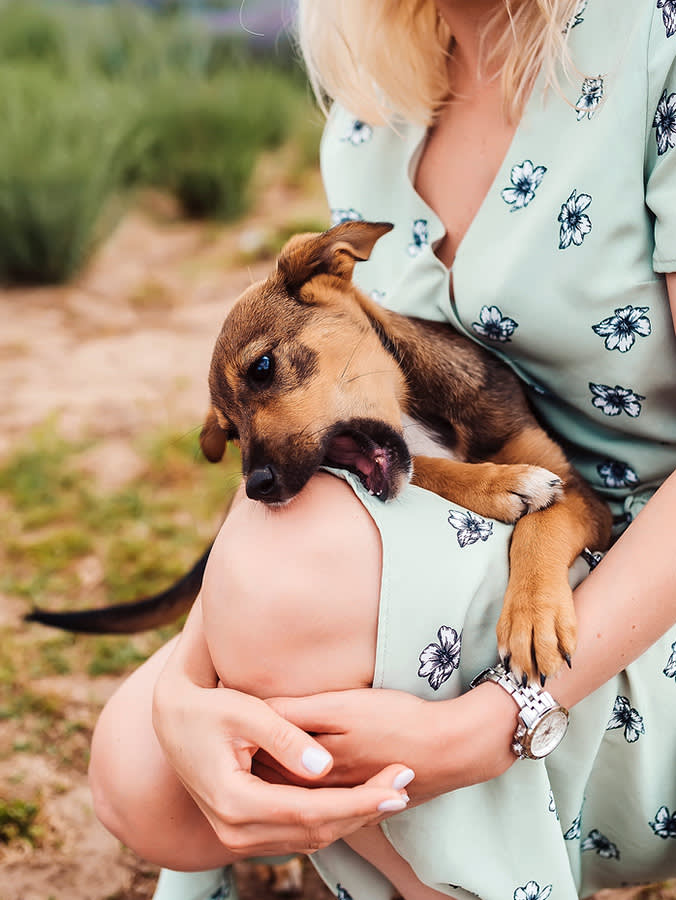
Your dog takes your hand in their mouth and works at it with their front teeth, gently, like corn on the cob. It’s oddly sweet. It’s also, at some point, going to hurt.
Most advice treats this as a category question: is my dog nibbling, mouthing, or biting? As though there are three different behaviors that need three different responses.
There aren’t. There’s one behavior, at different pressures. Nibble, mouth, and bite are three readings on the same dial, and the thing that turns the dial is not the dog’s opinion of you. It’s their arousal.
Once you see that, the standard fix starts to look suspicious. Because the standard fix, “yelp sharply and pull your hand away,” is a jolt of noise and sudden movement delivered to an already over-aroused dog. For a lot of dogs, that’s turning the dial the wrong way.
The dial, in three readings
Mouthing is low pressure with a wide grip, a whole hand or forearm held loosely while the jaw works.
Nibbling is that fast, front-teeth, corn-on-the-cob action, usually gentle.
Biting is anything that hurts. That’s the entire definition. If it hurts, it’s a bite, and that’s true no matter how sweet the dog’s intentions were.
Note what’s not in those definitions: motive. The dial tells you how much pressure your dog is applying. It tells you nothing about why. Which is why the useful diagnostic question isn’t “what is this called,” it’s “what is this dog’s arousal doing right now, and where is the dial heading.”
Ask it this way: if the dial went up 20 percent in the next thirty seconds, would this still be cute? If the answer is no, you have information.
Seven reasons the teeth come out
1. They’re talking to you
Dogs can’t say it, so they use what they have. Teeth on your skin can mean play with me, I need something, or look at me. Before you correct it, spend a second on translation. A dog nibbling at you at 6 p.m. might be asking for a bathroom break. As trade-offs go, a love bite beats a puddle on the carpet.
2. They’re exploring
A relaxed, open mouth with contact between teeth and skin is a play signal, and play in dogs is overwhelmingly social rather than solitary. Your dog is running an experiment. The question is what does my human do if I do this? Your answer becomes the rule.
3. They’re developing
Young dogs learn about the world with their mouths, and they learn about pressure by using it. When a puppy bites a playmate too hard, the playmate quits. That’s the whole feedback loop, and it is how a puppy discovers there’s a ceiling.
4. They’re teething
Puppies don’t have their full adult set until roughly seven to eight months, which means a good chunk of their first year involves an aching mouth that wants pressure on it. Frozen chews and a rotating supply of chewable things are not a luxury for a teething puppy. They’re the relief valve.
5. They’re reading you
Dogs have somewhere between 100 and 300 million olfactory receptor cells, against our five or six million. Your hands have been everywhere today. Mouthing them is closer to reading a diary than to eating.
6. It worked once
This is the driver the standard list leaves out, and it’s the one that turns an occasional nibble into a habit. If nibbling your arm has ever produced attention, food, play, or even a dramatic reaction, it has been paid, and your dog will run it again. A behavior that gets reinforced sticks. That’s not manipulation. It’s just how learning works, and it’s the reason the second-hardest nibbling case is a dog whose owner keeps accidentally rewarding it.
7. They’re at loose ends
You’re on the sofa, TV on, dog next to you getting restless. They shuffle closer, then start working on your forearm. When a dog isn’t sure what to do with themselves, they put their mouth on something, and you’re the nearest something. This is boredom with teeth, and it’s usually the easiest one to fix.
Why the yelp advice is shakier than it sounds
The classic instruction, borrowed from what puppies do to each other, is to yelp loudly and end the game. And the honest state of the evidence is thinner than the confidence with which it’s repeated.
There’s very little research showing that bite-inhibition training in puppyhood actually reduces bite force in an adult dog. The Academy for Dog Trainers has been notably candid about this: they still teach and endorse bite-inhibition work, but they acknowledge it’s done in the absence of good evidence, on the reasoning that the downside is small and the potential upside is enormous. That’s a defensible position, and it’s a very different thing from “science says yelping works.”
There’s also a practical failure mode. A high-pitched yelp plus a hand snatched away is a fast, exciting, high-pitched stimulus. Some dogs settle. Plenty of dogs wind up, and the nibbling gets harder, because you just made the game better. If yelping has ever escalated your dog, that’s not you doing it wrong. That’s the method meeting a dog it doesn’t suit.
“Almost everyone I see has been yelping at a dog for weeks and getting more teeth, not fewer,” says Dr. Ravi Mehta. “Once we stop treating the mouth as the problem and start treating the arousal underneath it, the mouth usually sorts itself out. You cannot train pressure down while a dog is climbing.”
The mechanism that genuinely does teach a dog about pressure is boring and slow: the game stops. Not dramatically. Completely.
Six ways to bring the dial down
1. Interrupt properly, then actually leave
If a nibble hurts, mark it with a short, flat sound (not a shriek), and then go. This is where people fail: they say “ouch,” stay put, and keep petting. The dog learns nothing except that “ouch” is a noise humans make during play.
Get up. Put a door or a baby gate between you for 20 to 30 seconds. Come back calm. The lesson is that the playmate leaves when it hurts, and it’s the leaving that teaches it, not the noise.
2. Rotate the toys instead of buying more
Keep a chunk of the toy collection in a cupboard and swap them every couple of weeks. A toy that has been away for a fortnight is a new toy. During a heavy teething phase, keep the chewable stuff frozen and everywhere.
3. Ditch the food bowl
Feed the meal out of a puzzle toy or a food-dispensing ball instead. It turns two minutes of eating into twenty minutes of working, and it uses the mouth for something legal. Wet food can be stuffed into a hollow toy, and dry kibble soaked in water or broth first works fine.
4. Arrange dog-to-dog play
Other dogs are far better than you at this. Puppies teach each other where the ceiling is, in a language you cannot speak, and a puppy with regular access to well-matched playmates learns pressure faster than any human protocol will teach it.
5. Give the teeth a legal target
Tug is the underrated answer. It’s a game where your dog’s teeth are supposed to be gripping, played with you, and it satisfies the same urge the nibbling was reaching for. Teeth on the rope, not on the forearm.
6. Manage the 30 seconds before, not the moment itself
Nibbling almost always sits at the top of an arousal ramp. Once you know what winds your dog up (a specific person arriving, a specific hour, the end of a play session), you can end the game one notch earlier than the point where the teeth show up. Prevention is not a cop-out. With arousal, it’s most of the work.
The signals that mean stop and get help
Nibbling in the middle of a loose, wiggly, happy dog is one thing. Teeth on skin from a stiff dog is another, and the difference is the whole safety picture.
Learn what your dog looks like when they’re delighted: loose, fluid, wave-like movement through the whole body. Now compare that to the dog in front of you. If the movements are stiff, jerky, and sharp, be careful.
Then look at context. If the dog was calm a moment ago and is now growling or snarling with teeth on you, that is not play. They may be guarding something. They may be uncomfortable with a person, a movement, or a space. Any of that combined with teeth on skin is a conversation with a qualified trainer or a veterinary behaviorist, not a training tip from an article.
And around children, hold the hard line: no teeth on skin, ever. Not because a child’s skin is more fragile, but because a child cannot calibrate. They will squeal and yank the arm away at exactly the wrong instant, which is how a gentle mouth becomes a graze.
What newer research adds
The most current thing worth knowing about puppy mouthing is what we don’t know. The bite-inhibition protocols passed around as gospel (yelp, withdraw, repeat) rest on much less evidence than their popularity implies, and the trainers who teach them most rigorously are the ones most willing to say so out loud. The reasoning is a cost-benefit call, not a settled finding.
What has held up is the unglamorous stuff: that arousal drives pressure, that punishment-based responses to mouthing tend to raise arousal rather than lower it, and that a dog who gets adequate sleep, enrichment, and legal outlets for their mouth simply has less need to use yours.
So if you take one thing from all of it, take this. Don’t fight the teeth. Turn down the dial they’re attached to.
References
- “Mouthing, Nipping and Biting in Puppies.” ASPCA. aspca.org
- “Acquired Bite Inhibition and Puppies.” The Academy for Dog Trainers. academyfordogtrainers.com
- “Training Bite Inhibition in the Dark.” The IAABC Foundation Journal. journal.iaabcfoundation.org
- Bradshaw, J.W.S., et al. “Why do adult dogs ‘play’?” Behavioural Processes, 2015. sciencedirect.com
Common questions
Are certain breeds more likely to nibble?
Not meaningfully. Every puppy of every breed teethes, mouths, and explores with their teeth. Breed-and-bite statistics are also less reliable than they look: in one review, any stocky, short-haired dog involved in an incident tended to get recorded as a Pit Bull regardless of what it actually was, which is how a stereotype gets built out of bad data.
Should I be worried if my dog nibbles on themselves or on another dog?
On another dog, usually no. Mouthing is a normal part of dog-to-dog play. On themselves, it depends: occasional grooming is fine, but persistent or compulsive nibbling at their own body points at fleas, allergies, pain, or anxiety, and all of those need a vet.
Will my puppy grow out of nibbling?
Most do, but what you allow now shapes what you get later. Dogs are creatures of habit, and a behavior that keeps working keeps happening. Growing out of it is likelier if you also give them something better to do.
Should I let my dog nibble on me at all?
That's your call and it's a legitimate one. Plenty of people enjoy it. The line worth holding is that it never hurts, and that it never happens with people who haven't consented, especially children, who cannot calibrate their reaction and will yank an arm away at exactly the wrong moment.
Dr. Kohl is a board-certified veterinary dentist with a particular interest in preventive oral care. She reviews all dental health content at The Pet Times and contributes practical guides on home dental routines, professional cleaning, and oral disease prevention.
Meet our experts ↗Keep reading
 First DaysTwo Puppies Sound Twice as Sweet. Trainers Beg You to Reconsider.Dr. Mara Chen · 8 min
 First DaysYour Puppy Isn't Manipulating You. Stop Letting Them Cry It Out.Dr. Nina Kohl · 6 min
 First DaysThe Only Puppy in the Litter Missed a Class. It Shows Up Years Later as a Bite.Dr. Nina Kohl · 9 min
 First DaysYour Puppy Isn't Being Wild. They're Overtired.Dr. Nina Kohl · 6 min
 First DaysYour Puppy Thinks the Cat Is a Toy. Fix That Before They Ever Meet.Dr. Mara Chen · 9 min
 First DaysThe '1 Hour Per Month' Puppy Rule, and When You Have to Break ItDr. Amara Solis · 8 min