Long toenails look like a grooming afterthought, the last thing on the list after the bath and the brush-out. They aren’t. When a dog’s nails grow past the point where they should stop, every step presses them back into the toe, and over time that force splays the foot, strains tendons, and changes the way your dog stands and moves. What looks like a cosmetic detail is quietly a mobility problem. That is the real reason to keep on top of it, and it reframes the whole task: you’re not tidying your dog up, you’re protecting how they walk.
There’s a second reframe that makes the job dramatically easier, and almost no one is told it. Inside each nail runs the quick, the pink, blood-filled cord that feeds the claw. Cut into it and you get pain and a startling amount of blood. But the quick isn’t fixed in place. When you trim little and often, it slowly retreats up the nail, giving you more room to work and making every future trim safer. Let the nails grow long, and the quick grows long right along with them. So the dog with the dreaded “you can never cut those” nails isn’t a lost cause. They’re a dog whose quicks need to be walked back, one small trim at a time.
First, figure out whether it’s actually time
Every dog wears their nails differently. A dog who logs miles on pavement may keep them filed down naturally; another needs a pedicure every couple of months. Rather than guessing, use a physical check. Lay your thumb across the top of the foot, cup your remaining fingers under the large central pad, and gently squeeze so the toes fan out and the nails extend. Look at the tips against the underside of the foot. If they sit level with the pad or shy of it, leave them be. If they push past it, they’re due. When you truly can’t tell, a vet, vet tech, or groomer can settle it in seconds.
Day to day, your dog will tell you too. Nails that visibly curve, a distinct clicking on hard floors, snags on your legs or the couch, and sudden paw-licking or an odd gait are all signs the clippers are overdue.
The short list of tools
You don’t need much:
- A good pair of dog-specific nail clippers in the right size for your dog. Human clippers are more likely to crush and fracture a nail. Buy well and a pair can last for years.
- Optionally, a rotary grinder (a Dremel-style tool) if you or your dog prefer grinding to cutting.
- Styptic powder (Kwik-Stop is a common brand) to clot a nicked quick fast. Have it out before the first cut, not buried in a drawer.
Teach the dog before you touch the clippers
Here’s where most trims are won or lost, and it’s the part the “five easy steps” guides rush past. The majority of dogs are uneasy about having their feet held, and a single trim that hits the quick can turn that unease into a lifelong fight. So the groundwork isn’t the trim, it’s teaching your dog that paws-and-clippers means good things.
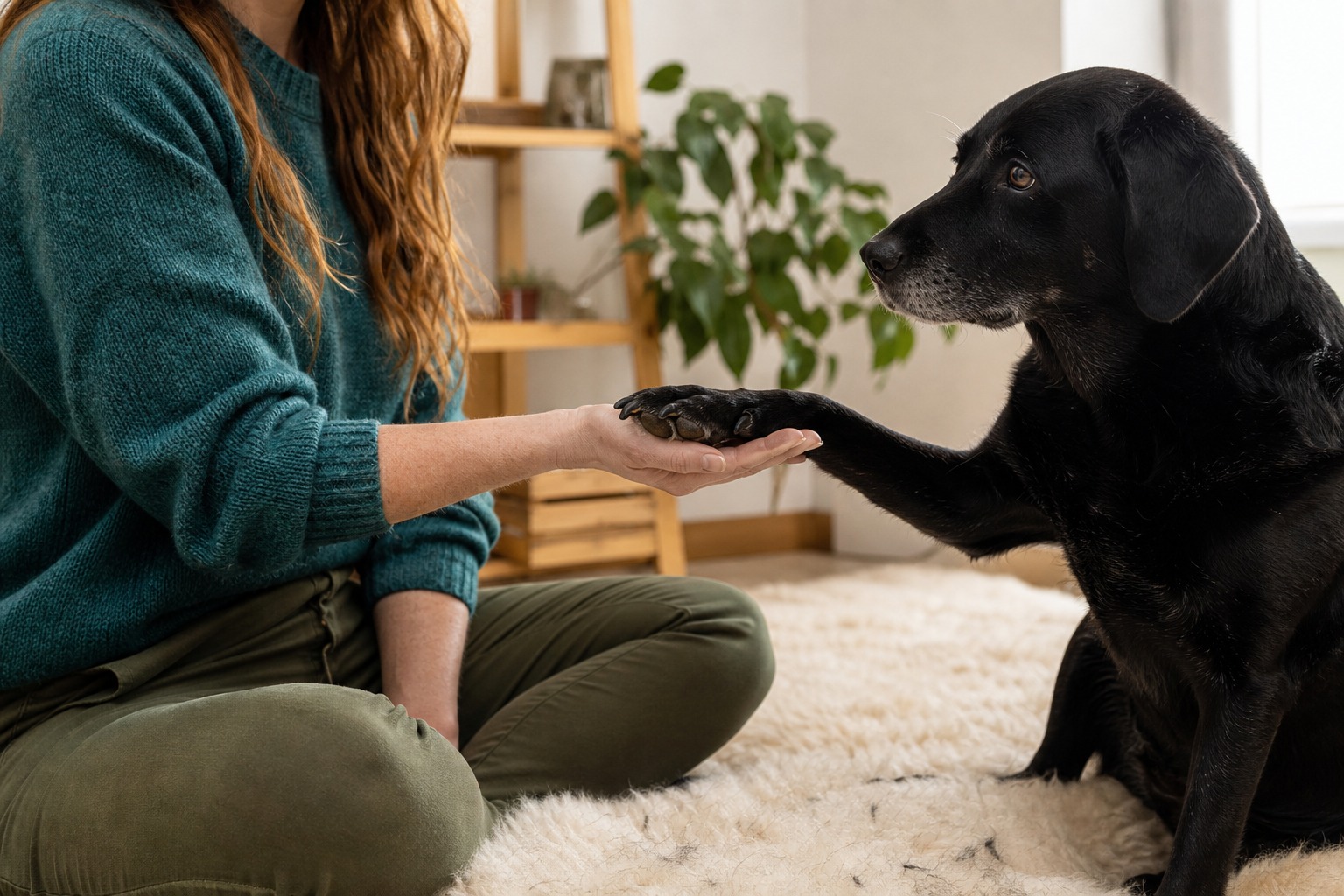
Start with plain handling, ideally in puppyhood but at any age. When your dog is calm rather than wound up, hold a paw, spread the toes, touch the pads, and pay them for sitting through it. Do it often and briefly. Once feet are no big deal, introduce the clippers as an object: let your dog see and sniff them, then tap the closed clippers against a nail without cutting, treating each time, for several sessions before you ever remove a sliver. You are building a chain of small yeses so that by the time a real cut happens, it’s just one more familiar step. This is the heart of what trainers now call cooperative care, letting the dog opt in rather than pinning them down, and it’s the single biggest predictor of whether trims stay peaceful for years.
The cut itself
When you’re ready, set up for calm. Sit on the floor with your dog in your lap, or work on a table with a second person to steady them, and position yourself opposite the nail so you can see it. Keep the mood light, warm voice, generous treats, a massage between paws. A cheerful handler makes a calmer dog.
Then extend the nail and find the quick. On clear or light nails, the pink is easy to spot, so trim just the tip below it. On black or dark nails you’re flying blind, which is exactly why you go slowly: make several tiny snips instead of one confident chop. With a scissor-style clipper, angle toward the end of the nail and cut at roughly 45 degrees. On dark nails, watch the freshly cut face after each pass. As you get close, a uniform gray-to-pink oval appears in the center of the cut. That is your stop sign, one more slice would sever the quick. Aim to finish within about two millimeters of it, and as a rule of thumb, a well-trimmed nail shouldn’t touch the floor when your dog stands.
Cap every paw, and ideally every clip, with a treat and a break. Go slow, keep it relaxed, and build up over time to more nails between rewards. And follow the golden rule of at-home trims: never do more than a nail or two if your dog is struggling, and always end on a calm note. Four short, pleasant sessions beat one long, traumatic marathon every time.
If you do catch the quick, don’t spiral. It happens to every owner eventually. Wipe the tip, press on styptic powder, and hold gentle pressure. The bleeding is dramatic on your floor but rarely harmful to your dog, and it usually stops within five minutes even with nothing at all. Only if it won’t slow within an hour does it warrant a vet call.
The nails and cases people forget
Dew claws. Those “puppy thumbs” higher up the leg don’t touch the ground, so they never wear down and can curl into the skin if ignored. Check them by running a finger under the nail; if it catches, trim it, watching for the quick just as you would elsewhere.
Brittle nails. If a nail splinters when you cut, switch to filing: sweep from the back of the nail along the curve to the tip.
The grinder route. A rotary grinder shaves the nail down in small amounts rather than cutting, which many owners find more forgiving near the quick. Support the toe, grind across the bottom and then in from the tip, smooth the edges, and keep any long fur well clear of the spinning head.
“There is a small group of dogs who turn every trim into a wrestling match no amount of treats seems to fix, and they’re often perfectly easy dogs in every other way,” says Dr. Amara Solis. “When you’re at that point, the kindest move isn’t to muscle through it at home, it’s to hand the job to your vet or groomer and ask what would make it less frightening for that particular dog.”
What newer research adds
We used to treat a dog’s dislike of nail trims as a quirk to power through. Newer behavior research pushes back on that. A 2022 study out of Australia that looked closely at how dogs actually experience nail trims, aptly titled “Puppy Pedicures,” found that aversion is common and, crucially, that it’s shaped by how the trims are done, not fixed in the dog. Dogs eased into trims with patience and rewards fare far better than those introduced abruptly or forced. It’s the science behind the cooperative-care approach: the calmer and more consensual the early experiences, the more likely your dog is to sit happily for a trim years down the line. If your dog already dreads the clippers, that’s not a permanent verdict either, it just means starting further back, with handling and treats, and rebuilding trust one paw at a time.
The bottom line
Keeping your dog’s nails short isn’t vanity, it’s protecting their feet and their gait. And the way to make it painless for both of you runs opposite to instinct: not one brave deep cut when things get bad, but small, frequent, low-drama trims that let the quick recede and keep the whole ritual boring. Boring, in nail trimming, is exactly what you’re going for.
References
- Edwards, Petra T., et al. “Puppy Pedicures: Exploring the Experiences of Australian Dogs to Nail Trims.” Applied Animal Behaviour Science, vol. 255, Oct. 2022, p. 105730. https://doi.org/10.1016/j.applanim.2022.105730
- American Animal Hospital Association (AAHA). “Nail trims and cooperative care.” aaha.org.
- American Kennel Club. “How to trim your dog’s nails safely.” akc.org.