


One Dog Licking Another's Ears Is Usually Fine. Two Things Make It Not.
It looks like grooming, and most of the time that is exactly what it is. But the dog doing the licking and the dog receiving it can each be telling you about a different medical problem, and neither one is obvious.

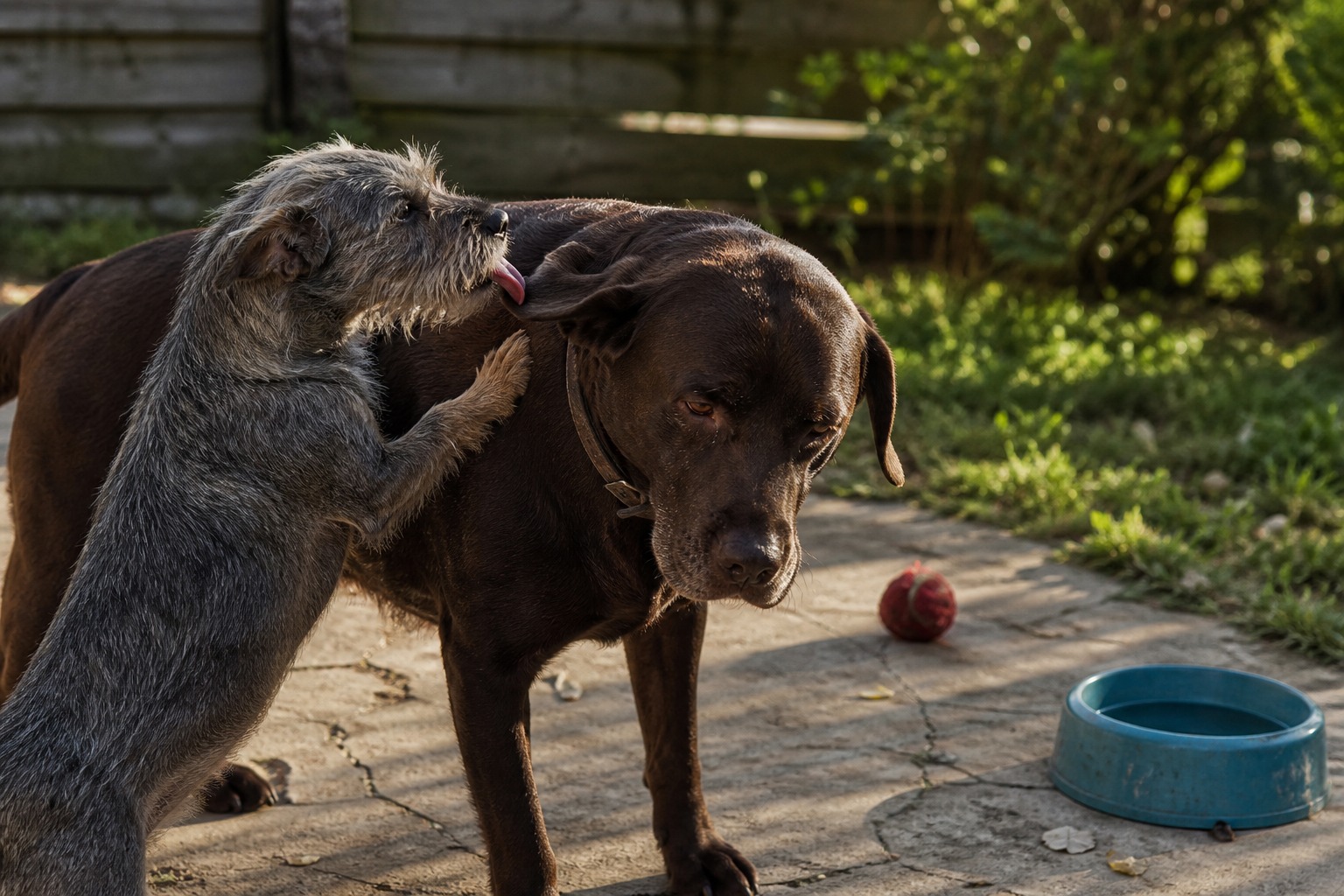
Two dogs are lying together, and one of them methodically works over the other’s ear. The dog on the receiving end tolerates it, or leans into it, or falls asleep. It is one of those things you can watch for ten minutes without ever quite deciding how you feel about it.
Most of the time it means nothing more than it looks like: dogs groom each other, ears are one of the few places a dog cannot reach on themselves, and this is what a social species does with an unreachable spot.
But there are two versions of this behavior that are worth catching, and they run in opposite directions. One is about the dog doing the licking. The other is about the dog getting licked. Neither one announces itself.
First, the ordinary explanation
Licking starts on day one. A mother licks her newborn puppies to clean them, stimulate them, and settle them. As they grow, littermates lick each other. By the time a dog reaches your house, licking has been established for their entire life as a way of being close to another animal.
So the everyday reasons are exactly what you would expect:
Grooming. The ear is a hard place to reach and an easy place to get dirty. Another dog can get at it. This is why you rarely see two dogs licking each other’s shoulders and constantly see them licking ears, muzzles, and eyes.
Greeting and affection. Ear licking that shows up with a wagging tail, a wiggling body, and general delight is a hello. It is the same impulse as a dog trying to get at your face when you come home.
Self-soothing. Licking releases endorphins, which means it feels good to do, not only good to receive. A dog who licks when they are anxious is medicating with the tools they have.
Smoothing things over. Old training culture would call the licker “submissive.” It is more accurate, and much more useful, to call the behavior appeasing. The dog is signaling that they mean no harm and want the interaction to stay friendly. That is a social move, not a rank.
Two dogs grooming each other is the most ordinary thing in the house, right up until you notice one of them can’t stop. The behavior is the same. The reason underneath it is completely different, and only one of those needs a vet.
Red flag one: the licker’s stomach
Here is the finding that should change how you watch this behavior.
Researchers at the University of Montreal’s veterinary teaching hospital studied nineteen dogs presenting with excessive licking of surfaces, the endless licking of floors, walls, furniture, and other dogs, and ran them through a full gastrointestinal workup. They found GI abnormalities in fourteen of the nineteen. Not vague ones, either: eosinophilic and lymphoplasmacytic infiltration of the GI tract, delayed gastric emptying, irritable bowel syndrome, chronic pancreatitis, a gastric foreign body, and giardiasis.
Then they treated the underlying disease. The licking significantly improved in ten of seventeen dogs, and resolved outright in nine.
Read that again, because it inverts the usual assumption. A dog who licks obsessively is not usually a dog with a behavior problem. A dog who licks obsessively is usually a dog with a sore gut, using the only self-soothing tool they have.
So: if one of your dogs is working the other’s ears in a way that is hard to interrupt, goes on and on, and shows up alongside licking the floor, the couch, and the air, do not book a trainer. Book a vet, and ask specifically about the gastrointestinal workup.
The other pattern to watch for in the licker: licking that spikes when you are not there. If the dog sitter reports that your dog spent the weekend fixated on the other dog’s ears, that is a stress signal, and separation distress is the first thing to consider.
Red flag two: the licked dog’s ear
The second red flag belongs to the dog on the receiving end, and it is much simpler.
Dogs are drawn to smell. An ear with an infection brewing in it smells and tastes different. It is entirely plausible that a dog fixating on one specific ear, on one specific dog, is telling you that ear is not healthy, and a good number of owners have found exactly that when they finally looked.
So look. Signs of otitis in the licked ear:
- A yeasty, sweet, or frankly foul odor
- Redness, swelling, or heat inside the flap
- Dark brown or black discharge
- Head shaking, tilting, or scratching at that ear
- Flinching when you touch it
If any of that is there, the licking is a symptom you noticed, not a problem you have to fix. Get the ear treated.
To be clear about the folk claim, because owners repeat it constantly: there is no evidence that another dog’s tongue cures an ear infection. Anecdotes exist. Evidence does not. An infected ear needs a diagnosis, because the treatment for yeast is not the treatment for bacteria and neither is the treatment for mites, and guessing wrong can cost a dog its hearing.
When to break it up
Genuinely, most of the time, you can leave them to it. Intervene when:
- The licked ear is getting raw, wet, or irritated. Constant moisture in an ear canal is itself a setup for infection.
- The licked dog is telling you it is too much: turning away, ducking, freezing, getting up and moving, or starting to growl. That dog’s boundary counts.
- The licker has been eating something you do not want deposited in an ear. Dogs get their mouths into a lot. An ear is not sterile, but there is a difference between saliva and debris.
- The behavior looks compulsive, per the section above.
How to redirect it
Give the tongue somewhere else to go. This is the single most effective intervention, and it works because it respects the drive instead of fighting it. A lick mat, a stuffed and frozen toy, or a snuffle mat gives a licking dog a legal outlet. If the licking is self-soothing, taking it away without a replacement just moves it somewhere worse.
Interrupt and reward, do not punish. Call the dog away, and pay them well for coming. Over time, the recall out of a licking session becomes its own reliable behavior. Scolding a dog for a stress behavior adds stress, which adds licking.
Fix the boredom underneath it. More sniffing walks, more chewing, more actual work for the brain. A dog with enough to do licks less.
What newer research adds
The most important update in this space is not new so much as under-adopted: the surface-licking-to-gut-disease link is now well enough established that veterinary behaviorists routinely send compulsive lickers for a GI workup before treating the behavior. Twenty years ago the same dog would have been labeled anxious and put on a behavior plan while an inflamed intestine went unexamined.
The second shift is the retirement of the dominance frame. Reading ear licking as a rank display in a wolf-pack ladder was always shaky, and it is not how behavior professionals describe affiliative grooming anymore. Dogs lick each other to stay close and to keep the peace, which is a much better description of what you are watching on your living room floor.
The bottom line
If your dogs groom each other’s ears and everyone seems fine, everyone is probably fine. Let them.
Just keep two questions in the back of your mind. Can the licker stop? And should someone look inside that ear?
References
- Bécuwe-Bonnet, V., et al. “Gastrointestinal Disorders in Dogs With Excessive Licking of Surfaces.” Journal of Veterinary Behavior, vol. 7, no. 4, 2012, pp. 194–204. sciencedirect.com
- “Excessive Surface Licking = Potential GI Pathology.” Clinician’s Brief. cliniciansbrief.com
- American College of Veterinary Behaviorists. “Compulsive Disorders in Dogs and Cats.” dacvb.org
Common questions
Does ear licking mean my dog is submissive to the other one?
That is the old reading, and it does not hold up well. Licking is affiliative and appeasing, meaning it is about smoothing things over and staying connected, not about a rank in a ladder. If you find yourself explaining your dogs' behavior with a hierarchy, you are usually explaining it wrong.
Can one dog's licking cure the other dog's ear infection?
No. Plenty of owners swear the licking dog seems drawn to an infected ear, and that observation is probably real, because an infected ear smells and tastes different. But there is no evidence that dog saliva treats otitis, and an infected ear needs a vet, drops, and a diagnosis.
When should I get the licking dog checked out?
When the licking stops looking social and starts looking compulsive: hard to interrupt, going on for long stretches, spreading to floors, furniture, and the air. Research links that pattern to gastrointestinal disease more strongly than to any behavioral cause.
Dr. Mehta is a board-certified veterinary nutritionist who evaluates pet food formulations, ingredient quality, and the science behind dietary trends. He writes and reviews all nutrition content at The Pet Times, including our food rankings and feeding guides.
Meet our experts ↗Keep reading
 Health & WellnessYour Old Dog Staring at the Wall Is Veterinary Medicine's Most Missed DiagnosisDr. Nina Kohl · 8 min
 Health & WellnessYour Dog's Sleep-Twitching Is Almost Always a Dream. Here's When It Isn't.Dr. Ravi Mehta · 6 min
 Health & WellnessA Quiet Dog Is Fine. A Newly Quiet Dog Is a Symptom.Dr. Ravi Mehta · 7 min
 Health & WellnessYour Dog's Squint Isn't a Smile. Count the Eyes.Dr. Mara Chen · 7 min
 Health & WellnessNo, Your Dog Isn't Schizophrenic. But What They Have Is Real.Dr. Lena Park · 7 min
 Health & Wellness'Is My Dog Depressed?' Skips the Question That Matters MoreDr. Amara Solis · 7 min