The night starts well. Your friends are there, the game is on, the patio is warm, and the sign on the door said dogs welcome. Three hours later you are standing in a puddle of your own dog’s urine, holding a leash attached to a barking, panting animal, while a server steps around you and a table of strangers stares.
Nothing went wrong, exactly. You had permission the entire time.
That is the trap in the phrase “dog-friendly.” It is a statement about the venue’s rules. It says the owner has decided that dogs are allowed on this floor. It says nothing whatsoever about whether your dog can spend an evening on that floor without suffering, and it never claimed to.
The decision about that was always yours. Here is how to make it honestly.
The four questions the sign doesn’t answer
Before you clip the leash on, you are actually answering four separate questions, and a no on any one of them is a no.
- Is my dog social enough for this specific setting?
- Is this environment survivable for a dog?
- Does my dog have the training to settle here?
- Will I actually be watching them?
Most people answer question one, feel good about it, and skip the rest. Questions two through four are where the bad nights come from.
1. “Social” is not one thing
Most dogs are not social or antisocial. They are selective: they like some dogs and some people, in some circumstances, for some length of time. That is normal, and it is closer to how most humans work than the golden-retriever fantasy we project onto the whole species.
So the useful question is not “does my dog like people.” It is: can my dog be comfortable in a place where strangers pass within a foot of them, a server reaches over their head, a chair scrapes, someone shouts at a screen, and none of it can be predicted?
A dog can adore your friends and be undone by that. Loving their humans is not the same as tolerating a room full of unfamiliar ones behaving unpredictably.
“Our dogs are not small people in fur coats,” says Dr. Nina Kohl. “They have their own nervous systems, and when the input runs past what that system can process, we should not be surprised when the behavior falls apart. The dog is not misbehaving. The dog is overwhelmed.”
2. Some environments are a no for almost any dog
Certain outings are a bad idea regardless of how wonderful your dog is. Skip them.
- Loud concerts and amplified events. Dogs hear a far wider and higher range than we do, and a venue built to move air through a human crowd is punishing to an animal who cannot cover their ears or leave.
- Events with a lot of other dogs. This is the counterintuitive one. Fifty over-aroused dogs in a small space is not a party, it is a pressure cooker, and it is where scuffles start.
- Anywhere with wildlife or livestock in view. You do not want to find out what your dog does when something that reads as prey walks past.
- Anything in extreme heat. Heat is the one that gets treated as an inconvenience rather than a hazard, and it should not be.
On that last point, a number worth memorizing: when the air temperature is 77°F, asphalt in direct sun with no wind can hit about 125°F, and a dog’s paw pads can be damaged by 125°F pavement in roughly a minute. Seventy-seven degrees is a pleasant day for you. It is a burn risk for them. Put the back of your hand flat on the pavement and hold it there for five seconds. If you pull away, so should they.
3. Training means “can settle,” not “knows sit”
The training question is not whether your dog knows the cues. It is whether the cues survive contact with a distracting environment.
Be honest with yourself:
- Will they sit and stay while people walk and talk and eat around them?
- Will they leave a dropped chicken wing on the floor, on cue, the first time?
- Can they walk on a leash through a tight crowd without veering into someone’s shins?
- Can they lie down under a table and stay down for an hour, not because you are holding them there, but because they have settled?
If the honest answer is no, that is not a reason to feel bad. It is information, and it points at a plan: work on those skills first, in easier places, and build up. Practice in a quiet pet-friendly store. Take a group class. Do a short trial run at the venue in an off-hour, in a tucked-away corner where nobody can step on your dog or loom over them, and leave while it is still going well.
Bringing an untrained dog to a busy venue is not a test they can pass. It is a setup they are guaranteed to fail, and then the failure gets blamed on them.
Before any of that, call ahead. Ask what the leash policy is, whether there is shade, and where a dog is meant to relieve themselves. Make sure your dog’s vaccines are current. And solve the problem nobody plans for: what will you do when you need the bathroom? A restroom is a small tiled box full of slamming stall doors, roaring hand dryers, and flushing toilets, and it is a genuinely alarming place for a dog who has never been in one. Either you have a person you trust to hold the leash, or you are taking the dog into that room with you. Decide before you need to.
4. The one nobody admits: your attention is the safety equipment
Here is the part that gets skipped, because it is the part that costs you something.
Watching a dog properly in a busy place is a job. It means reading their body continuously, noticing the third yawn, catching the moment they stop taking treats, seeing the stranger reaching toward their head before the hand lands. You cannot do that job while also tracking the score, losing yourself in a set, or falling into a real conversation with a friend you have not seen in a year.
If you are not prepared to spend the evening with half your attention on your dog, the answer is not “bring them and hope.” The answer is: leave them home. That is not a failure of love. It is the whole of it.
The signals people miss
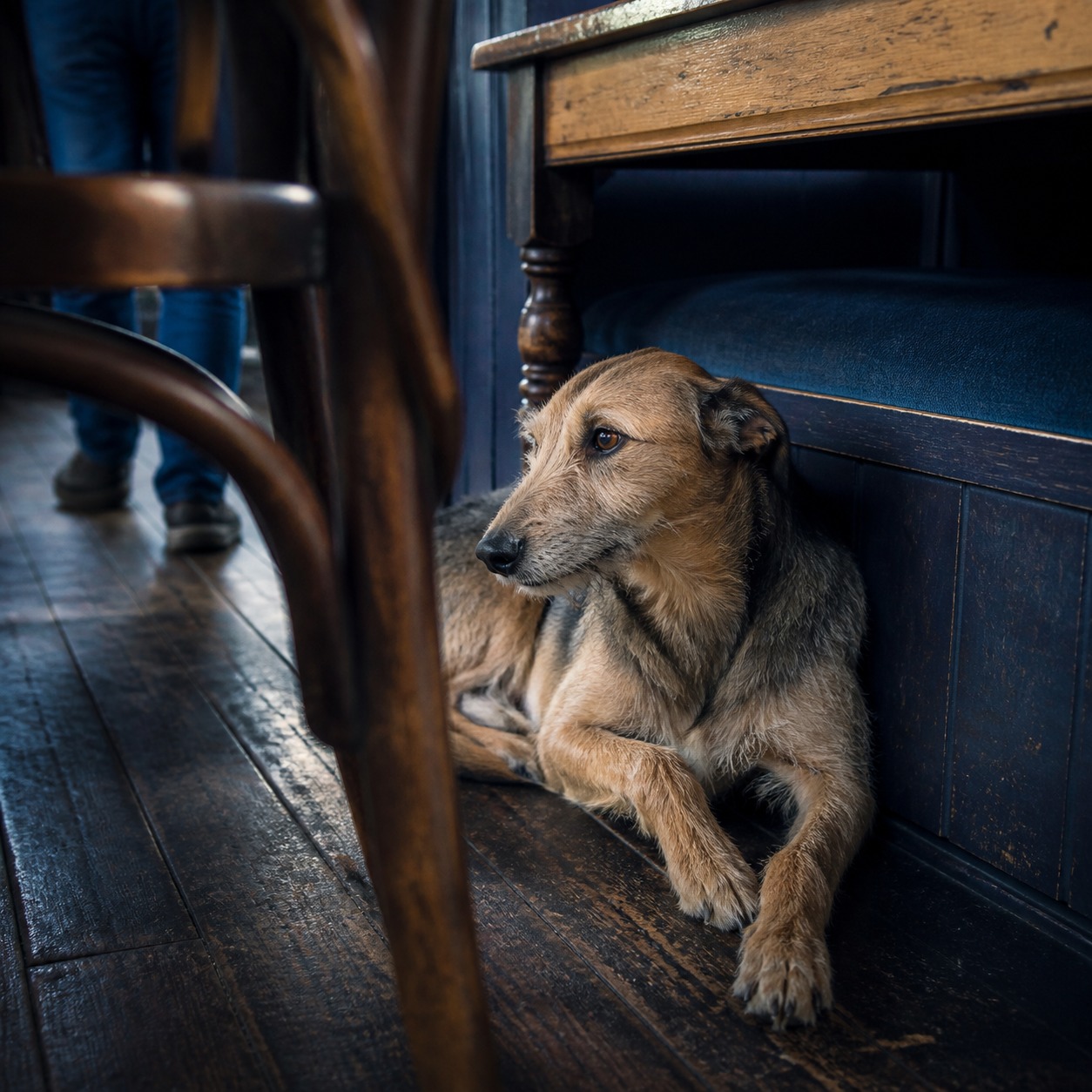
The dogs who get hurt at these places are almost never the ones lunging and barking. They are the still ones. The quiet, tucked, frozen dogs whose people think they are being good.
Early and easy to miss: yawning when they are not tired, lip-licking with no food present, repeated stretching, a tucked tail, ears pinned back, restlessness, a stiff body, hard staring eyes, a lowered crouching posture, excessive panting, frantic sniffing at the ground, sudden scratching, raised hackles along the spine, turning their face away from people, and refusing food they would normally take.
Louder and unmissable: barking, lunging, shaking, growling, snapping, or showing teeth.
By the time you get to the second list, you have missed a lot of the first one.
When you see the early signs, you have two good options: move to a quieter corner and give your dog a real break from the input, or go home. Both of those are wins. There is no prize for staying.
What to bring, even when the venue says they have it covered
Assume they have nothing.
- A flat leash, not a retractable or a bungee. You need to know exactly where your dog is, at all times, in a crowd.
- ID tags and a registered microchip, with the registration actually current. Crowds are where dogs get loose.
- Poop bags, hand sanitizer, antibacterial wipes, and something absorbent for accidents. Accidents happen to good dogs.
- Water and a collapsible bowl. Do not rely on a communal bowl.
- One familiar toy or chew, which gives your dog a job that is not “monitor this room.”
- Boots if the ground will be hot, icy, or salted, and a coat if it is cold. If you need a jacket, so might they.
- The address of the nearest emergency vet, looked up before you go, not during.
What’s new since this trend took off
Dog-friendly has gone from a novelty to a marketing category, and the venues have gotten better at the logistics: more patios with shade, more water stations, more staff who know not to reach over a dog’s head. That is real progress, and it is worth rewarding with your business.
What has not changed is the part the venue cannot do for you. The research on canine stress keeps pointing the same direction: the cost of an overwhelming experience is not paid on the night. It is paid later, in a dog who is a little more reactive at the next patio, a little quicker to bark at the next crowd. Dogs generalize from bad evenings.
So use the permission when your dog can genuinely enjoy it, and turn it down when they cannot. The sign says you may. Your dog gets to say whether you should.
References
- Fear, anxiety, and stress in dogs — American Veterinary Society of Animal Behavior position statements
- Hot asphalt: a danger to your dog’s paws — FOUR PAWS USA
- Protect your pet’s feet from heat and burns — Washington State University College of Veterinary Medicine
- Canine body language and signs of stress — American Kennel Club Canine Health Foundation
- Socialization and behavior — ASPCA