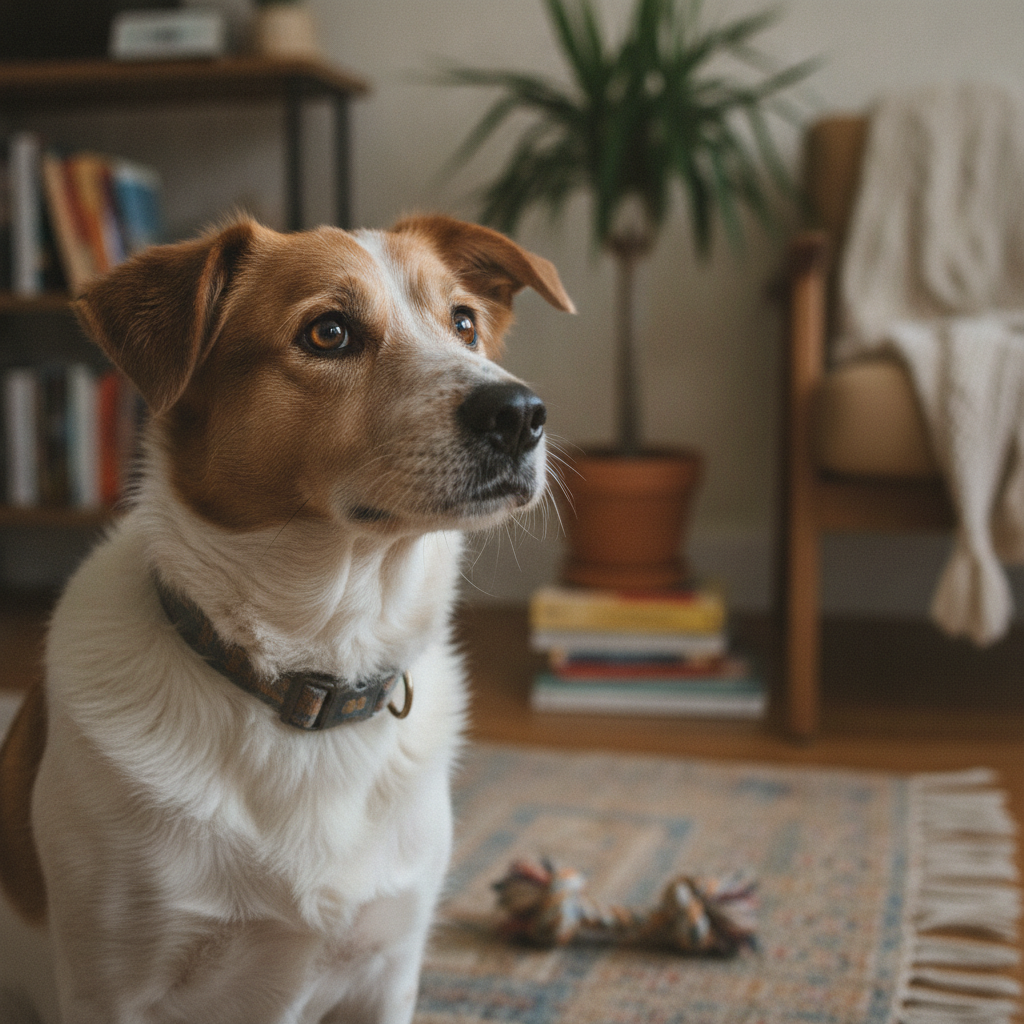
Some dogs eat as though the kibble is on a timer. Head down, forty-five seconds, empty bowl, mild bewilderment that it is over.
It is funny, and most dogs do it their entire lives without incident. But they are running a real risk, and it is worth being blunt about what it is.
Why this is not a manners problem
Eating that fast means a dog is not chewing and barely tasting. That produces choking, gagging, and vomiting, which are unpleasant.
Then there is the one that matters. Speed-eating is a recognized risk factor for gastric dilatation, which most people know as bloat.
Here is the mechanism, because it clarifies why the stakes are what they are. Gas builds up until the stomach distends. A distended stomach can twist within the abdomen, which seals the gas in with no way out. The twisting cuts off circulation, to the stomach and then to other organs, including the heart.
Dogs can die within hours of the onset of bloat. It is a genuine emergency, and it requires immediate veterinary attention, not a morning appointment.
So this is not about table manners. Eating fast is a modifiable risk factor for one of the fastest-killing conditions in dogs.
The insight that saves you months
People ask how to train a dog to eat more slowly, and the honest answer is that you should not bother.
It is far easier to make fast eating physically impossible than to teach a dog not to want to do it.
Think about what you would actually be training against. The drive to consume available food quickly is deep, old, and not especially amenable to persuasion. You are not going to reason a dog out of it, and every meal is a repetition of the thing you are trying to stop.
Change the physics instead. Every method below works on the same principle: set up a system where the dog cannot get more than a little bit of food at a time. The dog does not need to cooperate. The dog does not even need to notice.
“I never ask an owner to train a dog out of gulping, because the training is slow and the risk is now,” says Dr. Lena Park. “I ask them to change the bowl. It takes ten seconds, it costs nothing or very little, and it works on the first meal. Behavior change is the right tool for a lot of problems. This one is a plumbing problem, so use a plumbing solution.”
Start with the free one
Before you buy anything, try this.
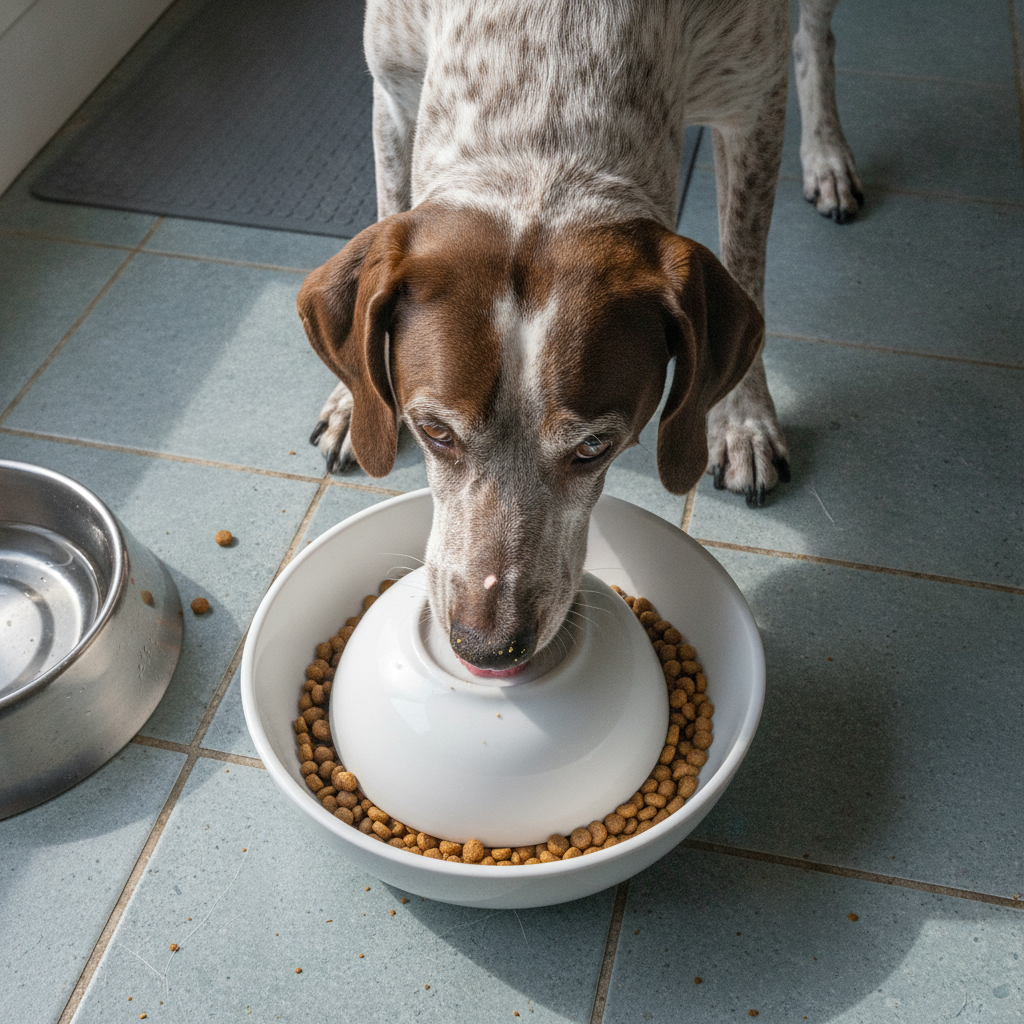
Put a small bowl upside down inside a larger bowl. Pour the food over the top of the small bowl so it settles into the ring around the outside.
You have just created a narrow moat of food. Your dog cannot take the meal in one enormous mouthful, because there is no pile to take. They have to work their way around the circle.
It costs nothing, it uses bowls you already own, and for a lot of dogs it is the whole solution.
Then, in order of escalation
Put obstacles in the bowl. Clean toys, too large to swallow, dropped into the food. The dog has to nose them aside or eat around them. Same principle, different geometry.
Scatter the food. Throw the kibble over a wide area, so the dog has to move for every piece. This works very well and adds foraging, which dogs enjoy.
But only in a single-dog household. This is the caveat people skip and it matters. Scattering food with more than one dog present is a bad idea. It creates direct competition over dispersed resources, which produces stress, tension, and can escalate into food aggression. If you have two dogs, do not do this.
Use a purpose-built slow feeder or a food puzzle. This is the best option for most dogs, and it does two jobs at once.
The ridged, mazed slow-feed bowls make gulping mechanically impossible. Food puzzles go further: a dog that has to roll or push a puzzle around to make kibble fall out will work at it for a long time.
And that work is the hidden benefit. A puzzle feeder turns dinner into mental exercise, which most dogs get far too little of, and it builds two things that are genuinely valuable in a dog’s life: persistence, and tolerance for a bit of frustration. A dog that has learned that effort eventually pays off is a more resilient dog in every other context.
They are noisy. That is the trade.
A snuffle mat does something similar, hiding food in fabric folds so the dog has to hunt it out with their nose. Nose work is unusually tiring for dogs, in the best way.
The emergency signs, which everyone should know
Whatever method you use, memorize these. Bloat can happen to a dog whose eating you have already slowed down, particularly in deep-chested breeds.
Go to an emergency vet immediately if you see:
- Retching or dry-heaving that produces nothing. The dog is trying to relieve pressure that cannot escape. This is the classic sign.
- A distended, hard, or painful abdomen.
- Restlessness and an inability to settle, pacing, repeatedly lying down and standing up.
- Weakness or collapse.
There is no waiting on these. Bloat kills in hours.
The other things worth doing
Split the meals. Two or three smaller meals rather than one large one means a less-distended stomach each time.
Mind the timing around exercise. Do not feed a large meal immediately before or after intense activity. Hard exercise slows the stomach’s emptying, and a full stomach and vigorous movement is precisely the combination you want to avoid.
Feed at floor level unless your vet advises otherwise. Raised bowls were once widely recommended and the evidence has not been kind to them; some research has associated elevated feeding with increased bloat risk in large breeds. If your dog needs a raised bowl for orthopedic reasons, that is a conversation with your vet.
What newer research adds
The current thinking on bloat has moved toward treating it as a multifactorial risk rather than a single-cause event, and speed of eating is one variable among several: deep chest conformation, large breed, older age, a first-degree relative with a history of bloat, stress, and eating a single large daily meal.
Which is why the interventions in this article stack. Slowing the meal, splitting the meal, keeping the stomach from being maximally distended, and separating feeding from hard exercise are all pulling the same lever from different directions.
The other genuinely useful development is the growing recognition of feeding as enrichment rather than logistics. The old model was to get food into the dog efficiently. The current view is that a dog putting real effort into acquiring a meal is a dog that is meaningfully occupied, and that the ten minutes your dog spends solving a puzzle feeder does more for its wellbeing than the ten seconds it used to spend inhaling a bowl.
The bowl was never the point. It just took us a while to notice.
References
- American College of Veterinary Surgeons. “Gastric Dilatation-Volvulus.” https://www.acvs.org/small-animal/gastric-dilatation-volvulus
- Glickman, L. T., et al. “Non-dietary risk factors for gastric dilatation-volvulus in large and giant breed dogs.” Journal of the American Veterinary Medical Association, vol. 217, no. 10, 2000. https://avmajournals.avma.org/
- Glickman, L. T., et al. “Incidence of and breed-related risk factors for gastric dilatation-volvulus in dogs.” Journal of the American Veterinary Medical Association, vol. 216, no. 1, 2000. https://avmajournals.avma.org/
- Cornell Richard P. Riney Canine Health Center. “Bloat (Gastric Dilatation and Volvulus).” https://www.vet.cornell.edu/departments-centers-and-institutes/riney-canine-health-center/canine-health-information
- Rooney, N. J., and Cowan, S. “Training methods and owner–dog interactions: Links with dog behaviour and learning ability.” Applied Animal Behaviour Science, vol. 132, 2011. (On enrichment and problem-solving.) https://www.sciencedirect.com/science/article/abs/pii/S0168159111000797