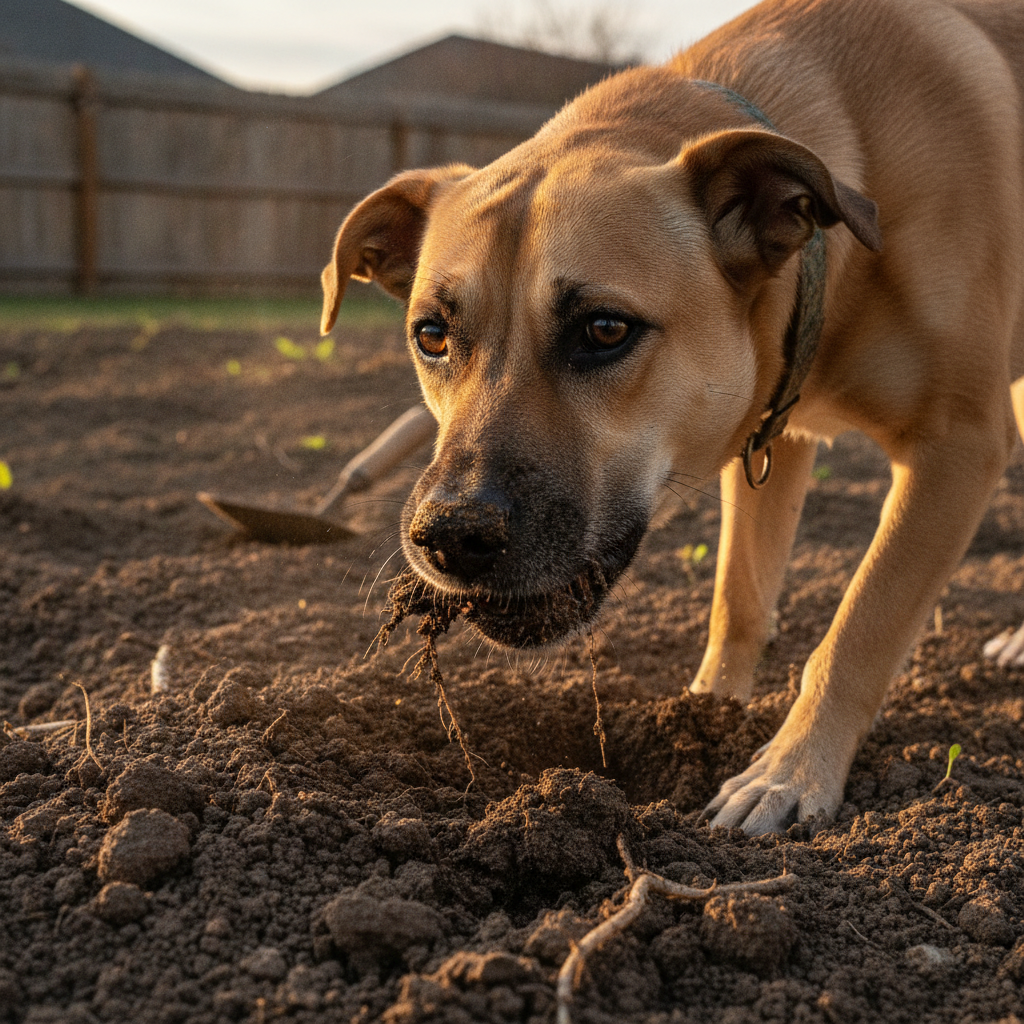
Dogs put things in their mouths. This is the deal you signed. But there is a specific moment that stops you cold, which is when your dog is not sniffing the dirt, not scratching in it, but eating it, mouthful after mouthful, with intent.
Most advice on this handles one half of the problem: why is my dog doing this. That’s the right question, and it’s incomplete.
There are two problems here, and they need to be solved separately.
Problem one is why. Something is driving the behavior, and sometimes that something is medical.
Problem two is the dirt itself. Soil is not inert. It carries parasites that survive in it for years, and in a lot of yards it carries things you’d rather your dog not eat. Even if you solve the “why,” a dog who has already been eating dirt has an exposure worth checking.
Handle both.
Problem one: what’s driving it
Anemia, and the iron that comes with it. This is the one to rule out first in an adult dog, and it’s the one most people never think of. Anemia, a low red blood cell count, is one of the most common medical reasons a dog starts eating dirt. So is poor absorption of nutrients from the GI tract, where the food going in is fine but the dog isn’t getting what’s in it. Both are diagnosed with bloodwork.
Gut trouble. Nausea and GI discomfort can drive a dog to eat strange things, the same way some dogs eat grass when their stomach is off. If your dog is eating dirt and also drooling, licking their lips, gulping, or vomiting, the dirt is probably a symptom and not the disease. And here’s the trap: even if the dirt gives some short-term relief, sustained dirt-eating makes GI problems worse. It can cause blockages, it introduces toxins, and rocks and sticks abrade the gut lining on the way through.
Parasites. This runs in both directions, which is what makes it interesting. Intestinal parasites can cause pica through blood and nutrient loss and through the cramping and discomfort of a heavy worm burden. And dirt-eating is itself an excellent way to acquire parasites. A dog can be in the loop in both directions at once.
Pica. The umbrella term for persistently eating things with no nutritional value. Pica is not an explanation, it’s a description. It can sit on top of a nutritional deficiency, a medical problem, teething in a young dog, a compulsive disorder with a genetic component, or boredom.
Boredom, stress, and anxiety. The residual category, and a real one. A dog with an empty day will invent an activity. A dog with separation anxiety may redirect that stress into their mouth. If dirt-eating happens specifically when your dog is alone in the yard, or specifically when you’re getting ready to leave, note the pattern, including the time, the frequency, and how long it lasts. That log is worth more to a vet or trainer than a description ever will be.
Puppyhood. Puppies mouth everything, and dirt is part of everything. Some of it is genuinely just development, and it fades.
Problem two: what’s actually in the dirt
This part rarely makes it into the standard advice, and it should.
Roundworm eggs are extraordinarily durable. Toxocara canis eggs pass in the feces of infected dogs, and they persist in soil. Under the right conditions they survive for months, and studies in the UK have found some eggs remaining viable in soil for up to three years.
Here’s the counterintuitive part that changes what you should worry about: the eggs are not infectious when they’re fresh. They need roughly two to four weeks in the environment to develop before they can infect anything. Which means the danger is not the pile of poop you just picked up. The danger is the ground where a pile sat a month ago, or a year ago, or three years ago.
This is why scooping fast matters more than scooping thoroughly, and it’s why a patch of dirt in a dog park is a genuinely worse bet than it looks.
Roundworms are also zoonotic. People, and especially children, can get toxocariasis by ingesting eggs from contaminated soil. The dirt problem in your yard is not just your dog’s problem.
Hookworms, whipworms, and Giardia all follow the same broad pattern: they hang around in soil and get picked up from it.
And then the non-living stuff. Soil in older neighborhoods, near old painted structures, near roadways, or on land with an industrial past can carry lead and other heavy metals. Fertilizer, herbicide, pesticide, and cocoa mulch are all common in yards and none of them belong in a dog. If your dog has a dedicated dirt-eating patch, it’s worth knowing what has been put on it.
“Two dogs eat dirt for completely different reasons and one of them has a low red cell count,” says Dr. Priya Nair. “You cannot tell them apart by watching. The first move is bloodwork and a fecal exam, not a training plan.”
How to stop it
Break the habit and treat the cause, in that order, at the same time.
1. See the vet. Bloodwork and a fecal test. Rule out anemia, parasites, liver disease, and other systemic problems. If the behavior is frequent, this is not optional. The vet visit is the first step.
2. Break access to the spot. Habits are location-bound. If there’s one patch of the yard your dog goes to, block it, cover it, or fence it. If you can’t do either, leash your dog every time they go out so they cannot get back to the same ground. This is the fastest, least glamorous fix and it works.
3. Build a recall that beats the dirt. As your dog heads for their patch, call them off, and pay them enormously: praise, high-value treats, a game. Practice the recall constantly in easy places, away from the dirt, so that by the time you need it in a hard place, it’s automatic.
4. Consider a basket muzzle. For a determined dog, this is the fastest way to make dirt-eating physically impossible while the training catches up. Basket muzzles let a dog pant, drink, and sniff freely, they just prevent them from picking things up. Introduce it slowly with treats so it’s a good thing, not a punishment. A muzzled dog should never be left outside unsupervised.
5. Fix the diet if the diet is broken. Make sure the food carries an AAFCO statement of nutritional adequacy for your dog’s life stage, and make sure your dog is actually being fed enough. Dogs eating dirt are sometimes short on minerals like iron, sodium, and calcium and are trying to source them elsewhere. But do this in consultation with your vet rather than throwing supplements at a problem you haven’t diagnosed.
6. Make the yard interesting. Change the routine. Toss a ball the moment you let your dog out so the yard means “game,” not “buffet.” Play “find it,” scattering food and cueing your dog to hunt for it, which puts their nose to constructive work. Add toys and rotate them. A dog with a job is a dog not mining your flower bed.
7. Get help for the anxiety. If the dirt-eating is anxiety-driven, none of the management above will hold. A qualified trainer or a veterinary behaviorist is the right call.
When it’s an emergency
Go to the vet immediately, not tomorrow, if your dog has been eating dirt and now shows:
- Repeated vomiting, especially if they can’t keep water down
- A tense, painful, or bloated abdomen
- Straining to defecate, or no stool at all
- Lethargy or collapse
- Pale gums
Those are the signs of obstruction, and obstruction is surgical.
What newer research adds
Two things have sharpened in the last few years.
First, the link between foreign body ingestion and underlying behavioral disorders is now better documented. Dogs that repeatedly eat things they shouldn’t are more likely to have other behavioral signs, which supports treating chronic pica as a whole-dog problem rather than an isolated bad habit. Bloodwork and a behavior history, not one or the other.
Second, the soil picture keeps getting more specific. Current CDC guidance on toxocariasis is clear that eggs require weeks in the environment to become infective and can then persist for a long time, which is why prompt cleanup of feces is the highest-leverage prevention step available to you. Keep your dog on year-round parasite prevention, run fecal exams on your vet’s schedule, and pick up the yard immediately rather than weekly. The dirt your dog is eating today was contaminated a long time ago.
References
- Centers for Disease Control and Prevention. “How Toxocariasis Spreads.” https://www.cdc.gov/toxocariasis/spreads/index.html
- Companion Animal Parasite Council. “Ascarid (Toxocara canis) Guidelines.” https://capcvet.org/guidelines/ascarid/
- Merck Veterinary Manual. “Gastrointestinal Obstruction in Small Animals.” https://www.merckvetmanual.com/digestive-system/diseases-of-the-stomach-and-intestines-in-small-animals/intestinal-obstruction-in-small-animals
- Amat, Marta, et al. “Assessment of the Link Between Behavioural Disorders and Foreign Body Ingestion in Dogs.” Journal of Veterinary Behavior / Animals. https://doi.org/10.3390/ani10091501
- Sueda, Kari L. C., Benjamin L. Hart, and Kelly D. Cliff. “Characterisation of Plant Eating in Dogs.” Applied Animal Behaviour Science, vol. 111, no. 1–2, 2008, pp. 120–132. https://doi.org/10.1016/j.applanim.2007.05.018
- Association of American Feed Control Officials. “Understanding Pet Food Labels.” https://talkspetfood.aafco.org/readinglabels