


Your Dog Is the Cheapest Anti-Anxiety Tool You Own. Most People Waste It.
The stress relief happens by accident every time you come home. Here's how to stop leaving it to chance and actually dose it, backed by what petting a dog does to your cortisol.

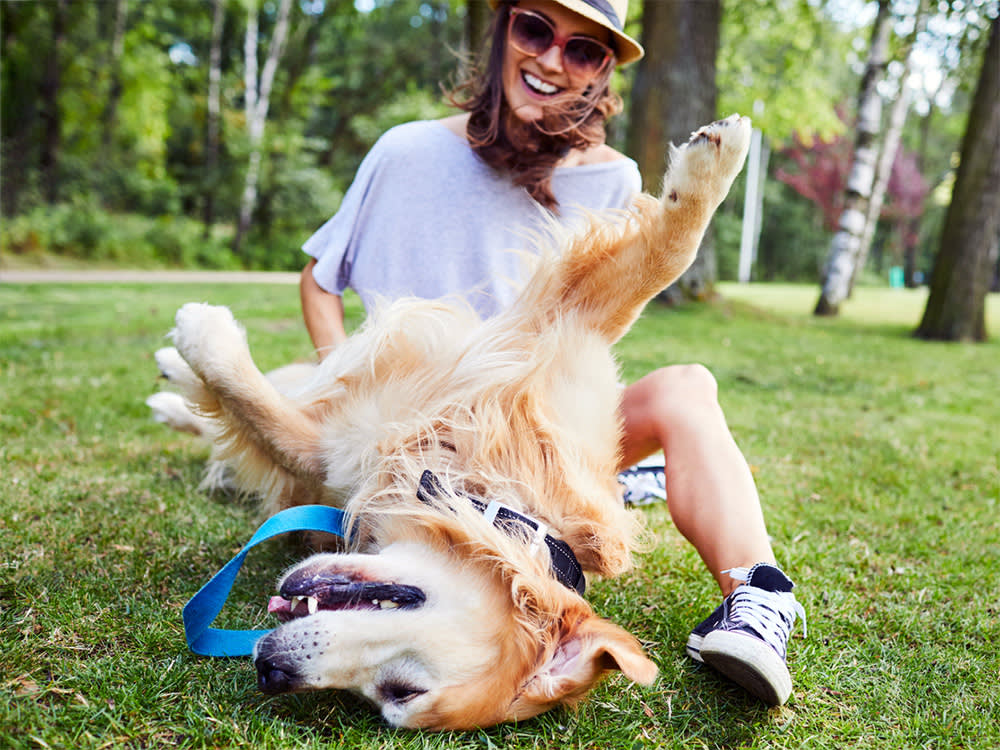
Ask a room full of dog people what keeps them sane, and the same answer keeps surfacing: the dog. Not in a cute, greeting-card way, but in a hanging-on-by-a-thread, the-dog-is-the-thread way. That instinct is correct, and it is measurable. The part almost everyone gets wrong is treating it as something that just happens to them, like weather, instead of a tool they could pick up on purpose.
Here is the reframe worth keeping: the calm your dog gives you is a real, physiological effect, and effects can be dosed. You do not have to wait for it to arrive at the end of a bad day. You can reach for it the way you would reach for a glass of water.
What is actually happening in your body
When you sit with your dog, scratch their chest, or just let them lean into your leg, your nervous system responds before your conscious brain catches up. Contact with a dog is associated with lower cortisol, the hormone your body pumps out under stress, and a bump in oxytocin, the bonding chemical that also shows up between parents and infants. Blood pressure tends to drift down. Heart rate settles. This is not a mood, it is chemistry, and it runs in both directions: your dog’s oxytocin rises too.
People treat the dog as a reward for getting through the hard day, when the dog is actually one of the tools for getting through it. Five minutes on the floor with your dog before the day starts is not a break from your real life. For your stress hormones, it is part of the work.
The useful takeaway is that the dose does not need to be long. Small, deliberate contact, repeated, beats one big weekend hike you keep postponing.
Stop waiting until you are already fried
Most people cash in on their dog only when they are already at the edge. Flip the order. Build in short, low-effort resets throughout the day, and you keep your baseline lower instead of scrambling to recover.
A few that take almost no time:
- A two-minute belly rub or ear scratch first thing, before you touch your phone.
- A single round of tug or fetch between meetings.
- Teaching or rehearsing one trick, purely because the tiny win feels good to both of you.
- If you are apart, thirty seconds of a photo or a pet-cam check instead of a scroll through the news.
None of this is indulgent. It is preventive maintenance for your own head, and your dog reads it as attention, which is all they ever wanted.
Rename the walk
The daily walk is where the biggest gains hide, and it is also the thing people most resent when they are tired. The fix is embarrassingly simple and it works: change the sentence in your head. “I have to walk the dog” is a chore. “I get to walk the dog” is a small privilege you are choosing. Same walk, different nervous system going into it.
Timing helps too. There is no rule that the walk belongs at 7 a.m. if 7 a.m. is when you are most frazzled. Put it after the meeting that always spikes your blood pressure. Put it at dusk when your obligations are done and you can actually notice the sky. A predictable routine is calming on its own, but only if the routine fits your life instead of fighting it.
Train, because a calmer dog is a calmer you
Training is rarely sold as stress relief, but it is one of the best forms of it. Reward-based training is genuinely fun, it deepens the bond, and it hands you a dog who makes daily life smoother. A dog who greets guests without bowling them over, walks without dragging you down the block, settles in a crate, and comes when called removes a hundred small frictions from your week.
There is a second, quieter benefit. Learning a new skill together and pulling it off is a little hit of competence for both of you, and competence is the opposite of the helpless feeling stress runs on.
Move, because it is the loudest lever
The most famous way a dog lowers your stress is the plainest: they get you moving. Dog people log more steps than their petless friends, and exercise reliably changes brain chemistry in your favor, easing tension, lifting mood, raising your tolerance for discomfort, and, crucially, improving sleep. Better sleep then makes you more resilient to the next day’s stress, so the benefit compounds.
The right exercise is whatever you and your dog will actually keep doing. Running suits some pairs. Others do better with swimming, which is easy on aging joints, or a long unhurried walk with a bit of a view. The best routine is the one that does not feel like punishment.
What newer research adds
The lab is catching up to what dog people already suspected. In a study out of Washington State University, researchers had 249 college students spend ten minutes petting and interacting with cats and dogs, then measured their cortisol. Ten minutes of contact was enough to produce a meaningful drop in the stress hormone, no lecture or breathing exercise required. Other work points the same direction: even a short, unhurried session with a friendly dog can lower heart rate and cortisol.
Two things are worth pulling out of that. First, the effective dose is small, which means the busiest, most stressed people are exactly the ones who can fit it in. Second, contact matters more than duration. You do not need an hour. You need to actually put your hand on the dog and stay there for a few unhurried minutes, on purpose, more than once a day.
Your dog will never file this under work. To them it is just the good part of the day arriving again. That is rather the point.
References
- Pendry, P., & Vandagriff, J. L. (2019). Animal Visitation Program (AVP) Reduces Cortisol Levels of University Students: A Randomized Controlled Trial. AERA Open. https://journals.sagepub.com/doi/10.1177/2332858419852592
- Handlin, L., et al. Short-Term Interaction Between Dogs and Their Owners: Effects on Oxytocin, Cortisol, Insulin and Heart Rate. Anthrozoös. https://www.tandfonline.com/doi/abs/10.2752/175303711X13045914865385
- Powell, L., et al. (2019). The Physiological Function of Oxytocin in Humans and Its Acute Response to Human-Dog Interactions. Journal of Veterinary Behavior. https://www.sciencedirect.com/science/article/abs/pii/S1558787818301813
Dr. Kohl is a board-certified veterinary dentist with a particular interest in preventive oral care. She reviews all dental health content at The Pet Times and contributes practical guides on home dental routines, professional cleaning, and oral disease prevention.
Meet our experts ↗Keep reading
 LivingThe 8 Dogs Who Built the Entire Pet-Influencer EraLeila Torres · 5 min
 LivingDon't 'Demote' the Dog When the Baby ArrivesDr. Amara Solis · 6 min
 Living8 Habits of a Great Dog Owner That Have Nothing to Do With MoneyClaire Sutton · 6 min
 LivingThe Dog Park Is a Near-Perfect Matchmaking Machine. Here's the ProofLeila Torres · 9 min
 LivingAt Cold Picnic, the Dogs Aren't a Side Story. They're the Whole PhilosophySara Lim · 6 min
 Living"My Last Dog Syndrome": Why Your New Dog Keeps Losing to a GhostDr. Nina Kohl · 7 min