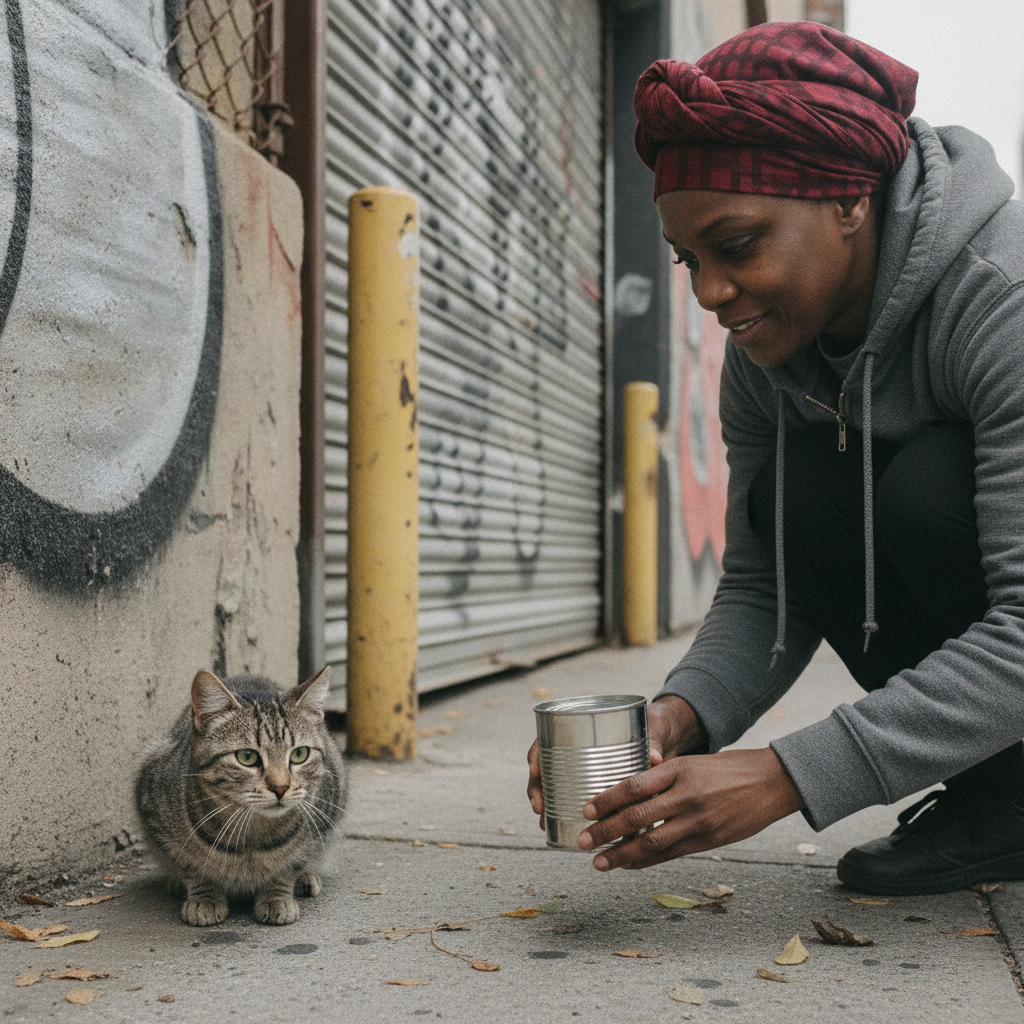
Every so often a post makes the rounds claiming your cat secretly thinks you’re a big, clumsy, furless kitten it’s stuck raising. It’s a charming idea. It’s also a trap, because it assumes the only two options are “your cat is your baby” or “you are your cat’s baby,” and the real answer isn’t on that menu at all.
Here’s the frame worth adopting instead: your cat has a relationship with you that it has with no other creature on earth, and trying to force it into a human family role tells you more about you than about the cat.
Why we reach for the parent-child story
We can’t help it. We carry cats around when they let us, take them to the vet, and feed them the second they cry. So when a cat does something that looks maternal, we file it under “family.” The problem is that the same behavior can mean three different things, and picking the cutest interpretation isn’t the same as being right.
The honest starting point is humility. We experience the world through a human lens, which makes “kitten,” “parent,” or “treat vending machine” the categories that come to mind first. A cat’s inner life doesn’t have to fit any of them.
“People want a cat’s love to look like human love, so they sort every purr and head-bump into ‘parent’ or ‘child,’” says Dr. Mara Chen. “But a cat isn’t running our family software. It has built a specific bond with you that doesn’t map onto how it treats other cats at all, and that’s the genuinely interesting finding, not which greeting card category you land in.”
Decoding the four behaviors everyone points to
The viral posts always cite the same evidence. Let’s take each on its own terms, because the truth is more interesting than the meme.
The “gifts.” Yes, mother cats bring prey to their kittens, both to feed them and to teach them to hunt, which is where the half-dead mouse comes from. But a cat depositing a toy at your feet may not be parenting you at all. For cats, hunting and playing are the same circuit. Handing you a “kill” can just as easily mean “I found this excellent toy, let’s play” as “you poor helpless thing, let me feed you.” Either way, it’s a compliment.
Grooming. Mother cats clean their kittens, true. But adult cats also groom each other when they’re bonded. Read a cat licking your hand as a sign it counts you as close family or a trusted friend, not proof it thinks you’re its offspring.
Following you around. Same story. Mother cats trail their kittens, and bonded adult cats trail each other. A cat that pads after you from room to room is most likely just socially attached to you, which is a lovely thing on its own without any parent-child overlay.
Meowing. This one is close to the opposite of the meme’s claim. Adult cats rarely meow at each other; they mostly reserve it for humans. And a meow usually isn’t “I think you’re my kitten,” it’s a request: food, attention, a door opened. Mother cats actually use different sounds with their young, chirps, chirrups, and trills, that they seldom aim at people.
What the research actually shows: cats bond like we do
This is the part the “baby or parent” debate skips, and it’s the strongest thing we know. Cats form measurable attachment bonds to their humans, and they look a lot like the bonds human infants form with caregivers.
In a well-known study of the “secure base” effect, researchers found that roughly two-thirds of cats were securely attached to their owners: placed in a strange situation, a securely attached cat used its person as a source of safety, then relaxed enough to explore. That figure, around 65 percent secure, is strikingly close to the rate seen in human infants. Follow-up work has continued to find that cats show distinct attachment styles, with a majority landing in the secure category and the rest split among anxious and avoidant patterns.
The takeaway isn’t “your cat is your child” or “you are your cat’s child.” It’s that cats are capable of a real, secure, individual bond, the emotional equivalent of a safe home base, which is a far bigger deal than winning an internet argument about who’s the baby.
The chemistry is real, and it runs both ways
There’s a biological thread underneath all of this. Oxytocin, the hormone tied to bonding and to nursing, can be released during affectionate human-animal contact and helps calm and strengthen the connection on both sides. That’s part of why cuddling your cat feels good to you and reinforces the relationship for both of you.
And if your cat never brings you a single toy mouse, never trails you down the hall, and never once acts maternal? That’s completely normal too. Every cat, and every cat-human pair, is its own thing. Some cats simply prefer to receive the benefits of the bond rather than perform them, and that’s a valid way to be a cat.
Does the answer even matter?
Not as much as the asking makes it feel like it should. We can’t interview a cat, so the best we can do is watch what cats do, make reasonable inferences, and resist the urge to over-explain. A more useful question than “what exactly is my cat doing when it leaves a toy in my shoe” is “is this a sign of a good relationship.” And the answer to that one is clearly yes.
Your cat isn’t your baby, and you aren’t your cat’s baby. You’re something your cat reserves only for you. That’s the better answer, and it happens to be the true one.
References
- Vitale, K. R., Behnke, A. C., & Udell, M. A. R. “Attachment bonds between domestic cats and humans.” Current Biology (2019). cell.com
- Oregon State University. “Cats, like children and dogs, develop attachments to their caregivers, study shows.” news.oregonstate.edu
- American Veterinary Society of Animal Behavior. “A deep dive into cat attachment to humans.” avsab.org