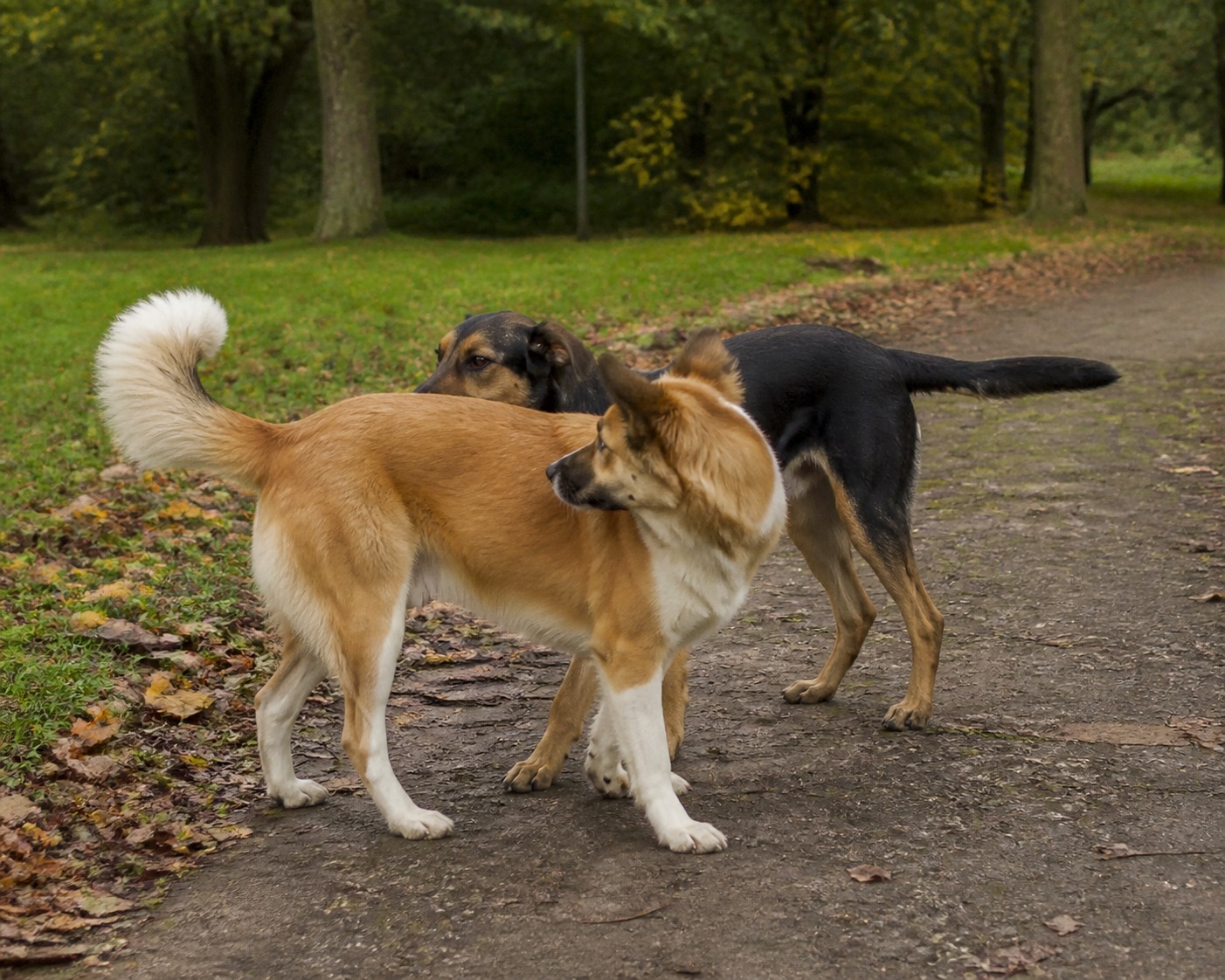
We treat docked tails and cropped ears as a style question, a look that belongs to certain breeds. But a dog’s tail and ears aren’t decoration. They’re two of the loudest instruments in the orchestra a dog uses to talk to other dogs. When we shorten them for the sake of a silhouette, we aren’t just changing how a dog looks. We’re cutting the wires on how a dog communicates, and there’s a clever piece of research with a robot dog that proves other dogs notice.
The thesis: a tail is a sentence, and docking edits it
Humans, when we try to read a dog, stare at the tail. Dogs do too. So the obvious question is what happens to that conversation when the tail is gone. Rather than guess, researchers built a life-sized robotic dog modeled on a Labrador Retriever, motionless except for its tail, and watched how real dogs approached it.
The results were tidy and revealing. When the robot had a long tail that wagged, dogs approached it more readily than when the long tail stayed still, exactly what you’d expect if a wag says “come closer.” But when the tail was short, the whole signal collapsed. Dogs approached the short-wagging robot and the short-still robot about the same. In other words, a long tail carried clear emotional information, and a short one carried so little that dogs couldn’t tell wag from stillness. The short tail wasn’t just quieter. For communication purposes, it was close to mute.
Sit with that. A docked dog isn’t sending a garbled version of the message. Other dogs may not be receiving a message at all.
Docking and cropping as social static
Trainers and behaviorists who work with dog-to-dog conflict see the downstream effect of this every day. When a dog can’t broadcast its intentions clearly, misunderstandings pile up, and misunderstandings are where a lot of aggression is born.
The tail is only part of it. Cropped ears do the same damage from the other end of the body. A dog with surgically altered ears often looks permanently alert, ears up and forward, whether or not that’s how it feels. To another dog, that fixed “on” posture can read as a challenge the dog never intended to issue. And because cropped ears can’t move through their full range, the subtle shifts that would normally soften or clarify the signal simply aren’t available.
“When we dock a tail or crop the ears, we’re taking away vocabulary the dog can’t get back,” says Dr. Nina Kohl. “I see dogs labeled as reactive or difficult who are really just being constantly misread by the dogs around them, because the equipment they’d use to say ‘I’m friendly’ or ‘I’ve had enough’ has been surgically shortened.”
It even trips up the humans. Owners of docked dogs lose the habit of checking the tail for movement and tension, because there’s so little tail to check. With cropped ears, people have to learn to read muscle movement at the skull instead of the ear itself, a signal most of us never think to look for.
Different bodies, different signals
None of this means an intact dog is an open book while altered dogs are ciphers. Every breed’s build shapes what it can say. A heavily coated breed like a Chow can be stiff with tension and other dogs can’t see it through the fur. Flat-faced, paedomorphic breeds, the ones bred to look permanently puppyish, French Bulldogs, Pugs, Cavalier King Charles Spaniels, have faces that struggle to make the fine muscular expressions other dogs rely on. The point isn’t that docking is uniquely bad; it’s that docking and cropping take a challenge that already exists and make it deliberately worse, for the sake of appearance.
There’s a vision angle too that’s easy to miss. Research on the canine eye found that short-nosed and long-nosed dogs literally see differently: flat-faced breeds have a central focusing area, like ours, that helps them lock onto what’s in front of them, including our pointing gestures, while long-nosed breeds have a “visual streak” tuned for peripheral movement. So a dog’s shape doesn’t just change what it can signal. It changes what it notices, including how well it tracks us.
The welfare and legal picture
Set communication aside for a moment, and there’s still the matter of the procedure itself. The American Veterinary Medical Association and the American Animal Hospital Association both oppose ear cropping and tail docking done purely for cosmetic reasons, noting the pain, distress, and risks of hemorrhage and infection that come with cutting healthy tissue on a young animal.
Defenders, primarily some breeders and kennel-club voices, argue docking preserves “breed character” and prevents working-dog tail injuries, and they’ve fought bans on those grounds. But the legal tide has been moving for decades. Much of Europe restricted these practices back in the 1980s; the UK treats cosmetic docking as prohibited mutilation, with a narrow carve-out for certain working dogs. In the United States the picture is patchier and slower: there’s no national ban, and only a couple of states, Maryland and Pennsylvania, place real limits, mostly requiring a licensed veterinarian and anesthesia rather than banning the practice outright.
Why this should change how you see your own dog
Here’s the practical, non-judgmental takeaway. Whatever your dog’s build, docked or intact, flat-faced or long-nosed, knowing what they can and can’t easily signal makes you a better advocate for them. If your dog struggles to be understood at the dog park, that’s not stubbornness or bad temperament, it may be that the tools they’d normally use are shortened, hidden, or fixed in place. Reading your dog’s whole body, and giving other dogs grace when their signals are hard to read, turns frustration into empathy. Sometimes the most useful thing you can do is exactly what we’re usually told not to: be a little superficial, and pay attention to what’s physically right in front of you.
What newer research and policy add
The professional consensus against cosmetic docking and cropping has only hardened recently. In late 2024 the AVMA published an updated literature review on tail docking that again found no compelling welfare justification for the cosmetic version, and around the same time the AAHA folded ear cropping, tail docking, and devocalization together into revised accreditation standards that discourage member hospitals from performing them for looks. The direction of travel is clear: what was once framed as breed tradition is increasingly treated by the veterinary mainstream as an elective harm. For owners, the meaningful shift is cultural, more vets are now willing to say plainly that these procedures cost a dog something real, and that the something is the ability to speak.
References
- Leaver, S. D. A., and T. E. Reimchen. “Behavioural Responses of Canis familiaris to Different Tail Lengths of a Remotely-Controlled Life-Size Dog Replica.” Behaviour, 2008.
- American Veterinary Medical Association. “Tail Docking of Dogs: Literature Review,” 2024.
- McGreevy, P., et al. “A Strong Correlation Exists Between the Distribution of Retinal Ganglion Cells and Nose Length in the Dog.” Brain, Behavior and Evolution, 2004.
- American Animal Hospital Association. “Ear Cropping and Tail Docking Position Statement.”