Picture mushing and your brain probably goes straight to Alaska: a fan of huskies, a wooden sled, and a hundred frozen miles of trail. Here is the part nobody tells you. You do not need snow. You do not need huskies. You do not even need a sled. You need a healthy dog who loves to move, about sixty-five dollars of gear, and a stretch of quiet path.
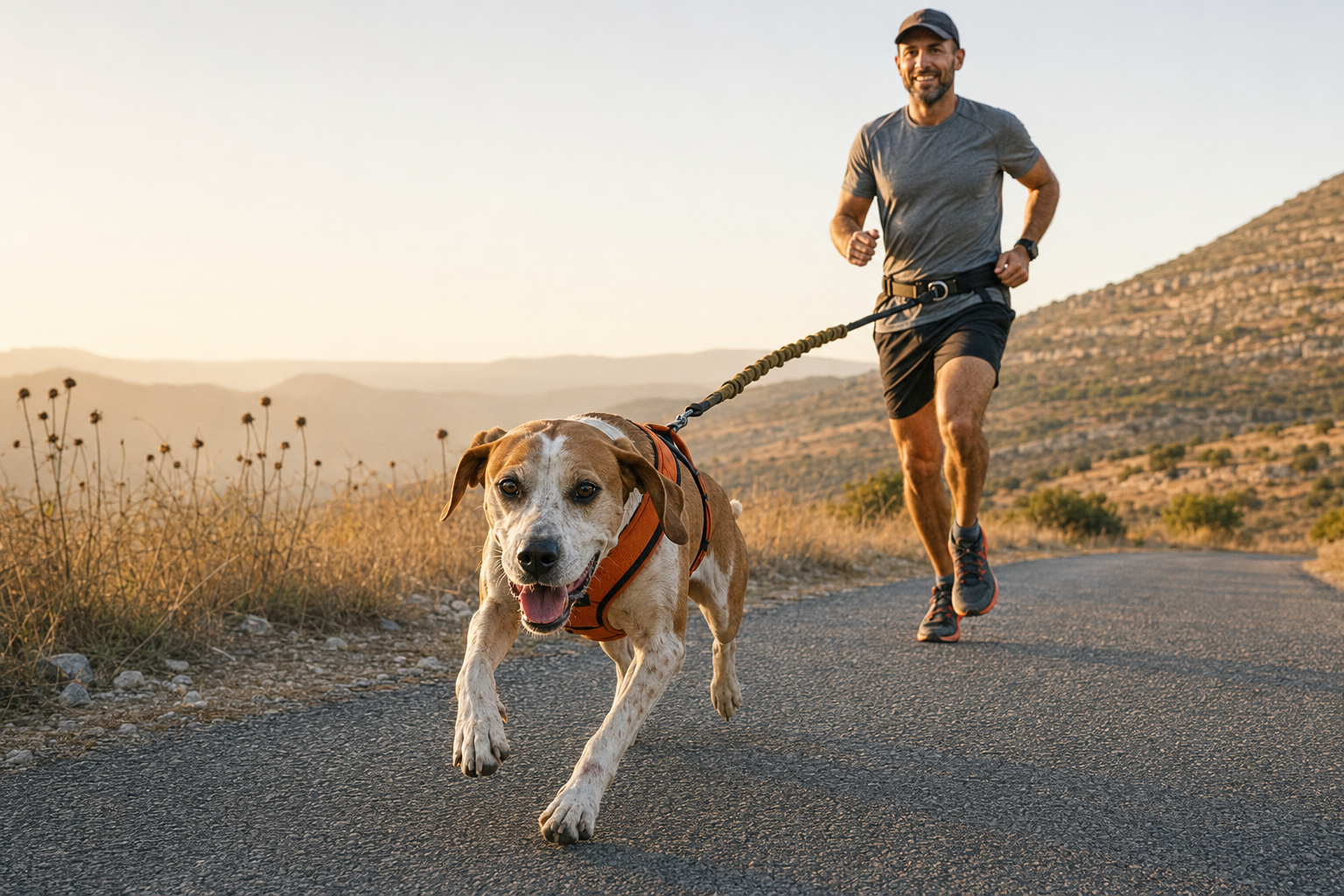
That sport has a name, and it is quietly booming: dryland mushing, the warm-weather, no-snow cousin of sledding. The most beginner-friendly version is called canicross, a mashup of “canine” and “cross country.” You clip your dog to a belt around your waist with a stretchy line, and they pull you forward while you run. That is it. No lead to hold, no elbow yanked every time a squirrel appears, just you and your dog working as one engine.
The point isn’t speed. It’s the two of you working together.
The reason canicross hooks people is not the pace, though yes, a motivated dog will make you faster than you have ever been. It is the feeling of moving as a team. Your dog gets a real job and a hard workout. You get pulled up the hills you used to dread. And because you are physically tethered, the whole thing forces a kind of communication and trust that a normal on-leash walk never quite reaches.
There is a real fitness payoff on both ends of the line, too. A dog who trots politely on walks is rarely working anywhere near their capacity. Leaning into a harness and driving forward is. For a high-energy dog who chews the couch out of sheer boredom, an outlet like this can change the whole household.
“The dogs I see thrive with canicross are almost never the ones people expect,” says Dr. Ravi Mehta. “It is not about breed or size. It is about a dog with a healthy set of joints and a real love of running. Give that dog a job on the end of a bungee line and you often watch the anxiety and the destructive habits melt away over a few weeks.”
What you actually need to buy
The gear list is short, and none of it is exotic. Three things do the work.
A pulling harness for your dog is the piece that matters most. It has to spread the pulling force across the shoulders while staying clear of the shoulder joints, the belly, and the spine. A poorly designed harness that loads the wrong spot is how dogs get sore. On dry ground, plenty of runners reach for the shorter “buggy style” cut, which points the pull at a friendlier angle than a full X-back sled harness does, though the X-back works fine too. What does not work is a freight or weight-pulling harness. Those are built to drag a load low to the ground, not to pull a person whose hips sit a few feet up. Budget roughly twenty-five to fifty dollars for a good one, and measure your dog several times before ordering, because dogs squirm and a single measurement lies.
For you, the setup is a padded running belt plus the gangline that links you to the dog. These are often sold together as a skijor kit, and a decent one runs about forty to seventy dollars. Add the harness and you are into the sport for well under a hundred dollars total.
Get both of you in shape first, and know who should sit it out
This is the step people skip, and it is the one that lands dogs at the vet. If your dog has been mostly a couch companion, do not clip in and sprint on day one. Build a base the same way a human runner would: start with brisk walks, then layer in short jogging intervals, and stretch the distance out over a few weeks as stamina climbs.
Canicross is open to just about any breed. A rangy pointer mix, a lab, a scrappy terrier, a herding dog, all of them can pull. What matters is health, not pedigree. Some dogs, though, genuinely should not do this. Puppies whose growth plates are still open, dogs recovering from an injury, and seniors carrying arthritis do not belong on a gangline, and a vet visit before you start is not a formality. Heat is the other quiet danger: a dog cannot shed heat the way you can, so save the hard efforts for cool mornings and skip them entirely on warm, humid days.
Canicross is just the doorway
Once you and your dog have the pulling idea down, dryland mushing opens up. Swap your feet for wheels and you are bikejoring, where your dog tows you on a bike. Trade the bike for a scooter or a set of rollerblades and it becomes scootering or skatejoring. Hitch them to a small weighted cart over a set distance and that is carting. Same core skill, same gear philosophy, wildly different rides. Most people start with canicross precisely because running needs the least equipment and the shortest learning curve.
The first run
Find a quiet, flat path with few distractions. Let your dog move out ahead of you and take up the slack in the line while you jog behind, rather than walking beside them like a normal outing. The goal is for them to learn that leaning into the harness is the job. Keep early sessions short and upbeat, and end while they still want more. Once they understand the pull, you can layer in simple cues: a word for “go,” directional words for turns, and a clear “stop.” Plenty of dogs pick it up faster than their humans do.
What’s new since this was written
Canicross used to be almost invisible in the United States, a curiosity you only heard about near sled-dog country. That is changing fast. In 2019, three runners, Alexis Karpf, Jacqui Johnson, and Lizzie Hill, founded North American Canicross to give the sport one clear home, and interest snowballed so quickly that membership pushed past a thousand within about a year.
Today there are organized races, titles, and regional communities well outside the cold-weather regions where mushing traditionally lived. If you want to try it, you no longer have to figure it out alone. Local clubs, beginner-friendly events, and online groups now exist to help you fit gear, learn the cues, and find a first race that welcomes newcomers and their dogs.