


The Cat on Your Lap Isn't the One Who Loves You Most
We've quietly agreed that cuddliness is the scoreboard for feline love. It isn't, and there's a better measure that researchers can actually test for. Most cats already pass it, including the ones who won't sit on you.

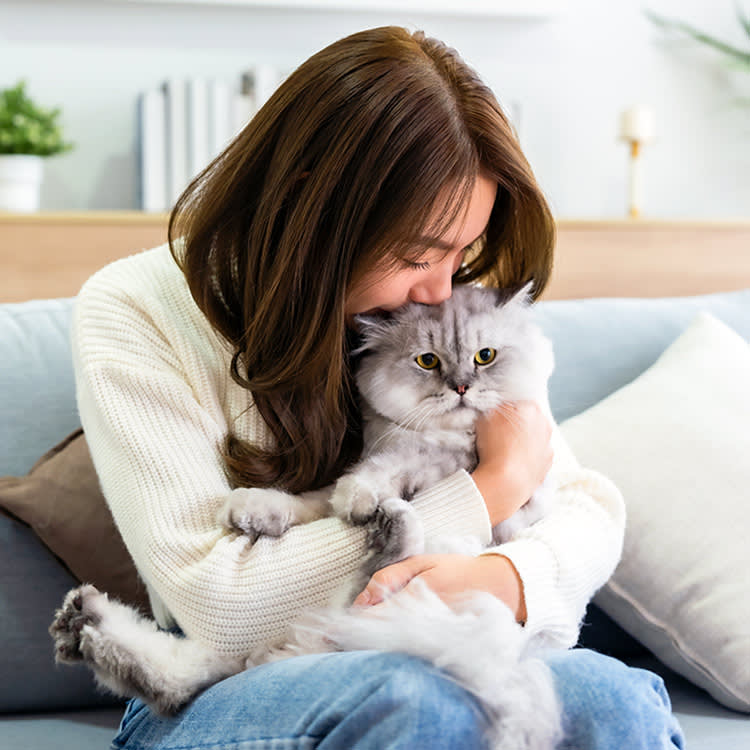
At some point we all absorbed the same bad idea: that a cat who climbs into your lap loves you, and a cat who doesn’t is holding something back.
It is a comfortable idea because it makes love legible. It is also wrong, and the way it’s wrong matters, because it turns a huge number of perfectly bonded cats into disappointments and encourages their owners to push, which is precisely the thing that makes a cat pull further away.
Here is a more accurate way to think about it. Cuddling is a tolerance trait. Attachment is a bond. They are two different things, they’re built at different times, and only one of them is a measure of your relationship.
The good news is that the one that isn’t cuddling is the one that’s actually testable. And most cats pass.
Cats were never designed to want this
Start with the thing nobody says out loud: physical affection from a human is not, for a cat, a natural category of experience.
A kitten seeks contact from its mother. That’s it. Being held, being stroked, being carried around, being pressed against a chest, none of that exists in a cat’s world unless a human introduces it. A cat born and raised without people will never once, in an entire life, experience being petted. Some of those cats can later be coaxed into taking food from a hand. Very few will ever be comfortable being touched by one.
So the correct baseline is not “cats like cuddles and some are broken.” The baseline is: cats have no innate interest in this at all, and we spend a narrow window teaching some of them that it’s safe.
The window is much earlier and much narrower than you think
This is where the popular advice is usually a bit off, and the correction is worth having, because it explains a lot.
The sensitive period for socializing a kitten to humans runs from roughly two to seven weeks of age. That is the window in which a kitten’s brain is most willing to file “human hands” under safe rather than dangerous. Handling after that still helps, and confidence-building continues for months, but the core work is done astonishingly early, before most kittens have even left the litter.
The research is old and consistent. Kittens handled gently in those first weeks grow into friendlier adults. And the number of different people matters, not just the amount of handling: kittens handled by four or more people during the socialization window become noticeably more sociable with strangers as adults than kittens handled by one.
This is why bottle-raised kittens, pulled from a nest at a few days old and hand-fed around the clock, tend to grow up so relentlessly people-focused. Humans were the mother. Human contact is the earliest safe thing they know.
It also explains the reverse. A feral kitten who never meets a person until four months old has missed the window entirely. Socialization is still possible, but it is slow, incremental work, and the ceiling is lower. Ask anyone who has taken in a five-month-old feral: years can pass before the cat volunteers a lap, and it may never happen at all.
None of which is a comment on love. It is a comment on when a nervous system got its formative information.
Owners keep asking me how to make their cat cuddlier, and it’s the wrong question. The honest answer is that most of that was decided in a two-week stretch before you met them. What you can still build is trust, and trust is the thing that actually matters.
To be clear, none of this is an argument for pulling a kitten out of the nest early. The litter is where a kitten gets fed, gets warm, and learns the entire behavioral vocabulary of its own species, and none of that is optional. Handling and staying with the mother are not in competition. A decent foster or breeder does both at once, which is exactly the point.
The measure that actually means something
So if not the lap, then what?
Researchers borrowed a tool from developmental psychology called the secure base test. You put a cat and its person in an unfamiliar room together. The person leaves. The person comes back. And you watch what the cat does on the reunion.
A securely attached cat greets the person and then goes back to exploring the room. The human is the anchor point that makes the strange room manageable, so the cat can get on with business. An insecurely attached cat either clings and can’t settle, or avoids the person entirely and stays stuck in stress.
When this was done with cats and kittens, roughly two thirds came out securely attached: about 64 percent of kittens and 66 percent of adult cats. Retest them later and the classification mostly holds, over 80 percent land in the same category, which suggests this is a stable trait of the relationship rather than a mood.
Sit with those numbers for a second. Two thirds of cats treat their person as a source of security in a frightening place. That proportion is broadly comparable to what you see in human infants and in dogs.
And crucially: nothing in that test involves sitting on anyone. A cat can be securely attached and never once tolerate being picked up. The lap is a preference. The bond is a bond.
What to do instead of pushing
If your goal is a closer cat, the fastest route runs through play, and the second fastest runs through leaving them alone.
Play, and play properly. Most people do not play with their cats anywhere near enough, and when they do, they do it badly, waving a wand twice and losing interest before the cat has engaged. Aim for two or three sessions a day. Five or ten minutes each is often plenty, but longer is better if the cat is still in it. Let them catch the toy. A hunt with no kill is a frustration, not an enrichment.
Close the loop with food. Play, catch, treat. That sequence mirrors the natural hunt-eat-groom-sleep cycle and it is enormously calming. It also builds, over weeks, an association between you and the best part of your cat’s day, which is worth more than any amount of unwanted stroking.
Then stop, and wait. After a session, offer a scratch on the head or cheek if the cat allows it, and then leave them be. Let the cat come to you. The single most reliable way to make a cat approach you is to become boring and available.
If they don’t play, find what they do like. Not every cat is a hunter. Some want a sunbeam, a high shelf, a specific window, a corridor to sprint down at 3am. Whatever the thing is, be near it, sweeten it, and let your cat build the association at their own pace.
And never force it. Holding a cat that wants down doesn’t teach them that being held is fine. It teaches them that you are a source of things they can’t get out of. Every non-consensual cuddle is a small withdrawal from an account you’re trying to build.
When cuddling stops, treat it as a symptom
There is one version of this that is genuinely urgent, and it’s the opposite of the cat who never cuddled.
A cat who used to cuddle and suddenly won’t is a medical question until proven otherwise. Cats are creatures of profound habit, and a sharp change in tolerance for touch usually means touch has started to hurt. Arthritis is the single biggest culprit and it is drastically underdiagnosed in cats, because they don’t limp, they simply do less. Dental pain, an injury, and a long list of internal problems can all present the same way.
If the change lasts more than a day or two, don’t wait it out. Get them seen. If it is pain, it is very often manageable, and a cat whose arthritis is being treated frequently comes back to the lap.
Age cuts both ways, incidentally. Some of the most affectionate cats you will ever meet are seniors, cats who spent a decade being aloof and then, somewhere around eleven, decided you were acceptable. Personality is not fixed. A clingy kitten can become a standoffish adolescent. A shelter cat who seemed docile can turn out to be an opinionated diva at home. The cat you have at two is not necessarily the cat you’ll have at ten.
The bottom line
Affection in cats is expressed in a vocabulary we mostly ignore because it’s quiet. Sitting in the same room. Choosing the chair nearest you. The slow blink. Following you between rooms and then doing nothing. Sleeping where they can see you. Coming to find you when something startles them, which is the secure base test, run live, in your hallway.
Cuddling is one dialect of that language, and it happens to be the one we understand best, so we mistake it for the whole thing.
Build the trust. Play until they’re tired. Let them decide. If the cuddles come, they’ll be worth having, because they’ll be given rather than taken. And if they never come, you will still, by every measure that researchers can actually test, be your cat’s person.
References
- Vitale, K. R., A. C. Behnke, and M. A. R. Udell. “Attachment Bonds Between Domestic Cats and Humans.” Current Biology, vol. 29, no. 18, 2019, pp. R864–R865. https://www.cell.com/current-biology/fulltext/S0960-9822(19)31086-3
- Karsh, E. B., and D. C. Turner. “The Human-Cat Relationship.” The Domestic Cat: The Biology of Its Behaviour, Cambridge University Press, 1988.
- Casey, R. A., and J. W. S. Bradshaw. “The Effects of Additional Socialisation for Kittens in a Rescue Centre on Their Behaviour and Suitability as a Pet.” Applied Animal Behaviour Science, vol. 114, no. 1–2, 2008, pp. 196–205. https://www.sciencedirect.com/science/article/abs/pii/S0168159108000749
- Bennett, V., et al. “Cat Behaviour in the Secure Base Test: Comparison Between Owned and Shelter Animals.” Behavioural Processes, vol. 215, 2024. https://pubmed.ncbi.nlm.nih.gov/38224845/
- Lascelles, B. D. X., et al. “Cross-Sectional Study of the Prevalence of Radiographic Degenerative Joint Disease in Domesticated Cats.” Veterinary Surgery, vol. 39, no. 5, 2010, pp. 535–544. https://pubmed.ncbi.nlm.nih.gov/20597965/
- Delgado, M., and L. Dantas. “Feeding Cats for Optimal Mental and Behavioral Well-Being.” Veterinary Clinics of North America: Small Animal Practice, vol. 50, no. 5, 2020, pp. 939–953. https://pubmed.ncbi.nlm.nih.gov/32653265/
Common questions
Does a cat who won't cuddle still love me?
Almost certainly. Cuddling is a tolerance trait shaped mostly by what happened to your cat before eight weeks old. The bond is measured by whether your cat uses you as a source of security, and by that measure most cats, cuddlers or not, are securely attached.
Can I make an adult cat cuddly?
You can make an adult cat more comfortable, more confident, and more willing to be close. Turning a genuinely non-cuddly cat into a lap cat is unlikely, and pushing for it tends to cost you ground rather than gain it.
My cat used to cuddle and suddenly stopped. What now?
Treat that as a medical question first. A change in tolerance for touch, especially in an older cat, often means pain, most commonly arthritis. If it lasts more than a day or two, book a vet visit.
What's the fastest way to bond with a cat who won't be handled?
Play, to genuine exhaustion, several times a day, ending with something to catch and something to eat. It builds the association faster than any amount of stroking, and it costs the cat nothing to accept.
Dr. Solis is a board-certified veterinary dermatologist with over twelve years of clinical experience. She advises on skin conditions, allergies, and grooming practices that affect coat and skin health. All dermatology and allergy content at The Pet Times is reviewed by her team before publication.
Meet our experts ↗Keep reading
 LivingYour Cat Isn't Trying to Cuddle. They're Doing Math.Dr. Nina Kohl · 6 min
 TrainingYour Cat's Trust Isn't Affection. It's a Threat Assessment You Keep Passing.Dr. Lena Park · 8 min
 TrainingYour Cat Doesn't Care About the Bathroom. They Care That You Finally Sat Down.Dr. Priya Nair · 8 min
 LivingYour Cat Isn't Watching You Cook. He's Reading the Room.Dr. Mara Chen · 7 min
 TrainingYour Cat Rubbing Your Legs Isn't a Hug. It's a Deposit.Dr. Priya Nair · 7 min
 TrainingBonding With a Cat Is Subtraction, Not AdditionDr. Mara Chen · 7 min