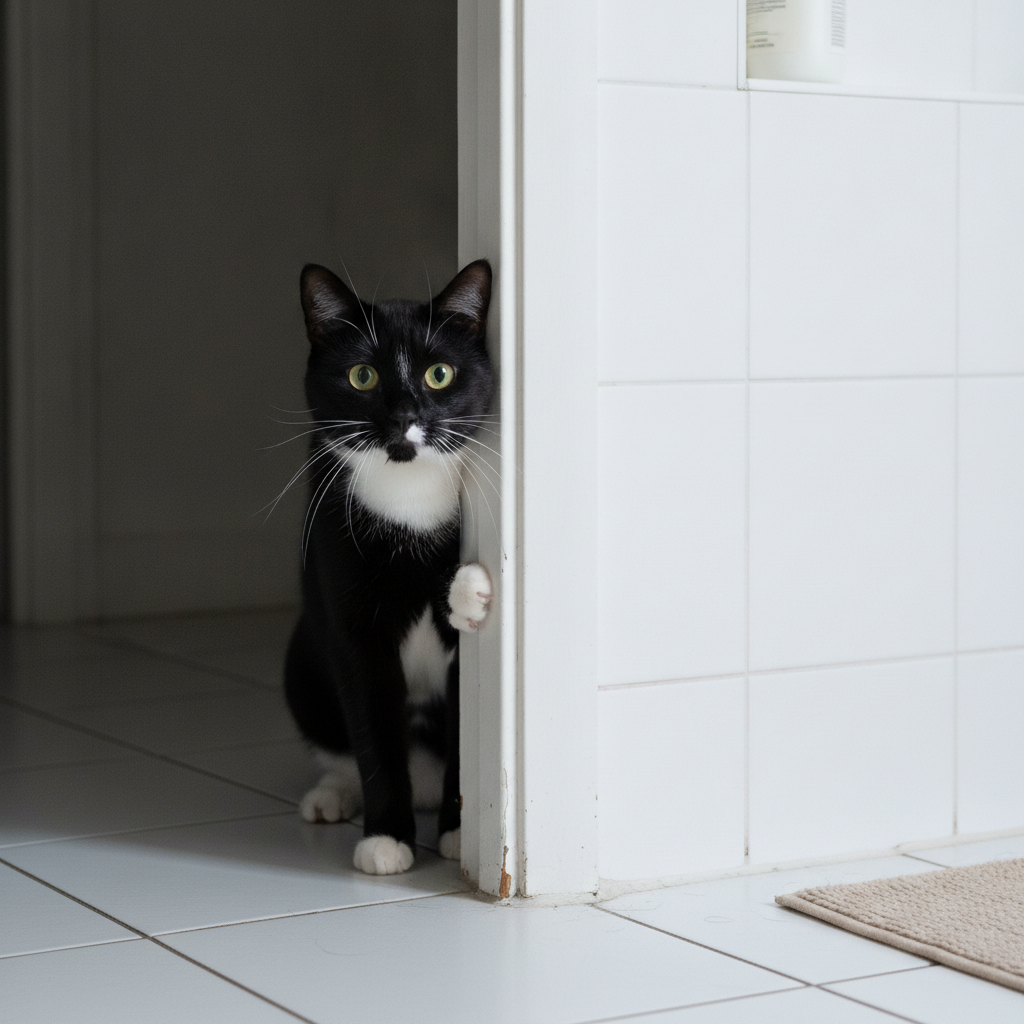
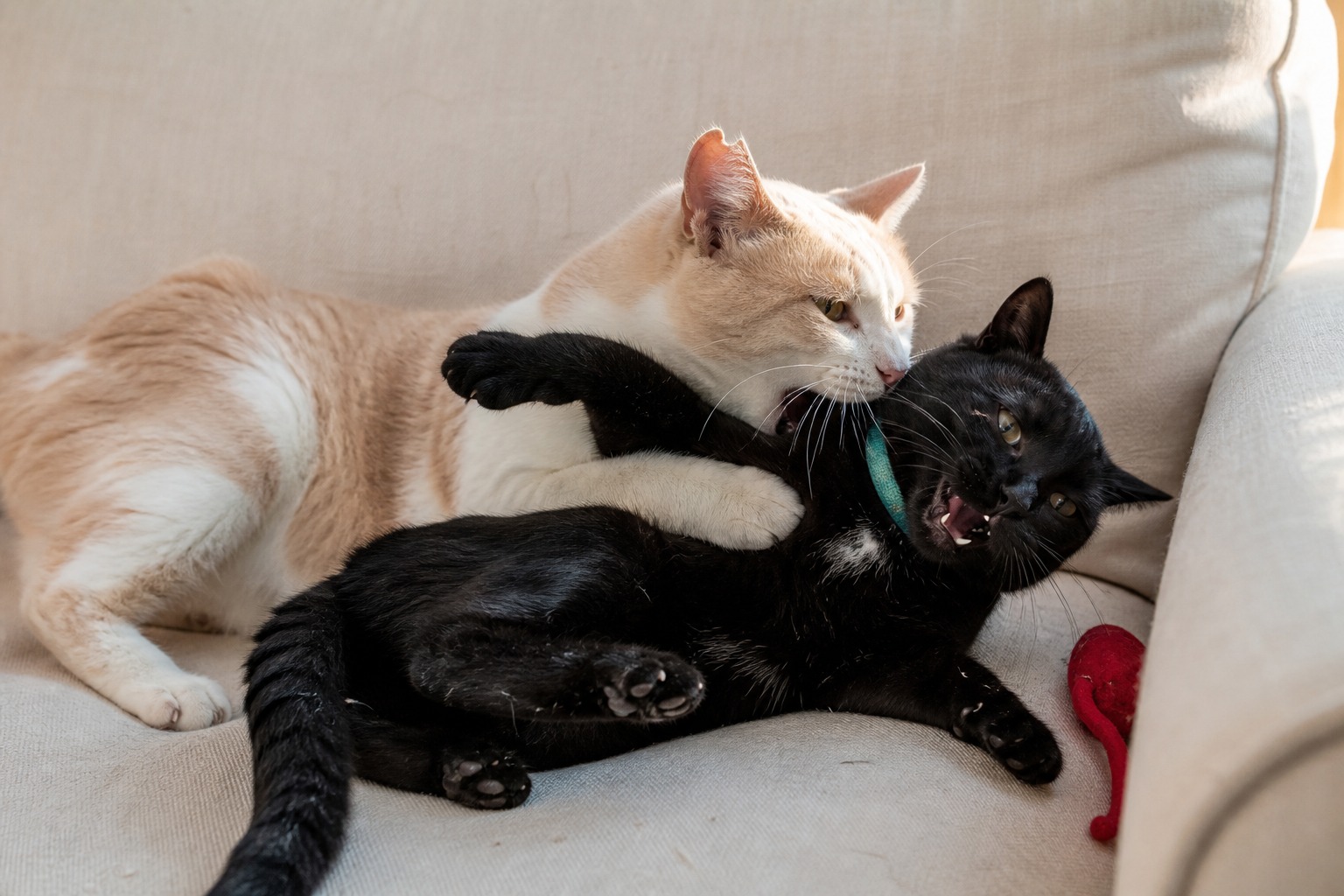
You walk into the room and one cat has their teeth on the other cat’s neck. Your stomach drops. You have about three seconds to decide whether to intervene, and the thing you are staring at, the bite itself, is the single least useful piece of information available to you.
That is the whole trick with neck biting, and it is why so many people get it wrong in both directions: panicking over a wrestling match, or calmly walking past an actual fight. A grip on the scruff is not a behavior with one meaning. It is a piece of hardware that feline evolution installed for several different jobs, and cats reuse it constantly. The meaning lives entirely in the context around the teeth.
So learn the context first. Then the bite reads itself.
The four-second read
Before we get into why cats do this, here is what you should actually be scanning when you catch them mid-grip.
Loose or stiff? A play body is fluid, rubbery, sprawled. A fight body is rigid, coiled, braced.
Ears up or flat? Forward or neutral ears mean the game is on. Flattened, sideways, airplane ears mean it is not a game.
Pupils? Round and normal, or blown wide?
Silent or loud? Play is mostly quiet, punctuated by thumps. Real aggression brings growling, yowling, and screaming.
Does it pause? This is the most reliable tell in the whole list. Cats who are playing take breaks. They stop, reset, and swap positions, so neither cat is on top the whole time. If one cat is pinning the other, continuously, and the roles never rotate, that is not play, no matter how quiet it is.
Are the back feet working? A play wrestle can include some bunny-kicking. Targeted throat biting combined with hard, driving rear-leg kicks is a different animal.
If you get loose bodies, forward ears, silence, and role-swapping, put your hands down and let them finish. If you get stiff bodies, flat ears, screaming, and one cat who never gets to be on top, separate them.
Now the why: what a neck grip is actually for
Every one of these is normal. Which is exactly why “is it normal?” is the wrong question and “what kind of normal?” is the right one.
Rehearsing the kill
Even a cat whose food materializes in a bowl twice a day is a predator with the software intact. Big cats in the wild kill with a bite to the back of the neck, severing the spinal cord. Every housecat carries that program, and play is where they run it.
So when your cat clamps a sibling’s neck and thumps them with the back feet, they are practicing a move they will never need. It looks alarming because it is a rehearsal of something genuinely lethal. As long as there is no screaming, nobody is executing the maneuver. They are pretending to be tigers, from the safety of a couch.
Learning the rules
Kittens learn how to be cats by playing at being cats: wrestling, pawing, hissing, and biting each other, mostly gently. A neck bite in a kitten pile is a curriculum. It teaches bite inhibition (how hard is too hard), it teaches boundaries (what happens when I go too far), and it sorts out who is the top cat of the litter.
Mother cats participate in this as instructors. They deliver small corrective nips, and they intervene when the game escalates past useful. A queen nipping a kitten during nursing or weaning is doing the same thing: sharp baby teeth are painful, and the nip is a note, not a punishment. It nudges the kitten toward independence.
Courtship, and its leftovers
During mating, a male grips the female’s neck. It is not aggression; it holds her in position through an interaction she may respond to by turning, hissing, or swatting.
The part that surprises people is that the behavior does not always disappear with the hormones. Neutered males may still grip a housemate’s scruff, particularly a dominant or overstimulated one, as a way of asserting control over an interaction that has nothing to do with mating.
Sorting out who gets what
In a multi-cat house, a neck bite can be a power move, and it shows up most where resources are scarce or shared: too few litter boxes, one food station, one good window. Intact males escalate over it more.
There is a specific and easily misread version of this called dominance grooming. One cat is grooming another, warmly, at length, and the moment the groomed cat tries to leave, they get bitten. The grooming was never entirely a favor. It was a claim, and the bite enforces it.
When a resource conflict becomes a real confrontation, the body goes unmistakable: flattened ears, stiff posture, a bite aimed at the throat, and hard kicking. Those cats are not playing, and they need to be separated before somebody needs stitches.
Pain, wearing a costume
This is the one that gets missed, and it is the reason a new pattern deserves a vet call rather than a behavior plan.
A cat in pain or feeling ill has a much shorter fuse for being approached. Another cat wanders too close, and what comes back looks like aggression or dominance but is actually defense. In cats, a behavior change frequently arrives before any obvious symptom does. Sudden, intense neck biting in a cat who never did it before is a medical question until proven otherwise.
When a cat’s tolerance drops overnight, I am not thinking about hierarchy, I am thinking about their teeth, their joints, and their bladder. Cats are terrible at showing us pain and excellent at showing us a shorter temper. The temper is often the only symptom we get.
What to do about it
Do not yell. Startling a cat mid-conflict adds fear to a situation that already has too much arousal in it, and fear is what produces redirected aggression, where the cat who cannot reach their target bites whatever is closest, which may be you.
Redirect, do not grab. If a real conflict is starting, break the focus without putting a hand into it. Toss a toy, clap once, shake a treat jar. Then get a physical barrier between them.
Use a time-out. Separate them into different rooms and let the adrenaline drop before anyone tries to make friends again. This takes longer than people expect, sometimes hours, not minutes. And if it was a quick nip and both cats walked away calmly, you do not need to do anything at all.
Fix the math, not the cats. Most chronic neck-biting in a multi-cat home is a resource problem in a costume. One litter box per cat plus one extra. Multiple feeding stations, out of sight of each other. Enough vertical space and enough hiding spots that a cat can decline an interaction without being cornered. Cats that can avoid each other cheaply do not need to negotiate expensively.
Spay and neuter. It removes the mating-driven scruffing and reduces a chunk of the intact-male conflict.
What newer research adds
The most useful shift lately is not about cats biting each other. It is about us.
Scruffing, meaning the human version, where a person grabs a cat by the loose skin at the back of the neck to hold or move them, was standard practice for decades on the theory that it mimics what a mother cat does and induces calm. Current feline-handling guidance rejects it. The stillness it produces is closer to shutdown than to relaxation, and it makes the cat more fearful of handling next time, not less. The 2022 cat-friendly veterinary interaction guidelines from the AAFP and ISFM advise against scruffing as a restraint technique, and recommend gentler handling with towels and choice-based restraint instead.
The distinction is worth holding onto: a mother cat carrying a kitten and a person pinning an adult cat are not the same act, and the cat knows it. If your vet or groomer still scruffs, it is entirely reasonable to ask them not to.
The short version
Neck biting is normal, ancient, and mostly boring. It is how kittens learn manners, how adults negotiate, how cats rehearse a hunt, and, occasionally, how a cat says something is wrong.
Watch the body, not the teeth. Loose and quiet and taking turns: leave them alone. Stiff and flat-eared and one-sided: step in. New and intense and out of character: call your vet.
References
- Cornell Feline Health Center. “Feline Behavior Problems: Aggression.” https://www.vet.cornell.edu/departments-centers-and-institutes/cornell-feline-health-center/health-information/feline-health-topics/feline-behavior-problems-aggression
- Rodan, I., Dowgray, N., Carney, H.C., et al. “2022 AAFP/ISFM Cat Friendly Veterinary Interaction Guidelines: Approach and Handling Techniques.” Journal of Feline Medicine and Surgery, 2022. https://journals.sagepub.com/doi/10.1177/1098612X221128760
- Gajdoš Kmecová, N., Pečová, B., Kottferová, J., and Mills, D.S. “Are These Cats Playing? A Closer Look at Social Play in Cats.” Scientific Reports, 2023. https://www.nature.com/articles/s41598-023-27829-4